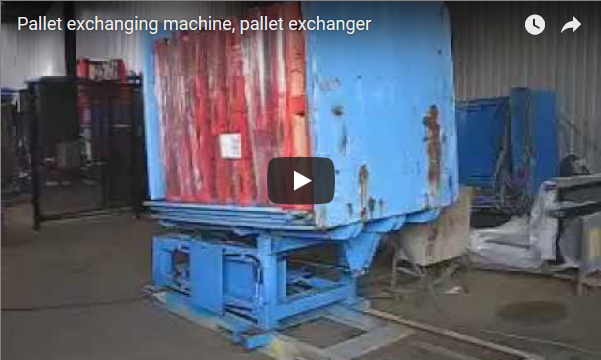
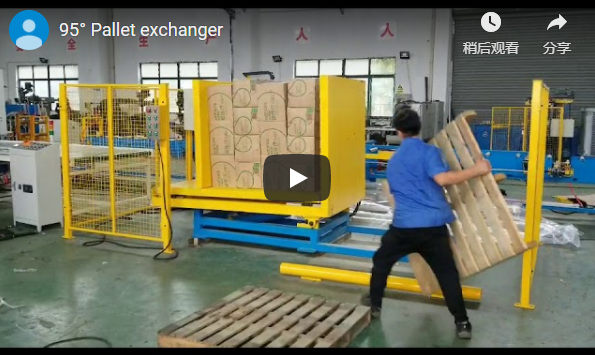
Executive summary This video shows a pushing-type pallet changing machine transferring a full load of cardboard boxes from an incoming blue pallet onto a new platform in one continuous, automated motion. The orange side panels hold the load steady throughout, and a mesh safety fence encloses the working area. Below, we break down what the footage demonstrates, the machine’s observed structure, where pushing-type pallet changers fit in industrial settings, and what a buyer still needs to confirm with the manufacturer before purchasing.
Why pallet changing matters in modern warehouses
Pallets are not interchangeable across a supply chain. A supplier may ship goods on one type of pallet, while your warehouse, an export destination, or a hygienic production area requires a different one. Moving products from one pallet to another by hand is slow, physically demanding, and risky — boxes can shift, workers can strain their backs, and stacking patterns get damaged along the way.
A pushing-type pallet changing machine addresses this by clamping the load laterally, transferring the entire stack onto the new pallet or platform in one motion, and separating the old pallet for removal. The video on this page demonstrates that transfer end to end, and this article walks through what the footage shows, what it doesn’t, and how to evaluate whether this machine type fits your operation.
What the video shows: how the machine works, process overview
The footage records one complete, continuous cycle lasting roughly 48 seconds, with no cuts or interruptions. Here is the sequence as it unfolds:
- Load in position (start of cycle). A blue pallet loaded with a stack of brown cardboard boxes sits on the left side of the machine. The machine’s orange side panels are closed around the load, holding the stack laterally on both sides.
- Push and transfer (approximately 0–24 s). The machine moves the pallet and load to the right, pushing the stack off the incoming pallet and onto a new, empty metal platform. The orange side panels remain closed throughout, keeping the boxes together during the transfer.
- Separation (approximately 24–48 s). Once the load is seated on the new platform, the machine moves the now-empty blue pallet to the left, away from the new platform. The cycle ends with the load on the new platform and the old pallet clear for handling.
The motion is smooth and continuous — the load never appears loose or unsupported, because the side panels keep it contained from start to finish. This is the defining characteristic of the pushing method: instead of tilting or gripping the load from below, the machine pushes it sideways while confining it between panels.
Direct observation notes
The following notes stay close to what is actually visible in the footage, with only light grammatical editing:
- A pallet changing machine operates inside a factory, surrounded by a yellow and orange metal mesh safety fence.
- A blue pallet loaded with a stack of brown cardboard boxes is positioned on the left. The boxes are rectangular, appear to be a standard size, are brown with white labels, and the labels are clearly visible. The boxes are clean and in good condition.
- The machine’s orange side panels are closed around the load. The machine then begins to move the pallet and load to the right, pushing it onto a new, empty metal platform.
- The orange side panels remain closed throughout the process. The machine stops, and the new platform with the load is now in position.
- The machine then begins to move the empty blue pallet to the left, away from the new platform. The machine stops, and the process is complete. The entire sequence is a continuous, smooth motion.
- The machine is predominantly painted bright orange, with a flat, silver-colored metal main platform and orange metal side panels. The pallet appears to be a blue plastic pallet, marked with the labels “BOL” and “C1”.
- The machine consists of a central platform with wheels, two large vertical side panels (one on the left, one on the right) that act as pushers, and a base structure. The machine is mounted on a wheeled base for mobility.
- The control panel is not visible in the footage. No emergency stop, warning labels, or interlocks are visible.
Machine structure: what the video reveals
The pushing-type design shown in the video is built around a small number of core components working together:
| Component | Observed detail | Function in the cycle |
|---|---|---|
| Side pusher panels | Two large vertical orange panels, one per side, mounted on hinges | Clamp and hold the load laterally, then push it across to the new platform |
| Central platform | Flat, silver-colored metal surface, on wheels | Receives the transferred load and positions it |
| Base structure | Wheeled base, bright orange finish | Carries and moves the pallet and load through the cycle |
| Safety fence | Yellow and orange metal mesh, surrounding the machine | Keeps personnel out of the operating envelope during the cycle |
| Incoming pallet | Blue pallet with labels (“BOL”, “C1”), appearing to be plastic | Carries the load into the machine; exits empty after transfer |
Note that the machine appears mounted on a wheeled base — the report observes mobility features, which can matter for facilities that reposition equipment between lines. Whether the machine in your application would be fixed or mobile is a configuration question to raise with the manufacturer.
What the video does not show
This footage demonstrates the transfer principle clearly, but several things a buyer would normally want to see are simply not in the frame:
- Rated capacity — no load weight limit is stated or displayed.
- Dimensions and footprint — overall machine size is not measurable from the footage.
- Cycle time — while this cycle takes roughly 48 seconds on camera, rated or guaranteed cycle time is not given.
- Model designation and power requirements — no model plate, electrical spec, or power connection is shown.
- Control panel and HMI — the operator interface is not visible; no buttons, screen, or emergency stop appears in the sampled frames.
- Safety interlocks — the fence is visible, but gate interlocks or access control are not shown.
- Certifications — no certification marks are visible.
None of these absences are red flags by themselves — a short demonstration video rarely shows them — but they should sit at the top of your inquiry list.
Industrial applications for pushing-type pallet changers
Based on what the footage demonstrates and how this machine category is typically used, pushing-type pallet changers fit these scenarios:
- Warehouse and distribution centers where inbound goods arrive on one pallet type and must be re-palletized onto your internal pallet standard before storage.
- Export and international shipping, where products must move from supplier pallets onto export-compliant or ISPM-treated pallets — again, confirm pallet treatment requirements with your own compliance team and the manufacturer.
- Hygiene-sensitive environments, such as food or pharmaceutical operations, where wooden or external pallets are not permitted past a certain point and loads must transfer to clean, washable plastic pallets — the blue pallet in the video appears to be plastic, which is consistent with this use case.
- Quality sorting and rework areas, where damaged pallets must be swapped out without disturbing the product stack.
The key suitability condition visible in the video is load type: the demonstration uses a stable, uniform stack of rectangular cardboard boxes. Pushing-type transfer relies on the load holding together as a block while it is pushed sideways, which is why this method works well for boxed and cartoned goods.
Where this machine type may not fit
The same footage points to limitations worth weighing:
- Irregular or unstable loads. A stack of loose, uneven, or fragile items may not survive a lateral push. Bagged goods, tall unstable loads, or mixed-height stacks may need a different transfer method (for example, tilting or gripping-based systems).
- Mixed pallet sizes. The machine is designed around a specific pallet size and load configuration. If you handle many pallet footprints, confirm flexibility or tooling options with the manufacturer.
- Throughput requirements. The video shows one cycle; it does not establish a rated speed. High-volume operations should request verified cycle-time data.
Buyer checklist: what to verify with the manufacturer
Before requesting a quote, use this list to close the gaps the video leaves open:
- Compatible pallet sizes and load weights for your specific SKUs and pallet types
- Cycle time under a load profile matching yours
- Control panel and HMI details: what the operator interface includes, and where the emergency stop is located
- Safety interlocks on fence gates and access points
- Power requirements and installation footprint
- Relevant certifications for your market and industry
Frequently asked questions
How does a pushing-type pallet changer move the load without damaging it? The video shows the side panels staying closed around the stack for the entire transfer — the load is contained laterally at all times, so it moves as one block. For fragile or unstable products, confirm suitability with the manufacturer using your actual load samples.
What kind of loads is the pushing method best suited for? The demonstration uses a clean, uniform stack of rectangular cardboard boxes, which is the ideal case: stable, boxed goods that hold their shape. Irregularly shaped loads are flagged as a potential limitation for this design.
Can it transfer loads from wooden pallets to plastic pallets? The video shows transfer onto a new platform, and the machine category is intended for moving products from one pallet type to another without manual handling — for example, between pallet materials. Confirm your exact pallet-to-pallet combination with the manufacturer.
How fast does it run? The filmed cycle runs continuously for roughly 48 seconds, but no rated cycle time is stated. Ask the manufacturer for a cycle-time figure based on your load weight and dimensions.
Where is the control panel? The control panel is not visible in the footage, and neither is an emergency stop. Verify the control interface, stop locations, and interlock scheme with the manufacturer before purchase.
Is the machine mobile? The machine is observed mounted on a wheeled base, suggesting mobility. Whether your configuration would be fixed or mobile depends on your layout — check with the manufacturer.
Pairing pallet changing with end-of-line packaging
Pallet changing is rarely the last step. Once a load sits on the correct pallet, it typically moves on to stretch wrapping for transport stability. Depending on your line layout and volume, that next step might be:
- A semi-automatic pallet wrapping machine for lower-volume operations where an operator attaches the film
- An automatic pallet wrapping machine for fully automated lines with no operator intervention at the wrapper
- A general stretch wrapping machine overview to compare available formats
- A rotary arm wrapping machine where the load is too unstable to rotate on a turntable
- A rotary ring stretch wrapping machine for high-speed, continuous film delivery
Planning pallet changing and wrapping together — with matched heights, load sizes, and transfer positions — avoids integration problems downstream.
Source and method
This article is based on the demonstration video embedded above. The footage was analyzed frame-by-frame using a local vision model on sampled frames; the video contains background music only, with no narration, so no speech transcription was performed. All factual observations come from what is visible on screen; specifications, capacities, and certifications are not shown in the video and must be confirmed with the manufacturer.
Next step
If your operation needs to switch pallet types without manual restacking, send us your load dimensions, pallet types, and typical stack profiles. Our team can confirm whether the pushing-type pallet changer suits your products and quote a configuration matched to your line. Contact us here to start the conversation.
Published: 2026-09-03