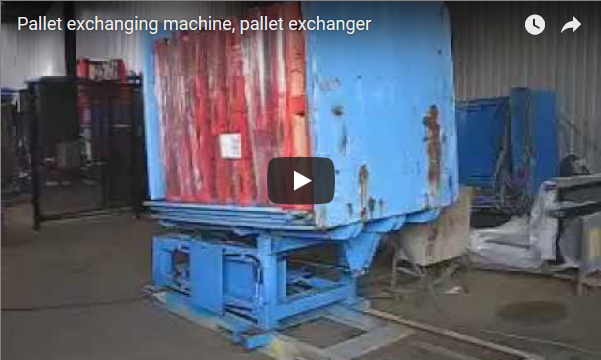
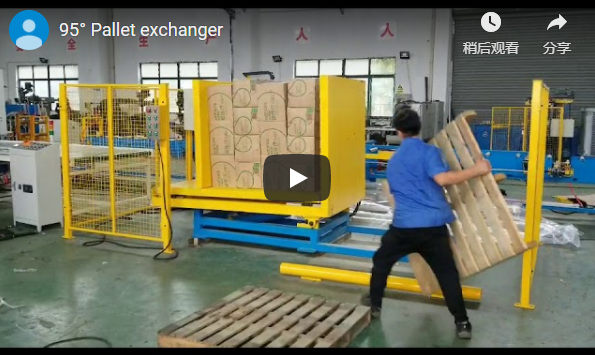
Executive summary This video shows a pushing type pallet changer handling a full pallet load in a warehouse aisle: a forklift places the load on the input platform, the machine’s pushing arms transfer the load, and an empty pallet is collected from the output side. Capacity, cycle time, power, and model details are not shown — confirm those with the manufacturer.
Why pallet changing matters
Many warehouses receive goods on one type of pallet — often a wooden one — but need those same goods on a different pallet for export, hygiene rules, or internal storage standards. Doing this by hand means lifting and re-stacking every single package. It is slow, tiring, and a common source of back injuries.
A pushing type pallet changer takes a different approach. Instead of breaking the load down, the machine keeps the load intact and slides it from one pallet to another. The video on this page shows exactly how that works in practice, using a real load of packaged consumer goods.
What the video shows: the machine in action, step by step
The footage runs about 15 seconds and covers one load-transfer sequence:
- 0s–4s — Loading. An operator on a forklift positions a full pallet of goods in front of the pallet changer and sets it on the machine’s input platform. The machine’s arms are resting.
- 4s–8s — Forklift withdrawal. The forklift backs away, leaving the pallet load sitting on the platform.
- 8s–12s — Pushing. The machine’s horizontal pushing arms move forward, sliding the pallet load off the input platform toward the output side. The side guides keep the load from shifting during the push.
- 13s–15s — Collection. The forklift returns to the output side to collect the load on its new pallet. The empty pallet is taken away for reuse or disposal.
The whole sequence is a simple load-and-transfer routine: forklift in, push, forklift out. There is no manual re-stacking anywhere in the clip.
Machine structure at a glance
| Component | Observed in video | Function |
|---|---|---|
| Main frame with two vertical posts | Grey painted steel | Carries the pushing assembly |
| Pushing arm assembly with central pusher plate | Yellow painted steel | Slides the load from input to output side |
| Side guides | Yellow, move in unison with the pusher | Keep the pallet load aligned and prevent shifting |
| Base frame | Yellow | Supports the standalone unit in the warehouse aisle |
| Control cabinet | Green, located to the left of the machine | Likely houses the controls (panel not visible in frames) |
| Pallet stack | Blue plastic pallets beside the machine | Supply of replacement pallets |
The machine is painted steel throughout — grey posts, yellow arms and guides, blue base components — and sits as a standalone unit between a warehouse aisle’s racking.
Direct observation notes
The following points are kept close to the visual record of the footage, with only light grammar edits:
- A forklift operator maneuvers an orange forklift to position a pallet of goods in front of the pallet changer; the machine is stationary, and its arms are in a resting position.
- The forklift is then driven away, leaving the pallet load positioned on the machine’s platform.
- The machine’s arms push the pallet load forward off the input platform.
- The forklift re-enters and positions itself to pick up the pallet from the machine’s output side.
- The machine consists of a central frame with two vertical posts; a horizontal pushing arm assembly with a central pusher plate and two side guides moves in unison.
- The pallet load is a standard size, approximately 1.2m × 0.8m, with packages predominantly white and orange with blue accents, on a green pallet, wrapped in clear plastic film.
- The control panel is not visible in the frames; it is likely located on the green cabinet to the left.
- No emergency stop button or warning labels are visible in the frames.
What the video does not show
A short marketing clip cannot answer everything a buyer needs to know. The following are not observable in this footage and should be confirmed with the manufacturer:
- Rated capacity — maximum load weight is not specified.
- Machine dimensions — physical footprint and height are not visible.
- Cycle time — a full load-push-collect cycle cannot be measured from the frames.
- Model number — not shown.
- Power requirements — voltage, power source, and whether pneumatics are involved are not specified.
- Certifications — CE, ISO, or other safety/quality marks are not visible.
- Emergency stop and warning labels — not visible in these frames; the full safety package must be confirmed directly.
Where this machine fits
Based on what the footage shows, this type of machine suits warehouses and distribution centers that need to:
- Switch pallet types — for example, moving goods from wooden pallets to plastic pallets for export or hygiene compliance. A stack of blue plastic pallets is visible next to the machine in the video.
- Remove pallets from storage — repalletizing loads when a damaged or non-standard pallet needs replacing.
- Reduce manual handling — the load stays intact, so no one has to re-stack individual cartons or shrink-wrapped bundles.
Limitations to keep in mind. The machine is designed around a specific pallet size and type. It requires forklift access on both the input and output sides, so it will not fit everywhere. And the quality of the transfer depends on the forklift operator’s placement and the consistency of the load itself.
What to verify with the manufacturer
Before specifying a pushing type pallet changer, work through this checklist:
- Maximum rated load capacity and center-of-gravity limits
- Compatible pallet sizes and types (wood, plastic, slip-sheet)
- Overall machine dimensions and required aisle clearance
- Power supply requirements and air consumption (if pneumatic)
- Full safety package: emergency stop, interlocks, guarding, warning labels
- Service, spare parts, and technical support availability
FAQ
How long does one pallet change take? The video does not allow an exact cycle-time measurement. The visible sequence (load, push, collect) completes in roughly 15 seconds of footage, but real cycle times depend on load type and operating practice — check with the manufacturer.
Does the load stay wrapped during transfer? Yes. In the video the load is wrapped in clear plastic film and remains intact as it is pushed across — no re-stacking is involved.
Can it handle different pallet sizes? The machine appears sized for a standard pallet load (approximately 1.2m × 0.8m in the footage). Compatibility with your specific pallet sizes must be verified with the manufacturer.
Does it need a forklift? Yes — the footage shows a forklift placing the load on the input side and collecting it from the output side. Sites without forklift access will need a different handling arrangement.
Where are the controls? A green control cabinet stands to the left of the machine, and the control panel itself is not visible in the frames. Confirm panel layout and safety controls with the manufacturer.
Source and method
This article is based on the embedded video only. The footage was analyzed frame-by-frame using a vision model on sampled stills. The video contains background music only — there is no narration, so no speech transcription was possible. All factual statements come from what is visible in the frames; everything else is either clearly labeled as derived evaluation or flagged for verification with the manufacturer.
Related reading
- Semi-automatic pallet wrapping machine
- Automatic pallet wrapping machine
- Pallet inverter
- Pallet changer
- Automatic packing line
Next step
If this pushing type pallet changer looks like a fit for your operation, the most productive next move is a short conversation about your pallet sizes, load weights, and available floor space. Visit our contact page to request specifications, capacity data, and a quotation — or to arrange a demonstration.
Published: 2026-09-03