Executive summary
An offline PVC pipe strapping and bagging line ties bundles of PVC pipe and slips each bundle into a transparent bag that is sealed at the open end. Pipes are staged on the infeed platform, strapped into bundles, bagged and carried out on the outfeed conveyor. Pipe diameter, bundle length and film choice are confirmed per project.
Table of Contents
- Why strap and bag pipe offline
- What the line does
- Infeed, strapping and bagging stations
- Cycle and control
- What the footage shows
- Typical configuration
- Selection checklist
- Operation and safety
- Engineering FAQ
- Next step
- Related reading
- Sources and standards
Why strap and bag pipe offline
PVC pipe is produced in long, straight lengths and handled as bundles. Before storage or shipment, each bundle needs to be tied and covered so it stays together and arrives clean. An offline line does this as a separate step, keeping the packing pace independent of production.
Strapping holds the bundle together and the bag keeps it clean, and both happen automatically on the line. Pipe diameter, bundle length and film choice are confirmed per project.
What the line does
The line takes staged PVC pipes, ties them into bundles, and covers each bundle with a transparent bag. On the infeed the pipes are held together, then the strapping unit applies strap around the bundle, and the bagging station draws a bag over it and seals the open end.
The finished bundle leaves on the outfeed conveyor. Line speed, bundle size and bag length are confirmed per project.
Infeed, strapping and bagging stations
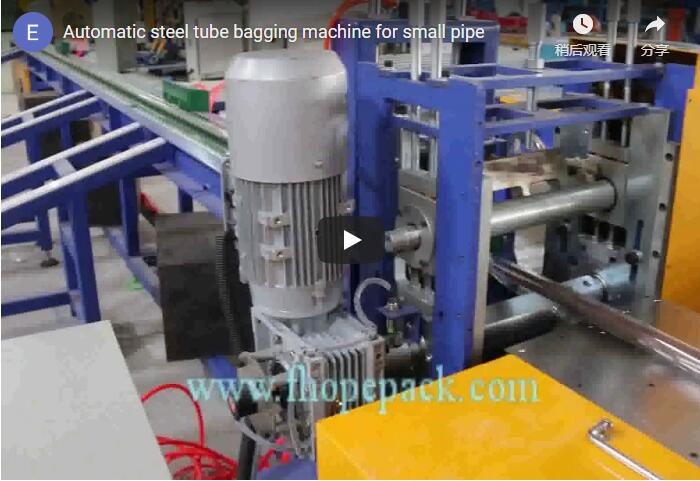
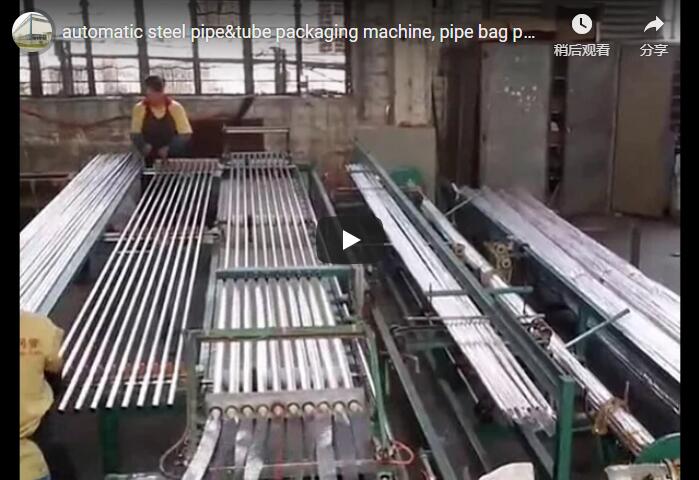
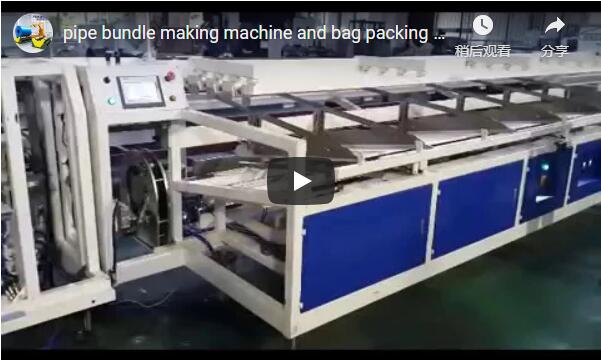
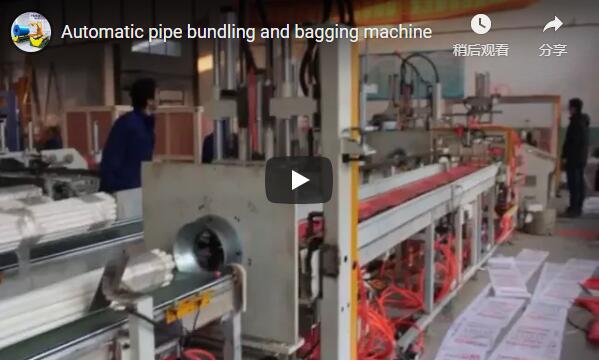
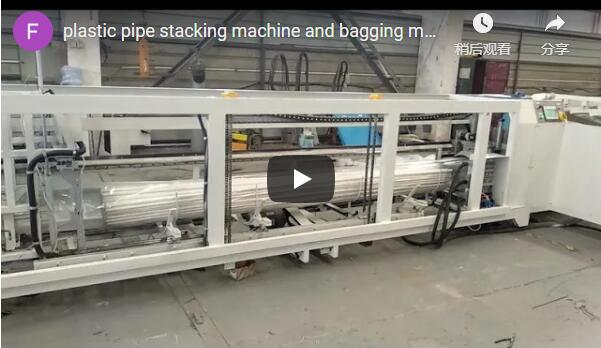
The line is laid out in a straight run. A blue infeed platform stages the white pipes, a strapping unit applies strap around each moving bundle, and a bagging station with a sealing press fits a transparent bag over the bundle and closes it. A blue outfeed conveyor carries the finished bundle away.
The control panel carries the start button, the emergency stop and the indicator lamps for the line. The infeed width, strapping position and outfeed height are confirmed per project.
Cycle and control
An operator runs the line from the control panel. Pipes move from the infeed platform into the strapping unit, the strap is applied around the bundle, and the bundle then passes through the bagging station where the bag is fitted and sealed.
Indicator lamps on the control panel show the running state, and the emergency stop halts the line when pressed. Start, stop and fault handling are done at the panel, per project.
What the footage shows
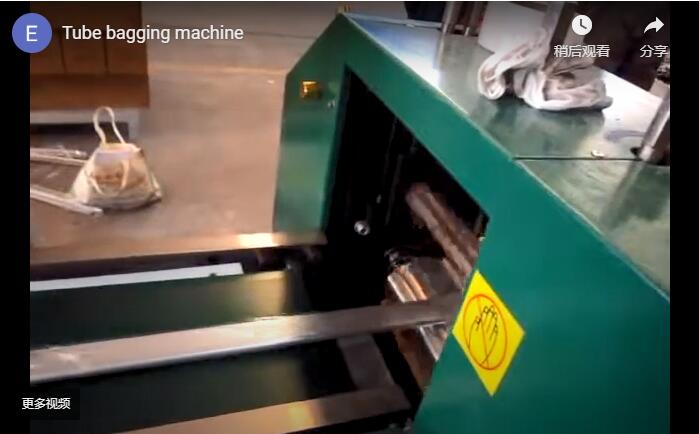
Our footage shows white PVC pipes staged on the blue infeed platform and moving into the machine, with the strap applied around the bundle as it passes. At the bagging station a transparent bag is drawn over the bundle, the open end is pressed shut, and the finished bundle exits on a blue conveyor. It is a general demonstration, so your pipe diameter, bundle length and film choice are confirmed with us per project.
Typical configuration
Figures below list functional design boundaries rather than numeric values, and are confirmed per project.
| Parameter | Typical range, confirmed per project |
|---|---|
| Work | white PVC pipe staged in bundles on the infeed |
| Strapping | strap applied around the bundle as it passes |
| Bagging | transparent bag fitted over the bundle, open end sealed |
| Transfer | infeed platform in, outfeed conveyor out |
| Control | start button, emergency stop and indicator lamps on the control panel |
| Mount | floor mounted in a straight line along the shop |
| Electrical supply | 380 V three phase 50 Hz, or 220 V single phase for light machines, selected per project |
Selection checklist
| Question | Confirm per project |
|---|---|
| Pipe | diameter, wall and straight length |
| Bundle | number of pipes, bundle length and weight |
| Strap | strap type, width and tension |
| Bag | film type, bag length and sealing |
| Line | infeed width, outfeed height and floor space |
| Electrical supply | voltage, phase and frequency on site |
Operation and safety
Stage the pipes on the infeed, start the line from the control panel, and let the bundles pass through strapping and bagging. Keep clear of the strap path, the sealing press and the moving conveyor while the line runs, and use the emergency stop if a clear is needed.
Routine checks cover the strapping unit, the sealing press and the conveyor, per the machine manual. Confirm the bundle is seated on the infeed before each cycle.
Engineering FAQ
Q: What does this line do? A: It straps bundles of PVC pipe and then slips each bundle into a transparent bag whose open end is sealed.
Q: Why bag the pipes after strapping? A: A sealed bag keeps the bound bundle clean and protected through storage, handling and transport.
Q: Do we load pipes by hand? A: An operator stages the pipes on the infeed platform, then each bundle is processed by the line through strapping and bagging.
Q: What pipe sizes work? A: Pipe diameter, bundle length and film choice are confirmed per project before we quote the line.
Q: What does it suit? A: Straight PVC pipe in long lengths that is produced and packed in bundles as an offline step.
Next step
- Email us at info@fhopepack.com with your pipe diameter and bundle length.
- We send a strapping and bagging line proposal within 48 hours.
- We confirm the infeed layout, bag length and electrical supply for your site.
Related reading
- Offline PVC pipe strapping and bagging line
- Hose Coil Wrapping and Strapping: Solutions for Industry
- Partial film wrapping and packing by orbital wrapper
- FHOPE packing machinery product lines
Sources and standards
- ISO 12100:2010 Safety of machinery, general principles for design and risk assessment
- EN 415-10:2014 Safety of packaging machines, general requirements
- EN ISO 13849-1:2023 Safety of machinery, safety-related parts of control systems
FHOPE offline PVC pipe strapping and bagging line demonstration video. Reviewed as a general demonstration; pipe diameter, bundle length and film choice confirmed per project.
Last reviewed: 2026-10-12