Executive summary
Bearings are made of high-carbon chromium steel, and the ground raceways rust quickly when humidity changes in transit. A bearing packing machine passes VCI film, paper or stretch film through the bearing bore with a rotating ring. The bearing turns at the same time, so the whole ring is sealed at even tension. This page covers the cycle, the FPB-400 data, how to pick film width for the bore, and how overlap sets wrap time.
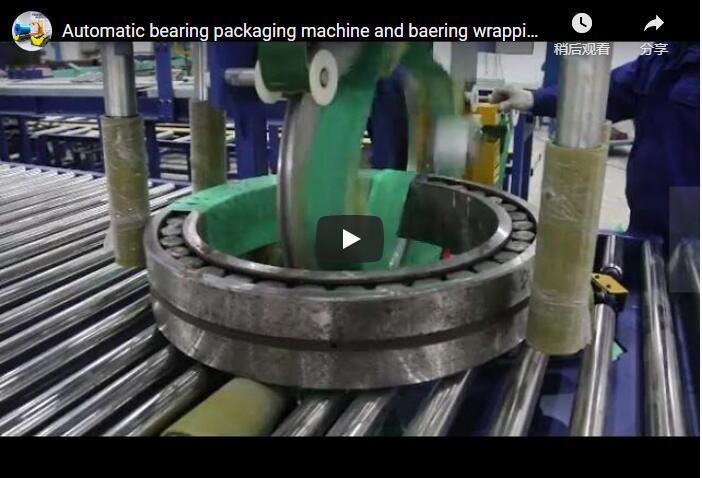
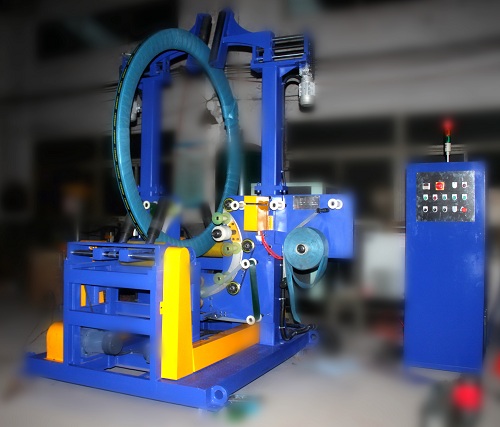
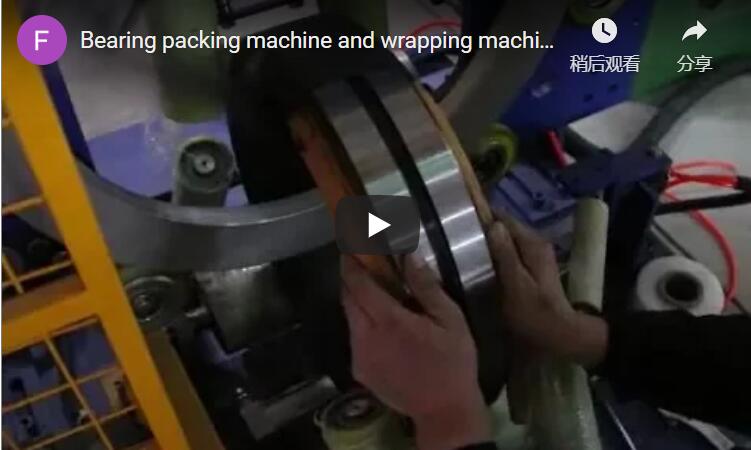
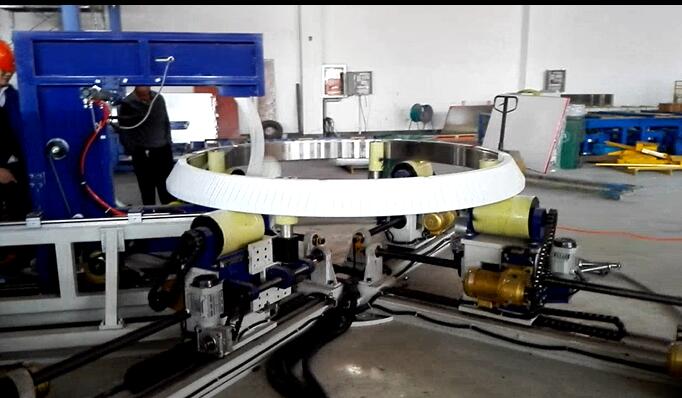
The operator sets a large light-coloured bearing ring on the support rollers of a blue frame and closes the press rollers onto it. After a start from the panel, the bearing turns while the yellow ring carries the tape through the bore and around the section, and the wrap builds up evenly with no further handling.
Table of Contents
- Why bearings need sealed packing
- The wrapping cycle
- FPB-400 data
- Film width and the bearing bore
- Overlap and wrap time
- Selection checklist
- Safety
- Engineering FAQ
- Next step
- Related reading
- Sources
Why bearings need sealed packing
A bearing that rusts on a raceway is scrap. Oil alone dries out over a long sea trip, and a loose bag lets moist air circulate. VCI film releases a corrosion inhibitor into the closed space, but only if the wrap is tight and has no gaps. Hand wrapping a 300 kg ring is slow and uneven. A machine wrap is the same on every bearing, and the bearing does not leave its rollers until it is closed.
The wrapping cycle
- Position: the bearing is placed on the rollers and centred automatically; sensors detect its position.
- Set: the operator enters OD, ID and width, or calls up one of up to 6 stored programs.
- Wrap: the ring passes the material through the bore while the rollers turn the bearing.
- Cut: the material is cut off at the end of the wrap.
- Unload: the wrapped bearing leaves by hand or on the outfeed conveyor.
FPB-400 data
| Item | FHOPE FPB-400 bearing packing machine |
|---|---|
| Bearing ID | 300–800 mm |
| Bearing OD | 500–1,200 mm |
| Bearing width | 100–400 mm |
| Bearing weight | 100–500 kg |
| Packing material | crepe paper, PE, stretch film, knit belt, PVC |
| Ring speed | 30–70 r/min |
| Wrapping speed | 30–50 s per piece |
| Overlap | 20%–90% |
| Power | 2.5 kW, AC 380 V 50 Hz |
| Stored programs | up to 6 |
Smaller bearings use the FPBS-200 bearing wrapper; ranges outside these are confirmed at quote.
Film width and the bearing bore
The film roll on the ring must pass through the bore with room to spare. On one VCI project for smaller bearings, with bores from 150 mm on a compact wrapper, the customer proposed 59 mm film; our engineers recommended 50 mm so the head keeps a safe margin. A wider roll can strike the inside of the bore if the bearing sits slightly off centre.
With 59 mm film, the 150 mm bores in that range could not be wrapped. Rule: choose the widest film that still clears the smallest bore with margin.
Overlap and wrap time
Ring turns = π × mean diameter ÷ (film width × (1 − overlap)). For a bearing with OD 800 mm and ID 500 mm, the mean diameter is 650 mm and the circumference about 3.14 × 650 = 2,041 mm. With 100 mm material at 50% overlap each turn advances 50 mm, so the ring makes about 41 turns; at 60 r/min that is about 41 s, inside the 30–50 s range (example only). Narrow 50 mm VCI film at the same overlap doubles the turns to about 82 s. Higher overlap seals better but takes longer, so set it from the storage time.
Selection checklist
- Bearing ID, OD, width and weight range?
- Bearings per shift?
- VCI film, paper or two materials on one bearing?
- Smallest bore, to set film width?
- Manual loading or inline conveyors?
- Labels or outer box after wrapping?
Safety
We design bearing wrappers to EN ISO 12100:2010 for risk assessment, EN 415-10 for packaging machine safety and EN 60204-1 for electrical equipment. The ring is guarded, and fault causes are shown on the panel with an alarm light.
Engineering FAQ
Q: Can two films go on one bearing? A: Yes; an inner VCI layer and an outer stretch film layer can be applied in sequential passes, configured per project.
Q: Does the machine need to be reset for each size? A: Only OD, ID and width are entered; stored programs hold common sizes.
Q: Can it link to the bearing line? A: Yes, with infeed and outfeed conveyors and automatic start.
Q: What if the film breaks? A: The fault is displayed and the alarm light comes on.
Next step
- Send your bearing sizes, weights and wrap materials to info@fhopepack.com.
- We match the wrapper and film width to your smallest bore.
- We reply within 24 hours with a proposal and quotation.
Related reading
- Bearing packing machine FPB-400 (product)
- Bearing wrapping machine FPBS-200 (product)
- Automatic bearing packaging machine (video)
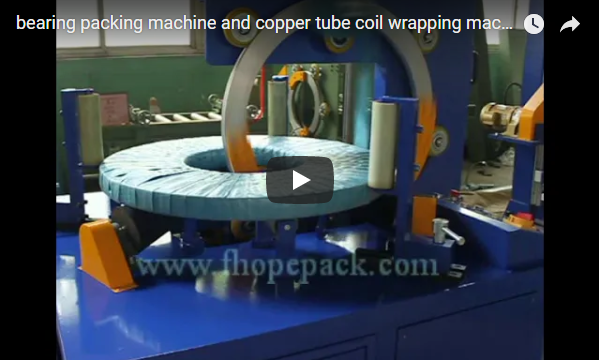
- Coil wrapper with logo tape (video)
Sources
- FHOPE product pages: FPB-400 and FPBS-200 bearing wrappers
- FHOPE project correspondence on VCI film width for bearing wrapping
- EN ISO 12100:2010; EN 415-10; EN 60204-1
- The bearing wrapper shown above
Last reviewed: 2026-10-20