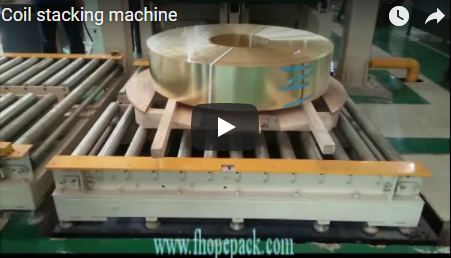
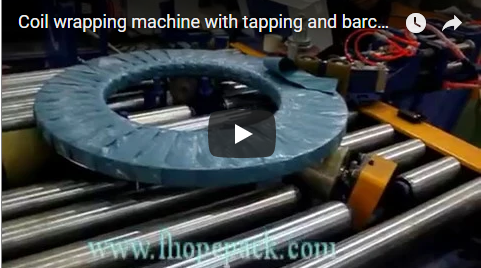
Executive summary In a steel processing center, the packing line often ends at a manual step: a crane or forklift taking each wrapped coil off the conveyor. This short clip shows our answer, a light-green gantry stacker that lowers wrapped coils from the roller conveyor onto pallets on the floor. Below we explain how the gantry works, which factors set the stack configuration, and what to check before you specify one.
Table of Contents
- What the clip shows
- Why the end of the line is the bottleneck
- How the stacking gantry works
- Stack and pallet options
- Fitting the gantry into the line
- Selection checklist for a coil stacking gantry
- Controls and safety
- Engineering FAQ
- Next step
- Related reading
- Sources
What the clip shows
| Clip time | What is on screen |
|---|---|
| 0–4 s | Wide view of a light-green gantry over a roller conveyor, with a yellow mobile ladder beside it |
| 6–10 s | The camera moves in; two people stand by the machine as the gantry carriage moves down |
| 12–14 s | A coil wrapped in white sits on a wooden pallet below the gantry arms, set down from the conveyor |
| final seconds | An end screen, not factory footage |
The factory part of the clip is about 14 s long, filmed in our hall during a test.
Why the end of the line is the bottleneck
A packing line wraps and straps coils in a steady rhythm. If one crane driver has to lift each coil off the conveyor, the line waits for the crane.
- The crane serves other jobs too, so coils queue on the outfeed.
- Every manual lift puts a person near a hanging coil.
- Fresh wrap gets damaged when slings or forks touch it.
A stacking gantry takes over this last step. The crane or forklift then only removes finished pallets or stacks.
How the stacking gantry works
- The wrapped coil stops on the roller conveyor under the gantry.
- The carriage lowers and its arms take the coil.
- The carriage lifts, travels to the pallet position and lowers the coil.
- The next coil goes onto the same stack or the next pallet.
The coil is handled from above, so its wrapped faces are not touched by forks. The gantry frame spans both the conveyor and the pallet position, so no person needs to stand between them.
Stack and pallet options
From our automatic coil packing line:
| Option | Choice |
|---|---|
| Stack height | up to 6 coils per stack |
| Package direction | eye to sky on the stack; eye to wall as a separate option with its own handling |
| Base | pallet, or timber runners from a timber feeder |
| Extra stations | weighing, labelling, strapping |
| Layout | straight, L-shaped or U-shaped |
Every line is configured per project, so the stack height, pallet size and station list follow your coils and your warehouse.
Fitting the gantry into the line
The gantry is the last station, so it sets how the line meets the warehouse:
- Label before stacking, so each coil’s label faces the reading side.
- Weigh before stacking, if the stack weight must be known.
- Leave forklift access to the pallet positions from outside the guarded area.
- Add a buffer conveyor if pallets may wait for the forklift.
Our lines also connect to the warehouse system (WMS) or ERP, so the stack data follows the pallet.
Selection checklist for a coil stacking gantry
- Coil OD, ID, width and weight, smallest and largest.
- Stack height and package direction.
- Pallet or timber runner size.
- Coils per hour at the end of the line.
- Forklift or crane route for removing stacks.
- Hall height under the crane and floor space for pallet positions.
Controls and safety
The standards that apply depend on the destination market. For CE markets, ISO 12100 sets the risk-assessment method and EN 415-10 covers general requirements for packaging machines, which fixes guarding and the emergency-stop arrangement.
The gantry moves loads above the floor, so the stack area sits inside a guarded zone. Forklift access, fencing and stop circuits are set in the risk assessment for each layout.
Engineering FAQ
Q: Does the gantry replace the crane completely? A: Inside the line, yes. The crane or forklift only removes finished pallets or stacks from outside the line.
Q: How many coils can it stack? A: Up to 6 coils per stack on our automatic coil packing line, depending on coil weight.
Q: Can coils be stacked eye to wall? A: Yes, as a package direction chosen when the line is specified. Multi-coil stacks on a pallet are built eye to sky.
Q: Can it stack on timber runners instead of pallets? A: Yes. A timber feeder is available as an additional function, so runners are laid without manual work.
Q: Can the stack data go to our warehouse system? A: Yes. Our lines connect to the WMS or ERP, so the stack data follows each pallet.
Q: Does stacking slow the line down? A: Not if the gantry travel is short. We place pallet positions close to the conveyor and add a buffer conveyor where needed.
Next step
We plan a stacking gantry in three steps:
- Submit your layout drawing with coil range, stack pattern and pallet size, to info@fhopepack.com.
- Receive a proposal within 48 hours, with the gantry, pallet positions and guarded zone.
- Book a site survey so we confirm hall height, crane coverage and forklift routes.
Related reading
- Slit Coil Stretch Wrapping and Stacking Line: Eye-Through Ring to Gantry Stacker
- How Does a Two-Stage Automatic Steel Coil Packaging and Stacking Line Work?
- Stainless Steel Coil Packaging Line with Automatic Labelling and Stacking
- Automatic coil packing line
Sources
- Machine in action: the video on YouTube (factory footage about 14 s)
- Up to 6 coils per stack, eye to sky / eye to wall, timber feeder, weighing, labelling, strapping, L/U layouts, WMS/ERP connection: Automatic coil packing line
- Standards scope: ISO 12100:2010; EN 415-10:2014
- Proposal timing: approved house CTA (proposal within 48 hours)
Last reviewed: 2026-10-06