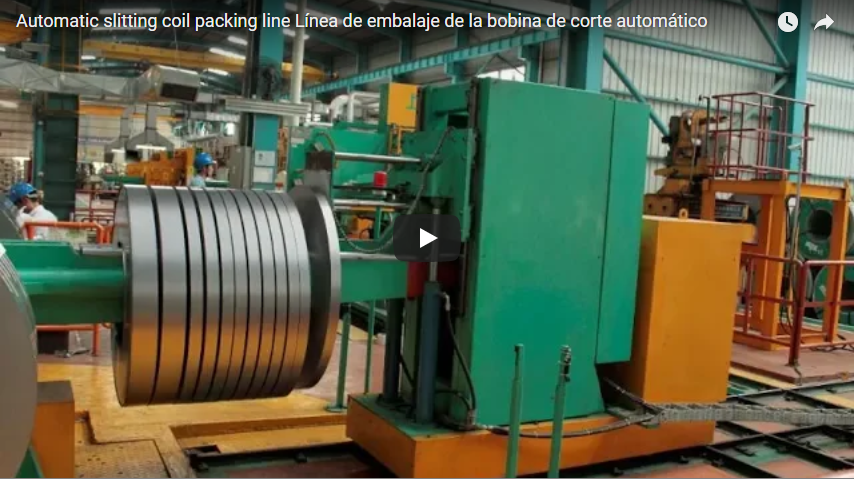
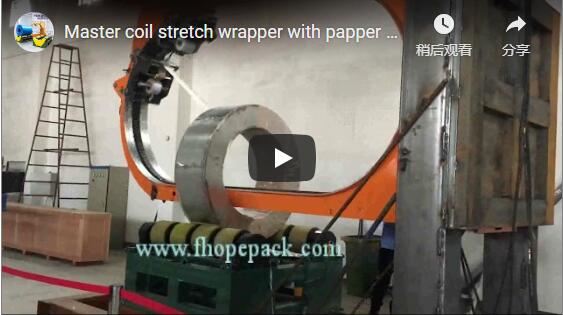
Executive summary Narrow slit coils feature unprotected, precision-sheared edges that are exceptionally susceptible to edge wave, indentation, and telescoping damage during conventional overhead crane lifting or manual hook transfers. A synchronized automated line—maintaining slit coils on precision-driven roller conveyors from downending and centering through axial pressing, orbital wrapping, and automated stacking—eliminates critical edge-contact hazard points. This technical review details the functional sequence of the FHOPE slit coil packaging line, dynamic coil weight calculations, CE/OSHA safety governance, and a field-tested specification matrix for line procurement.
[Video embed]
Technical Process Overview
The automated packaging line integrates material handling, 90° downending, powered roller transport, and through-the-eye wrapping into a unified programmable transfer system.
[Slitter Recoiler / Turnstile]
              │ (Eye-Horizontal)
              ▼
[90° Hydraulic Downender] ───► [Centering & Infeed Conveyor] (Eye-Vertical)
                                               │
                                               ▼
[Palletizing / Stacking Station] ◄─── [Through-the-Eye Wrapping Station]
Slit coils originate eye-horizontal on the slitter turnstile. The hydraulic downender picks single or stacked coils, reorienting them 90° into an eye-to-sky (eye-vertical) orientation onto a heavy-duty roller conveyor.
Once indexed into the wrapping station:
- Centering rollers align the coil bore with the orbital ring axis.
- Overhead pneumatic/hydraulic stabilizing arms descend onto the coil face to prevent internal strip slippage or rotation.
- The rotating shuttle traverses through the inner diameter (ID) to apply pre-stretched film or protective paper.
- The sealed coil discharges downstream to intermediate buffering, automated stacking, or strapping zones.
How the Line Works
The system maintains continuous physical support beneath each coil from arrival to final offload, eliminating intermediate crane lifts, C-hook scuffing, and fork-truck tines contact.
Step-by-Step Production Flow
| Step | Machine Operation | Technical Parameters |
|---|---|---|
| Downending & Infeed | Hydraulic tilt cradle transitions coil from horizontal mandrel to vertical axis (eye-up) onto powered rollers. | 90° tilt cycle: 15–25 s; soft-stop hydraulic deceleration. |
| Roller Conveyance | Polyurethane-sleeved rollers index eye-up coils to downstream stations. | Inverter-driven variable speed: 6–18 m/min. |
| Centering & Clamping | Bilateral pneumatic centering rollers align coil bore; vertical hold-down stabilizes strip edges. | Adjustable clamping force: 2.0–15.0 kN based on coil thickness. |
| Orbital Wrapping | Ring shuttle dispenses stretch film / VCI through the coil core while coil turns on drive rollers. | Ring rotation: 40–100 RPM; overlap ratio adjustable: 30%–70%. |
| Outfeed & Stacking | Wrapped coils index to turnstile, scissors lift, or pick-and-place magnetic/vacuum stacker. | Automated pallet buffering and strapping integration. |
Key Mechanical Design Features
- Continuous Roller Support: Eliminates concentrated rim stresses. Coils sit entirely on their flat lateral cut face, distributing gross weight over multiple conveyor rollers.
- Controlled Vertical Restraint: The vertical hold-down mechanism incorporates free-spinning, non-marking polyurethane contact rollers. It applies sufficient axial pre-load to suppress strip “clock-springing” and telescoping without generating surface gouges.
- Modular Infeed Integration: Interfaces directly with master slitting exit turnstiles, walking beams, or automated coil cars (AGV/RGV).
Why Roller Transfer Matters for Slit Coils
Slit coils present distinct material handling challenges compared to full-width master coils:
- Exposed, Uncoated Margins: Slitting exposes bare, ungalvanized, or raw carbon steel edges that corrode quickly without VCI protection.
- Burr Interlock and Notch Sensitivity: Microscopic shearing burrs can catch on adjacent surfaces. Mechanical point loads cause localized plastic deformation, ruining dimensional tolerances for automated stamping dies.
- Aspect-Ratio Instability (Narrow Widths): Narrow coils (width < 60 mm) transported eye-horizontal are prone to toppling. Conveying coils in the eye-to-sky orientation on heavy-duty rollers prevents tipping entirely.
Conventional Sling Transfer (High Stress)        Roller Bed Transfer (Distributed)
           ▼ [Crane Hook]
         /   \                                    [Eye-to-Sky Coils]
       /       \                                  ═══╤═════════╤═══
     │◄ Edge Stress Concentration (Dent Risk)       O    O    O    O (Driven Rollers)
     └───[Coil]───┘                              Distributed Surface Support
For high-finish applications—such as automotive exposed panels, polished stainless steel (BA/2B finishes), or pre-painted aluminum—steel rollers are fitted with vulcanized rubber or 90 Shore A polyurethane sleeves to eliminate contact friction and zinc/micro-particle pick-up.
Slit Coil Weight Calculation
Accurate mass calculation governs conveyor drive power, roller wall thickness, downender hydraulic sizing, and wrapping ring tension.
Sizing Formula
Volume (m³) = [π ÷ 4 × (OD² − ID²)] × Width
Weight (kg) = Volume × Material Density (ρ)
Where:
OD= Outer Diameter (m)ID= Inner Diameter / Core Bore (m)Width= Strip Slit Width (m)ρ(Carbon Steel) = 7,850 kg/m³ (Stainless Steel: 7,930 kg/m³; Aluminum: 2,710 kg/m³)
Engineering Calculation Example
| Parameter | Metric Value | Imperial Equivalent |
|---|---|---|
| Outer Diameter (OD) | 1,000 mm (1.00 m) | 39.37 in |
| Inner Diameter (ID) | 508 mm (0.508 m) | 20.00 in |
| Strip Width (W) | 150 mm (0.150 m) | 5.91 in |
| Net Volume | ~0.0874 m³ | ~3.086 ft³ |
| Steel Density (ρ) | 7,850 kg/m³ | 0.2836 lb/in³ |
| Calculated Coil Mass | ~686.2 kg | ~1,512.8 lbs |
Operational Note: Narrower strips decrease single-coil payload but substantially increase processing cycle frequency (cycles/hour), requiring higher acceleration ratings (dv/dt) on conveyor inverter drives.
Technical Specifications
| Parameter | Standard Industrial Envelope | Heavy-Duty Option |
|---|---|---|
| Coil Outer Diameter (OD) | 600–1,600 mm | 800–2,000 mm |
| Coil Inner Diameter (ID) | 508 mm / 610 mm standard | 405 mm / 508 mm / 610 mm / 760 mm |
| Slit Width Range | 20–500 mm | 30–800 mm |
| Maximum Coil Weight | Up to 3,000 kg | Up to 10,000 kg |
| Conveyor Speed | 6–18 m/min (VFD controlled) | 4–12 m/min |
| Roller Specifications | Ø89–133 mm, PU-coated (5–10 mm thick) | Solid steel with engineered elastomeric sleeve |
| Wrapping Overlap Ratio | 20%–80% (programmable via HMI) | 20%–80% |
| Shuttle Ring Speed | Up to 100 RPM | Up to 80 RPM |
| Consumable Media | Stretch film (PE), VCI paper, woven PP tape | Interleaving composite / high-barrier film |
| Hydraulic System Pressure | 10–14 MPa (for downender) | 16 MPa proportional control |
Safety Controls & International Standards
Handling multi-ton steel coils with automated rotational and conveying machinery requires strict compliance with international machine safety regulations:
- Perimeter Guarding & Light Curtains: Optical safety light grids (Category 4, SIL 3 per EN ISO 13849-1) mute during automated pallet transport but trip instantly upon operator intrusion.
- Hydraulic Counterbalance Protection: Downender cylinders feature direct-mounted, hard-piped pilot-operated check valves (anti-drop) to prevent tilting cradle collapse during sudden hydraulic pressure drops.
- Lock-Out / Tag-Out (LOTO): Centralized energy isolation lockouts conform to OSHA 29 CFR 1910.147 for pneumatic, hydraulic, and electrical prime movers.
- Harmonized Standards Compliance: Complete line design adheres to ISO 12100 (Risk Assessment & Reduction) and EN 415-10 (Safety of Modular and Integrated Packaging Machinery).
Production Benefits
| Engineering Benefit | Technical Implementation | Operational Outcome |
|---|---|---|
| Zero Edge Scuffing | Polyurethane roll beds replace manual lifting grabs | Scrap and surface-defect customer claims drop by >95% |
| Labor Consolidation | PLC-coordinated transport, wrapping, and indexing | Operational staffing reduced to a single monitoring technician |
| Hermetic Edge Packaging | Orbital pre-stretch wrapping through coil eye | Consistent tensioning and corrosion prevention (VCI seal) |
| Eliminated Drop Hazards | Controlled eye-up transfer eliminates crane suspended loads | Major improvement in shop-floor safety and OSHA incident ratings |
Procurement & Engineering Selection Checklist
Evaluate the following operational parameters prior to final line specification:
- Coil Dimensional Envelope: Minimum/maximum OD, ID, and slit width (check for narrow coils <50 mm requiring tight conveyor roller centers).
- Maximum & Average Coil Mass: Determines conveyor drive sizing, shaft diameter, and hydraulic cylinder bore.
- Surface Finish Constraints: Specify 85–95 Shore A PU roller coatings for polished, galvanized, or coated materials.
- Target Packaging Takt Time: Coils per hour target (typically 30–90 seconds per single coil packaging cycle).
- Protective Material Spec: Single layer stretch film, dual-layer VCI paper + film, or edge protective circular cards.
- Strapping Requirements: Downstream manual or automated strapping (through-the-eye radial strapping vs. circumferential outer strapping).
- Stacking & Palletizing Protocol: Pallet layout, total stack height allowance, and spacer insertion requirements.
- Facility Infrastructure: Plant electrical grid (
380V/480V, 3-Phase, 50/60Hz), compressed air delivery (0.6–0.8 MPa), and floor slab load capacity (kN/m²).
Next Steps
To configure an automated slit coil packaging line:
- Parameter Audit: Compile your facility’s coil dimensions (min/max OD, ID, width, weight) and target line cycle speed.
- Layout & Concept Proposal: Submit your operational envelope to info@fhopepack.com for a full 2D/3D layout proposal, cycle-time simulation, and station bill of materials delivered within 48 hours.
- Engineering Feasibility Review: Conduct an on-site or virtual layout validation to review factory floor interfaces, utility tie-ins, and production ergonomics before manufacturing sign-off.
Related Reading
- Automatic Coil Packing Line Systems
- Video: Slit Steel Coil Packaging System
- Video: Automated Slit Coil Packing Line for Service Centers
Sources & Industry References
- Equipment Engineering Data: FHOPE Engineering Technical Archives
- Carbon Steel Densities & Mechanical Formulations: Standard ASTM/EN Engineering Reference Tables
- Machinery Safety Standard: ISO 12100:2010 Safety of Machinery — General Principles for Design
- Packaging Machinery Safety Standard: EN 415-10:2014 Safety of Packaging Machines
- Video Reference: YouTube – Slit Steel Coil Upending, Handling and Wrapping Packaging Line
Last reviewed: October 2026