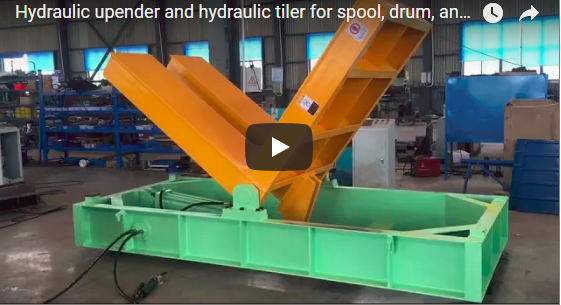
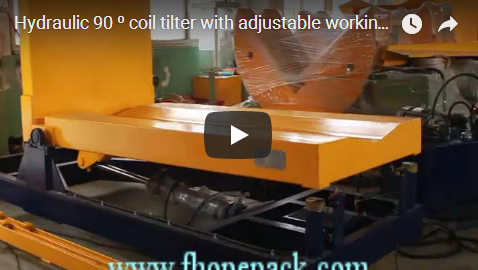
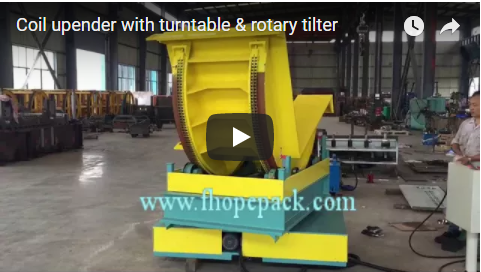
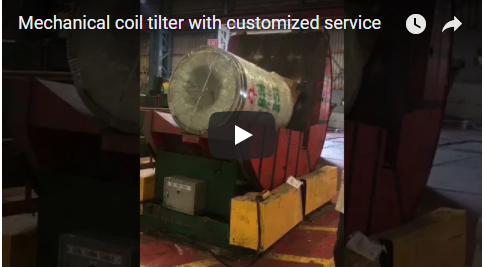
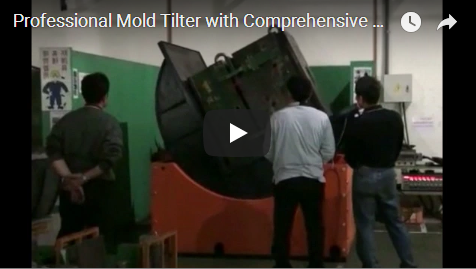
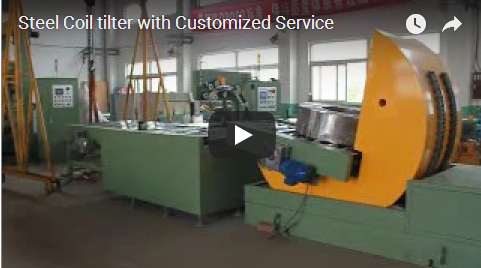
Executive summary This video shows a hydraulic upender (sheet turner) receiving a pallet-wrapped stack of board, then rotating the load inside a fenced safety zone until the stack’s orientation is reversed — a 180-degree change completed without any manual lifting. The footage also shows the unload side: a forklift retrieves the turned pallet. Specifications such as load capacity, cycle time, and power ratings are not shown and must be confirmed with the manufacturer.
Why this machine exists
Stacked board products — drywall, gypsum panels, plywood, tile, glass, and similar sheet goods — are almost always stored, shipped, and handled flat on a pallet. Sooner or later in the supply chain, someone needs that stack flipped onto its edge or onto its opposite face: for repacking, for edge-protection installation, for quality inspection of the bottom layer, or for feeding a production line that only accepts sheets in one orientation.
Doing that flip by hand is slow and risky. A full pallet of drywall can weigh hundreds of kilograms, and manually tipping a tall, flexible stack of sheets invites cracked edges, crushed corners, and injured backs. A powered upender turns the whole pallet in one controlled motion. That is exactly what the footage on this page demonstrates.
The machine in action: what the video shows
The video runs just under 100 seconds and covers both the turning operation and the removal of the turned load. Here is the sequence, with time references:
| Time | What happens |
|---|---|
| 0:00–0:04 | A forklift approaches the yellow upender with a palletized load wrapped in clear plastic film. The safety fence gate on the machine is open, and the pallet is aligned with the rotating platform. |
| 0:04–0:08 | The forklift pushes the pallet fully onto the rotating platform and withdraws. The fence gate remains open during loading. |
| 0:08–0:20 | With the area enclosed, the machine starts. The platform rotates slowly, carrying the pallet and the stacked sheets through a full reversal — the load’s orientation changes by 180 degrees, so what faced forward now faces the opposite way. The yellow mesh fence gates stay closed throughout the rotation, and no operator intervenes. |
| Later segment | The video then shows the other end of the cycle: the turned pallet stands on the machine’s platform, and a second forklift enters, slides its forks under the pallet, lifts the load cleanly off the platform, and drives away. The machine stays stationary during this removal. |
The full cycle visible in the footage is therefore: load with a forklift → close the fence → powered 180° rotation → open up and lift the turned pallet out with a forklift.
Machine structure observed
The footage is clear enough to pick out the main functional parts of the machine:
| Component | What is visible | Function |
|---|---|---|
| Rotating / tilting platform | Central metal platform holding the pallet | Carries the load through the 180° turn |
| Drive unit | Motor with gearbox on the left side of the machine | Powers the rotation of the platform |
| Safety fence | Yellow metal mesh panels and posts surrounding the platform, with a gate on one side | Separates the moving machine from people and forklift traffic |
| Control box | Black cabinet on the right side with buttons and indicator lights (no screen visible) | Starts and controls the turning cycle |
| Base frame | Gray painted steel base | Supports the whole structure |
This layout — platform in the middle, drive on one side, controls on the other, fencing all around — is a typical configuration for pallet-style upenders used with board and panel products.
Direct observation notes
The block below stays close to the factual observations recorded during the frame-by-frame analysis of the video. Only light grammatical editing has been applied.
- A forklift brings a pallet of goods wrapped in plastic film toward the yellow rotating machine; the machine’s fence gate is open.
- The forklift pushes the pallet fully onto the machine’s rotating platform and then withdraws.
- The machine starts and the platform rotates slowly, carrying the pallet; the goods’ orientation changes by 180 degrees during the rotation.
- The rotation happens inside the closed yellow safety fence; no operator intervenes during the turn.
- The machine body is a yellow-painted metal frame on a gray metal base; a blue motor and drive mechanism sit on the left side.
- A black control cabinet with buttons and indicator lights (no screen visible) is on the right side.
- The load consists of large, light-colored sheet or panel material stacked on a wooden pallet, wrapped in transparent film, and secured with strapping; the stack height is roughly 1.5 times the pallet width.
- In the later part of the video, a forklift enters, inserts its forks under the turned pallet, lifts it off the platform, and removes it while the machine remains stationary.
- No emergency-stop button, light curtain, warning signage, or control screen was clearly visible in the footage.
What the video does not show
Buyers should be aware of the limits of the footage. The following are not observable and should be verified with the manufacturer before purchase:
- Rated load capacity (maximum turning weight)
- Rotation angle options (90° vs 180°) and rotation speed
- Cycle time per pallet
- Power supply, voltage, and motor rating
- Control method details (buttons only, or PLC/touchscreen options)
- Whether the fence gate has a confirmed interlock with machine motion
- Footprint, installation dimensions, and foundation requirements
- Compliance with specific safety standards (CE, ISO, etc.)
- Maintenance intervals and spare-parts policy
None of these numbers appear in the video, and we will not invent them. Ask the manufacturer for a datasheet covering each item above for your specific load profile.
Where a sheet turner like this fits
Based on the load seen in the video — a full pallet of stacked, film-wrapped sheet goods — the natural applications include:
- Drywall and gypsum board plants and distributors, where stacks must be flipped for edge protection, strapping changes, or repacking
- Panel and furniture board processing, where sheets need a face change before finishing or CNC feeding
- Glass, tile, and stone sheet logistics, where fragile stacks benefit from a controlled mechanical turn instead of manual tipping
- Warehouses and cross-docks, where inbound pallets arrive in one orientation and must be reoriented for storage racking or outbound shipping
In every case the benefit is the same in kind: one forklift driver replaces a team of people manually tipping a heavy, flexible stack, and the product is turned in a fenced zone rather than on an open floor.
Operation checklist for new users
If you are evaluating or about to operate a machine like the one shown, the visible workflow suggests a simple discipline:
- Confirm the pallet is properly strapped and film-wrapped before turning — the load in the video is both banded and wrapped, which keeps the sheets from shifting during rotation.
- Place the pallet fully and squarely on the platform before starting.
- Close the fence gate and confirm nobody is inside the fenced zone.
- Start the rotation from the control box and stand clear until the platform stops.
- Open the gate only after the platform is fully stationary, then remove the load with a forklift, forks square to the pallet.
Whether the gate in this specific machine is electrically interlocked with the drive could not be confirmed from the footage — check with the manufacturer.
Frequently asked questions
Does the machine rotate the load a full 180 degrees? Yes. The footage shows the load’s orientation reversing completely during the powered rotation — the side facing forward at the start faces the opposite direction after the cycle. Whether 90° intermediate positions are also possible is not shown; check with the manufacturer.
How is the load loaded and unloaded? By forklift, at floor level. The video shows a forklift pushing a pallet on and a forklift lifting the turned pallet off the same platform.
Does an operator need to touch the load during turning? No. Once the pallet is on the platform and the fence is closed, the rotation proceeds with no visible manual intervention.
Is the load damaged or shifted by the rotation? The stack in the video is strapped and film-wrapped, and it comes through the turn intact with no visible breakage or deformation. Results with other products depend on packaging; confirm suitability for your load.
What load capacity does this upender handle? The video does not state a capacity figure. Verify the rated load with the manufacturer against your heaviest pallet.
Is a control screen included? The visible control cabinet has buttons and indicator lights; no screen was observed. Control options should be confirmed with the manufacturer.
Related reading
- Hydraulic lifting and turning equipment overview
- Coil upender machines for metal coils
- Mold upender for heavy industrial flipping
- Pallet inverter for load transfer and exchange
Next step
If your operation handles palletized drywall, panels, or other sheet goods that need regular turning, this type of hydraulic upender is worth a closer look. Watch the video above for the full load–turn–unload cycle, then contact us through our contact page to discuss your pallet size, load weight, and required orientation change — and request the specification data listed in the “not shown” section above.
Source and method
The facts in this article come from the embedded video, which contains background music only — no narration or speech — so no transcript was used. The footage was analyzed frame by frame with a vision model on sampled stills; all machine behavior described here is limited to what those frames show. Specifications, ratings, and options not visible in the video are explicitly marked as items to verify with the manufacturer.