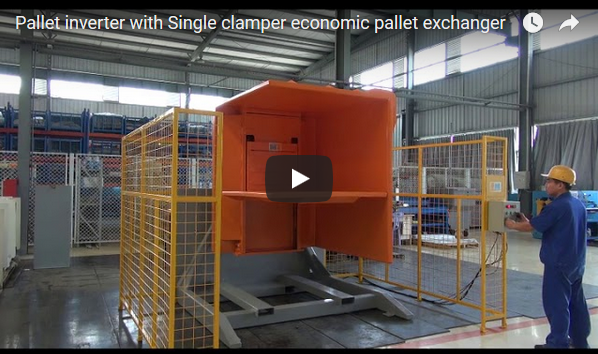
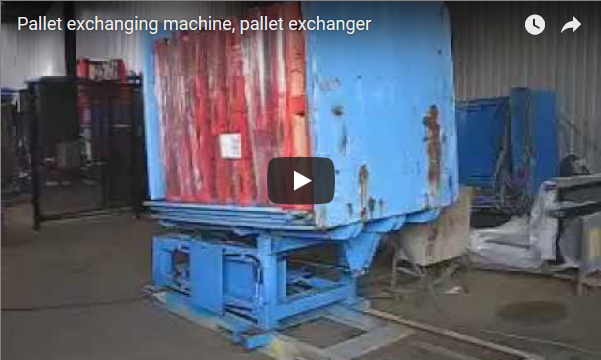
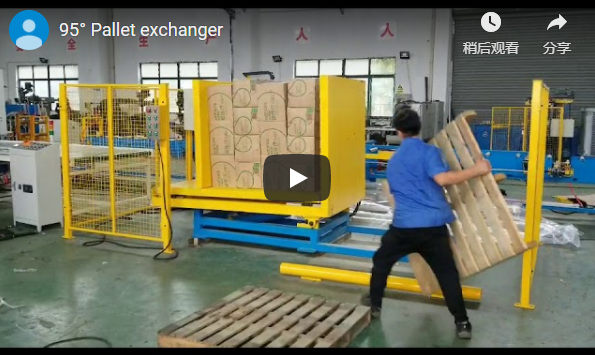
Executive summary This video shows a C-type 180° pallet inverter handling a full pallet of stacked cartons: a worker pushes the loaded pallet into the machine, presses a button, and the C-shaped rotating structure turns the entire load 180° in roughly 8 seconds, with the cartons held stable throughout. The footage covers loading, clamping, rotation, and the ready-for-retrieval state — but not load capacity, model specs, or safety certifications.
Why watch this video before buying a pallet inverter
If you handle boxed goods on pallets, there are moments when the load needs to be flipped: replacing a damaged bottom pallet, accessing goods pressed against the pallet deck, reorienting products for labeling or scanning, or stabilizing a load before stretch wrapping. Doing this by hand is slow and risky. A 180° pallet inverter clamps the whole load and rotates it, so nobody has to lift or restack anything.
This video is a good starting point because it shows the complete working cycle on a real machine with a real, film-wrapped carton load — not a render. Below we describe exactly what the footage shows, what it deliberately does not show, and which questions you should put to the manufacturer before you decide.
The machine in action: full cycle with time references
The footage follows one pallet through a single turnover cycle:
| Stage | Approx. time | What happens |
|---|---|---|
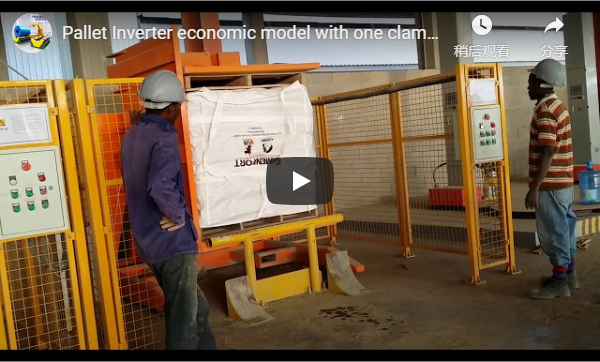
| Loading | ~0–8 s | A worker in green workwear pushes a pallet loaded with stacked cartons into the machine on a yellow manual pallet truck; the pallet settles on the central metal platform. The orange C-shaped structure is stationary and the top guard is open. |
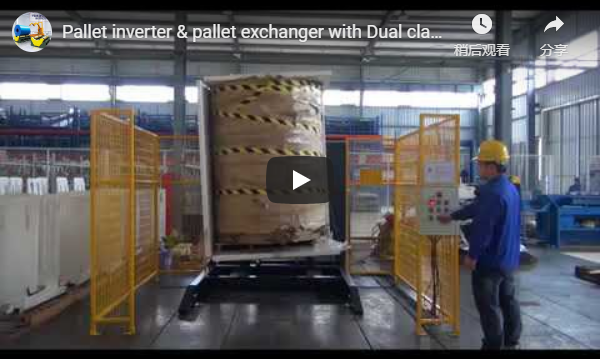
| Standby | ~10–18 s | The worker walks to the free-standing control console on the right side. At one point he holds a small carton — apparently a sample or test piece — while the machine waits. |
| Start | ~20 s | The worker presses a button on the console. The clamp arms close on the pallet edges and the top plate closes. |
| Rotation | ~20–28 s | The C-shaped structure rotates, turning the pallet and load 180°. The cartons tilt progressively — upright, angled, then inverted — with no visible slipping or collapse. |
| Hold & retrieve | ~28 s onward | The rotation ends with the load inverted (former bottom face up). The worker later brings the pallet truck back toward the machine to retrieve the load. |
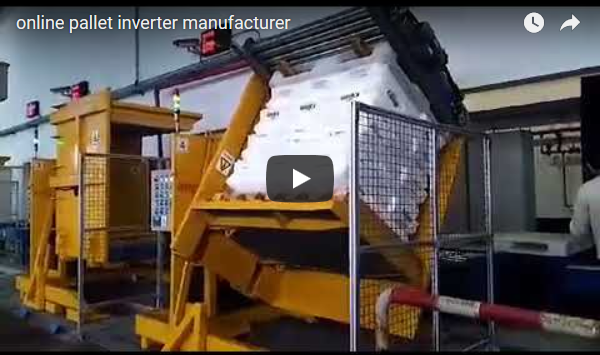
The second half of the video shows the same machine and cycle again, including the mid-rotation phase around the 135° point, where the load leans inside the rotating structure while still held by the clamping arrangement. The pallet remains stable throughout — the stretch film around the cartons visibly does its job keeping the stack together.
Direct observation notes
The following points are kept close to the raw frame-by-frame analysis, with only grammar-level editing:
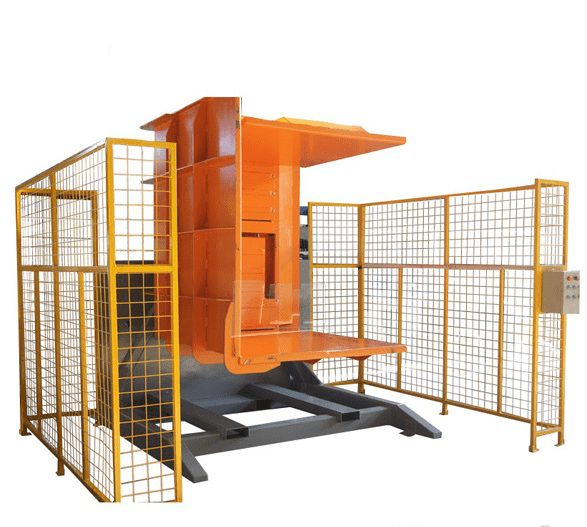
- The machine body is a large orange-red painted steel structure in a C-shape (semi-circular ring), with a dark grey metal working platform and clamping arms inside; several labels on the body are present but not readable.
- An entry gate of yellow-green wire mesh on yellow posts can open and close at the loading side; a taller yellow mesh safety fence covers the rear of the rotation area.
- The clamping mechanism consists of upper and lower thick steel plates forming a V-shaped clamping arrangement that moves with the rotation; a liftable top plate starts open and stays closed during rotation.
- The control console is a floor-standing column unit on the right, in light grey/white housing, with multiple push buttons (red/green/black), 2–4 indicator lights (red/yellow/green), a selector knob, and a red mushroom-head emergency stop button visible in the lower right area of the panel. No screen or digital display is visible.
- The load is white corrugated cartons with a dark blue band print, stacked in a multi-layer, multi-column pattern on a wooden pallet and wrapped in clear plastic film. Estimated carton height is roughly 30–40 cm; the full load is roughly pallet-sized (around 1.2 m footprint, based on visual estimate only).
- Legible on the machine body: “FHOPE GROUP” branding and the words “PACKAGING TURNING” on the C-wheel side. No nameplate, model number, capacity rating, or safety certification marks are readable in any frame.
- One complete rotation takes roughly 8 seconds of footage; the video does not show a timed full cycle including loading and unloading.
What the video shows (with time references)
- Around t≈0–8s an operator in green workwear pushes a pallet loaded with stacked cartons into the machine entrance with a yellow hand pallet truck; the orange semicircular C-type ring is static and the top guard is open.
- Around t≈14–18s the operator stands at the right-side control console and watches the machine, holding a small carton; the machine is still at rest with the pallet in place.
- Around t≈20–28s the machine starts: the pallet and its carton stack are gripped and rotated about 180° around the vertical axis over about eight seconds — front-facing, tilting, then ending inverted (carton underside up).
- Around t≈50–58s during the second cycle the orange-red cylindrical shell rotates clockwise, tipping the pallet and cartons from upright through a gradual tilt into the fully inverted posture; the stack stays stable with no slippage while the operator steps back to watch.
- Around t≈60s the flip is complete: the machine stops at the new position, the pallet is fully inverted (original base facing up) and the platform is level again.
- Around t≈60–78s a later pass shows the C-type ring about 135° into the tilt with the pallet ‘leaning’, then settling vertical; a worker in green workwear pushes a yellow hydraulic truck up in front of the pallet and prepares to move it.
What the video does not show
A demonstration video necessarily leaves gaps. Based on the frame analysis, the following are not observable and must be confirmed with the manufacturer:
- Rated load capacity — maximum pallet weight and load dimensions.
- Acceptable pallet size range — the pallet in the video appears standard, but adaptability to other sizes is unstated.
- Exact full-cycle time — only the ~8-second rotation phase is visible; feeding and retrieval are manual.
- Drive system details — motor power, voltage, hydraulic/electromechanical drive, gearbox specification.
- Model designation — “C-type 180 degree” comes from the video title, not a machine nameplate.
- Safety certifications (CE, UL, or similar) and whether the fence gate has a door interlock.
- Automation options — whether powered infeed/outfeed conveyors or line integration are available; in this video, loading and unloading are done manually with a pallet truck.
- Control logic details — no visible screen, so parameter setting and diagnostics (if any) cannot be assessed from footage.
Where a 180° pallet inverter fits
(The following applications are derived inference from what the machine does in the video, not claims made in the footage.)
| Scenario | Why inverting helps |
|---|---|
| Replacing a damaged or wrong bottom pallet | Flip the load, swap the pallet, flip back — no restacking by hand. |
| Quality inspection of bottom-layer cartons | The bottom face becomes accessible without unloading. |
| Reorientation for labeling, coding, or scanning | The whole load face changes orientation in one motion. |
| Load stabilization before wrapping | Inverting can settle a stack evenly before stretch wrapping downstream. |
| Cold-chain / warehouse goods transfers | Reduces manual handling of heavy, high-center-of-gravity loads. |
Key features visible in the footage
- C-type rotating structure: the load rotates within a large C-shaped ring, with clamping plates holding the pallet from above and below during rotation.
- Closed guarding: wire-mesh fencing surrounds the rotation zone, with a gate at the loading side.
- Simple push-button control: a small number of buttons and indicator lights, plus an emergency stop — suitable for routine operation without programming.
- Manual infeed/outfeed: the operator uses a standard hand pallet truck, so no conveyor infrastructure is required to run the machine as shown.
Operating steps as shown
- Push the loaded pallet into the machine on a hand pallet truck and center it on the platform.
- Step away from the load area to the control console.
- Press the start button; clamping plates close and the top guard closes.
- The structure rotates the load 180° (about 8 seconds of rotation).
- Wait for the machine to stop completely before approaching; retrieve the inverted pallet with the pallet truck.
Safe operation checklist
Based on standard practice for this machine class and the layout seen in the video:
- Center the pallet on the platform before starting; off-center loads stress the clamp and rotation mechanism.
- Confirm the load is film-wrapped or otherwise secured so cartons cannot shift mid-rotation.
- Close the mesh gate before initiating the cycle; confirm with the manufacturer whether a door interlock is fitted.
- Keep hands clear of the clamp area; use the emergency stop if anything looks wrong.
- Never approach the machine until rotation has fully stopped.
What to verify with the manufacturer
- Maximum load weight and pallet size range for the model you would receive.
- Available clamping options for non-standard or fragile loads.
- Whether a gate interlock or light curtain can be supplied, and which safety standards the machine meets in your region.
- Full cycle time including material handling, and options for conveyor-fed automatic in/outfeed.
- Warranty coverage for drive components (bearings, gearbox) and spare parts availability.
- Power supply requirements and installation footprint (the machine sits on a fixed base in the footage).
Frequently asked questions
How long does one inversion take? The rotation phase seen in the video takes about 8 seconds. Total cycle time including manual loading and unloading depends on your handling equipment — check with the manufacturer for a rated figure.
Does the load need to be wrapped in film? In the video the cartons are film-wrapped and stay stable. Unsecured or loose stacks may shift during rotation, so wrapping or strapping is advisable — confirm recommended load preparation with the manufacturer.
Can it integrate with an automatic packing line? The video shows manual loading only. Whether conveyor infeed/outfeed or PLC integration is available — check with the manufacturer.
Is there a display or parameter setting on the control panel? No screen is visible; the panel shows buttons, indicator lights, a selector knob, and an emergency stop. Operation appears to be simple push-button control.
What safety guarding is included? Wire-mesh fencing around the rotation area and a gated entry are visible. Interlock and light-curtain options are not shown — verify with the manufacturer.
Related reading
- Pallet inverter product overview
- Steel sheet upender for heavy flat loads
- Automatic pallet wrapping machine
- Semi-auto pallet wrapping machine
- Automatic packing line solutions
Next step
If a 180° turnover of full pallets would solve a handling problem in your facility, the next move is a short conversation about your pallet sizes, load weights, and throughput. Contact the FHOPE team via the contact page to confirm specifications, request a quotation, or arrange a demonstration.
Source and method: this article is based on the demonstration video above. The footage was analyzed frame-by-frame using a vision model on sampled stills; the video contains background music only, with no narration or speech, so all descriptions come from visual observation. Statements not observable in the video are marked as needing manufacturer confirmation.