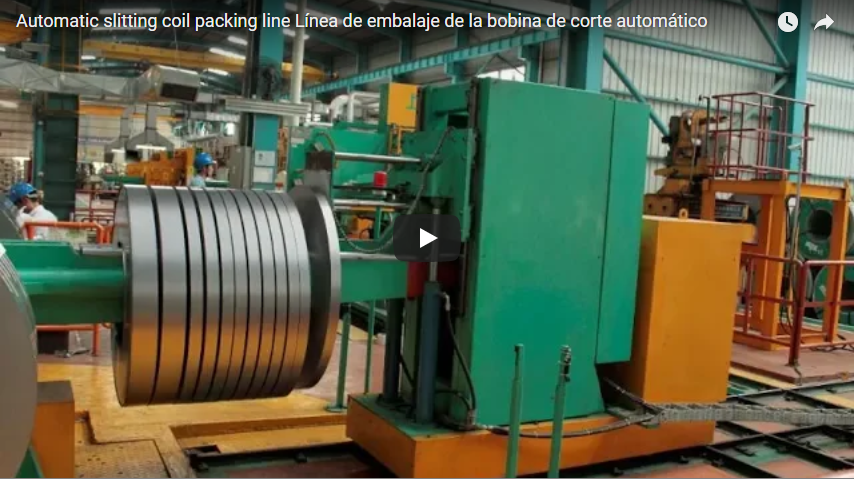
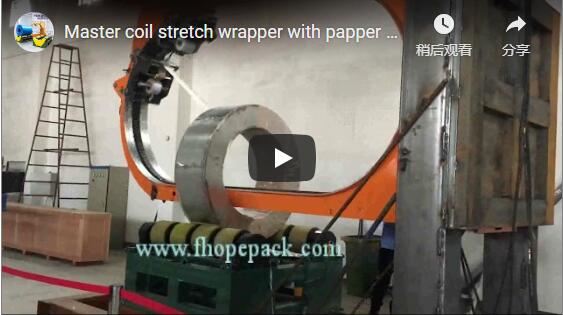
Executive summary Coils that roll or shift while they are wrapped end up with loose film and marked edges. Our packaging line holds each steel coil flat on the roller conveyor under a lowering beam while the wrapping unit runs round it. Wrap passes follow from the coil OD and the film overlap. We set both per project.
Table of Contents
- What the machine does
- How the press-and-wrap station works
- Film passes and overlap per coil
- What the line can include
- Controls and safety
- Selection checklist for a steel coil packaging line
- Engineering FAQ
- Next step
- Related reading
- Sources
What the machine does
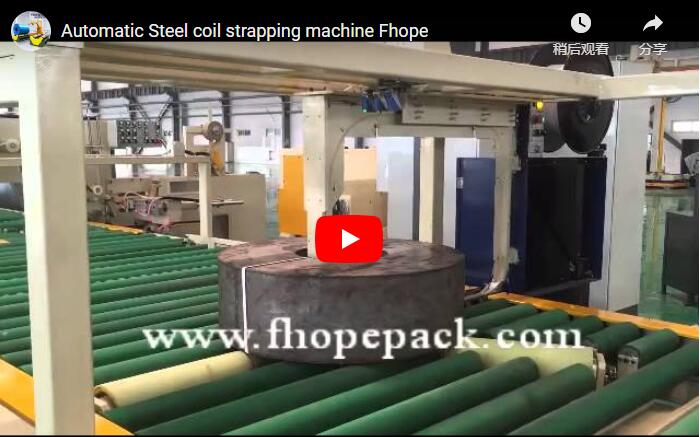
The line keeps every steel coil flat on the roller conveyor in a single layer, maintaining an eye-to-sky orientation throughout transfer and packaging. At the press-and-wrap station, the upper beam of the wrapping machine lowers directly over the coil on the support rollers, the orbital wrapping unit travels through the eye and round the coil body, and the beam rises again upon cycle completion. The coil remains completely flat and supported from arrival through outfeed.
The station integrates within a gantry-serviced packaging line layout equipped with operator access platforms, perimeter safety perimeters, and marked floor areas alongside the roller conveyor. By securing the workpiece against the conveyor bed, the machine prevents axial wandering, telescoping, and surface abrasion during the dynamic packaging cycle.
How the press-and-wrap station works
The complete wrapping sequence executes in five coordinated mechanical steps:
| Step | What happens |
|---|---|
| Arrive | The coil reaches the wrapping station on the roller conveyor and aligns axially |
| Press | The upper beam lowers onto the top face of the coil to clamp it securely |
| Wrap | The wrapping unit travels through the eye and round the coil perimeter |
| Release | The upper clamping beam unloads and rises back to its home clearance position |
| Outfeed | The tightly wrapped coil advances downstream for subsequent buffering or handling |
Holding the coil under the clamping beam prevents it from shifting, sliding, or creeping under the tangential pull of the packaging material during high-speed orbital rotation. This rigid restraint ensures the protective film or protective wrapping layers lie tight, smooth, and evenly tensioned around all outer surfaces and corner profiles.
Film passes and overlap per coil
Wrap calculations reference the outer circumference of the coil, where tangential surface speed is highest and film overlap is lowest. The following calculation serves as an illustrative example for line throughput and material consumption estimation:
| Item | Value |
|---|---|
| Coil OD (illustrative) | 1,500 mm |
| Circumference, π × 1,500 | about 4,712 mm |
| Film width (illustrative) | 120 mm |
| Advance per pass at 50% overlap | 60 mm |
| Passes, 4,712 ÷ 60 | about 79 |
Because the inner diameter (eye) has a significantly smaller circumference than the outer diameter (OD), orbital wrapping kinematics dictate that film advance per rotation is compressed inside the eye. Consequently, the coil eye always receives a higher percentage of overlap than the OD, ensuring that the entire coil package exceeds the specified minimum 50% protective barrier coverage.
What the line can include
A complete automated packaging installation balances coil transport, wrapping, mechanical handling, and finished goods palletizing:
| Station | Role |
|---|---|
| Roller conveyor | Moves flat coils sequentially between inline process stations |
| Press and wrap | Holds the coil rigid under mechanical clamp force and applies eye-through wrap |
| Gantry handling | Lifts bare coils onto the line and offloads wrapped coils reliably |
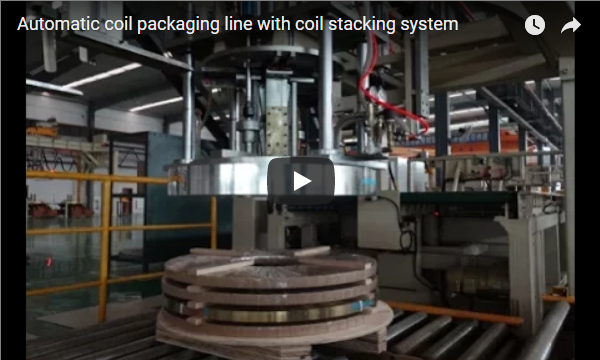
| Stacking or pallets | Groups wrapped coils into stable vertical stacks or secures them onto shipping pallets |
We configure every station around your specific coil dimension ranges, material weight limits, and target hourly output, integrating upstream coil feeding and downstream pallet logistics as required. See how a full automated line fits together in our station-by-station steel coil packaging line.
Controls and safety
The overhead beam lowers under mechanical force, and the orbital wrapping shuttle traverses through the coil center at operating speed. Operating personnel must remain strictly outside the active station perimeter while the automated cycle is underway. Coil handling, maintenance inspections, and reel changes must only take place with the line completely brought to rest, safety circuits disengaged, and hazardous energy isolated.
Compliance standards depend on the installation territory. For installations across CE-regulated markets, ISO 12100 governs the risk assessment and hazard mitigation methodology, while EN 415-10 dictates the specific safety requirements for automated packaging machinery and integrated safeguarding systems.
Selection checklist for a steel coil packaging line
Ensure your engineering team defines the following mechanical and logistical baseline specifications:
- Coil dimensional envelope: minimum and maximum outer diameter (OD), inner diameter (ID), axial width, and total weight range.
- Protective packaging media specifications: stretch film, VCI paper, or woven composite tape width and target layer count.
- Line throughput requirements: required finished coils per hour.
- Upstream and downstream transfer interfaces: crane hook, turnstile, downender, or walking beam integration.
- Final palletizing criteria: individual dispatch, wooden pallet mounting, or vertical nested stacking.
- Plant infrastructure: available installation floor space, layout clearance, and overhead crane access envelopes.
Engineering FAQ
Q: Why press the coil during wrapping? A: Pressing clamps the coil securely against the conveyor bed, eliminating rotational creep, sliding, and surface rubbing caused by dynamic film tension during orbital wrapping. This ensures a tight, uniform layer application across all edges.
Q: How many passes does a coil need? A: About 79 passes for a 1,500 mm OD coil wrapped with 120 mm film at a 50% outer surface overlap, as demonstrated in our worked calculation example.
Q: Does the coil turn over in this station? A: No. The coil remains flat in an eye-to-sky orientation on the powered roller conveyor continuously from infeed arrival through outfeed transfer.
Q: Where is overlap counted? A: Overlap percentage is calculated at the coil outer diameter (OD), where linear pitch is widest; the inner eye circumference is shorter, meaning inner overlap is consistently higher.
Q: Can stacking be added? A: Yes. Downstream gantry pick-and-place manipulators, coil stacking turntables, and automatic pallet dispensers can be integrated directly following the press-and-wrap station.
Next step
We engineer your steel coil packaging line through an efficient three-stage technical onboarding process:
- Submit your layout drawing along with coil dimensional ranges, mass thresholds, and production rate requirements to info@fhopepack.com.
- Receive a proposal within 48 hours, including station layout configurations, cycle time estimates, and clamping press parameters.
- Book a site survey with our engineering team to inspect space clearances, foundation requirements, and material flow integration.
Related reading
- Steel coil packing line
- Video: steel coil, copper coil packaging machine for eye-through film wrapping
- Video: automatic steel coil strapping machine
Sources
- Line content: FHOPE engineering team, 2026-10-04
- Pass example: our worked example, illustrative values
- Machine in action: our video on YouTube
- Standards scope: ISO 12100:2010, EN 415-10:2014
Last reviewed: 2026-10-29