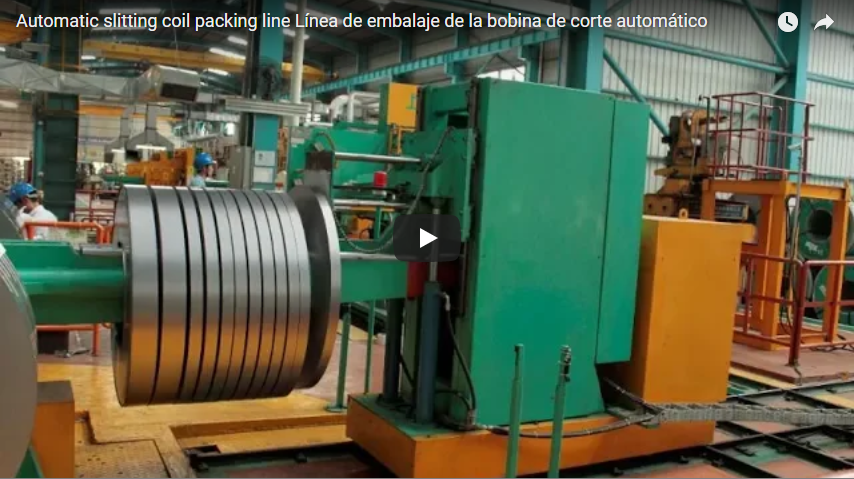
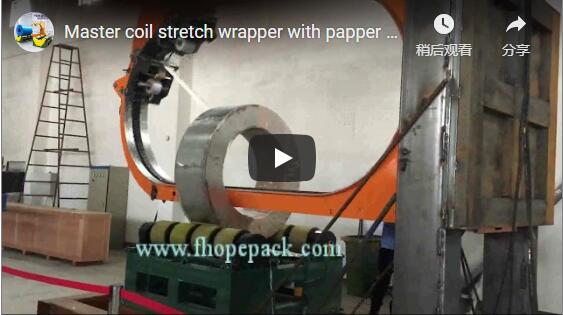
Executive summary This 68 s clip runs through a complete stainless steel coil packing line of ours. It shows a roller-table tilter, an eye-through ring on yellow rollers, a labelling unit at the outfeed, and a stacker setting coils on timber runners. The wrapping is the visible work, but the label is what the warehouse reads. Below we follow the coil data from the line control to the label and on to the stack.
Table of Contents
- What the clip shows
- How coil data reaches the label
- Where the label goes on a wrapped coil
- Stacking after labelling
- Layout options for a full line
- Selection checklist for labelling and stacking
- Controls and safety
- Engineering FAQ
- Next step
- Related reading
- Sources
What the clip shows
| Clip time | Station |
|---|---|
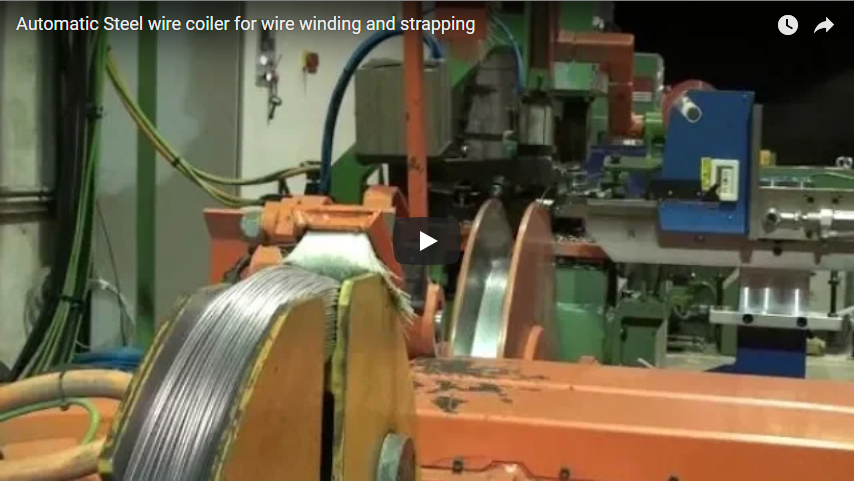
| 0–12 s | Wide views of the line; a roller-table tilter, as on our steel coil upender and eye-through wrapping line, holds a coil upright, marked “C” on its frame |
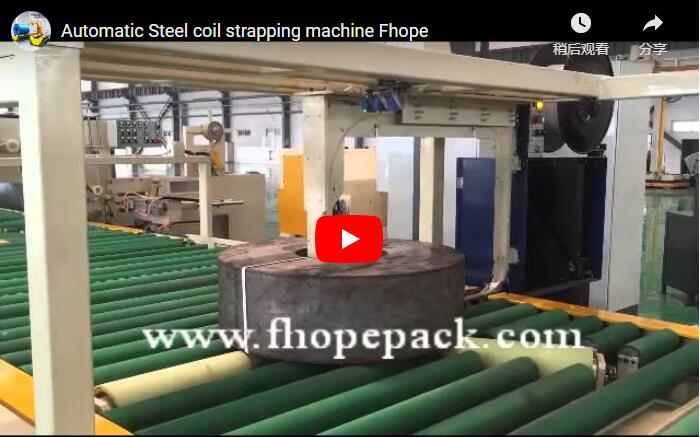
| about 14–34 s | A bright stainless coil lies flat on yellow rollers while a vertical ring wraps it through the eye in white film |
| about 36 s | The wrapped coil reaches a silver roller section beside a grey labelling unit |
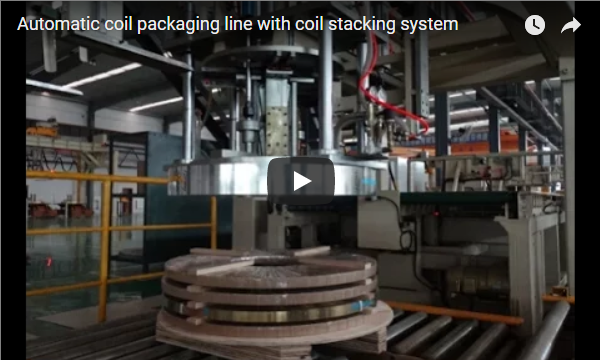
| about 42–54 s | A stacker sets wrapped coils on timber runners at floor positions marked A and B |
| final seconds | An end screen, not factory footage |
Times come from frames taken every 2 s. Picture-in-picture windows show other stations of the same line.
How coil data reaches the label
A label is only useful if it carries the right coil’s data. On our coil packing lines the chain looks like this:
- Upstream: the line connects to the production line or ERP/MES, which knows the coil number, grade and order.
- Weighing (option): a weighing station adds the actual coil weight.
- Tracking: the line control follows each coil from station to station, so the data stays with the right coil.
- Labelling: the labelling unit prints and applies the label as the coil passes.
- Downstream: the data goes on to the warehouse system (WMS) or ERP for stock and dispatch.
Our automatic coil packing line is built for this real-time tracking, data logging and automated labelling.
Where the label goes on a wrapped coil
A label applied after wrapping sits on the outside of the film, where a scanner or a person can read it without opening the package.
| Placement | When we use it |
|---|---|
| Outer diameter | coils stored on edge, read from the aisle |
| Top face | coils stacked eye to sky, read from above |
| Two labels | when the stack is read from more than one side |
Tell us how your warehouse reads coils, and we place the labelling unit to match.
Stacking after labelling
In the clip, the stacker builds stacks on timber runners. Runners keep the bottom coil off the floor and leave room for forks.
- Stack height: up to 6 coils per stack on our automatic coil packing line.
- Orientation: multi-coil stacks on runners are built eye to sky, as in the clip; eye-to-wall packing is also offered in the quote form, with its own handling.
- Timber feeder: available as an additional function, so runners need not be laid by hand.
Labelling before stacking matters: once a coil is in the middle of a stack, its label must already face the way the stack will be read.
Layout options for a full line
Not every hall has room for a straight line. Our automatic coil packing line can be laid out:
- Straight, when the hall is long enough.
- L-shaped or U-shaped, when space is limited.
- With added conveyor lengths and auxiliary stations for weighing, strapping and labelling.
The line can also be fed from the production line upstream, so coils arrive without a forklift.
Selection checklist for labelling and stacking
- Data each label must carry, and which system sends it.
- Label size, placement and how many labels per coil.
- Weighing needed or not.
- Stack height, orientation and timber runner size.
- Straight, L or U layout, and the space you have.
- Coil range: ID, OD, width and weight.
Controls and safety
The standards that apply depend on the destination market. For CE markets, ISO 12100 sets the risk-assessment method and EN 415-10 covers general requirements for packaging machines, which fixes guarding and the emergency-stop arrangement.
In the clip, yellow fencing surrounds parts of the line, and the labelling unit carries an electrical warning sign. Guarding for the stacker area is set in the risk assessment for each layout.
Engineering FAQ
Q: Can the line connect to our ERP or MES? A: Yes. Our automatic coil packing line connects upstream to production and downstream to WMS or ERP for tracking and labelling.
Q: Is weighing included? A: Weighing is an additional function, selected when the line is specified.
Q: How high can coils be stacked? A: Up to 6 coils per stack, depending on coil weight and handling.
Q: What if our hall is too short for a straight line? A: We lay the line out in an L or U shape and add conveyor lengths where needed.
Q: Where can the label be applied? A: On the outer diameter, on the top face, or as two labels when the coil is read from more than one side.
Q: Why label before stacking? A: Because a coil inside a stack cannot be relabelled. The label must face the reading side before the coil is stacked.
Next step
We plan a labelling and stacking line in three steps:
- Submit your layout drawing with coil range, label data and stack pattern, to info@fhopepack.com.
- Receive a proposal within 48 hours, with the station list, layout and data interface.
- Book a site survey so we confirm space, the upstream link and the warehouse interface.
Related reading
- Stainless Steel Coil Packaging Line: Tilting, Eye-Through Wrapping, Labelling and Stacking
- Two-Stage Copper Coil Packing Line: Eye-Through Wrapping, Then Stacking on Timber Runners
- How Does a Two-Stage Automatic Steel Coil Packaging and Stacking Line Work?
- Automatic coil packing line
Sources
- Machine in action: the video on YouTube (68 s)
- ERP/MES, WMS, real-time tracking, data logging, automated labelling, weighing, timber feeder, L/U layouts, up to 6 coils per stack, eye to sky / eye to wall: Automatic coil packing line
- Standards scope: ISO 12100:2010; EN 415-10:2014
- Proposal timing: approved house CTA (proposal within 48 hours)
Last reviewed: 2026-10-06