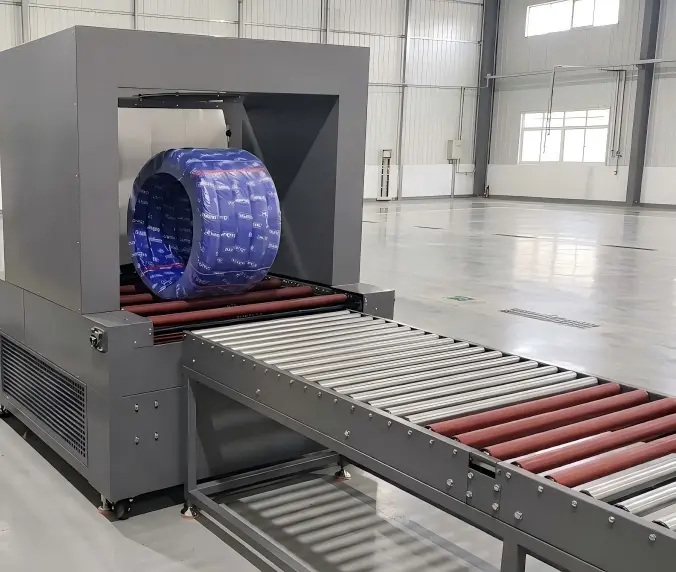
Summary: Many procurement teams mistakenly prioritize upfront equipment pricing when selecting a tyre wrapping system, overlooking hidden operational drains from labor turnover, film waste, and inconsistent load protection. This technical comparison evaluates semi-automatic stations against fully automatic packing lines across five engineering and financial dimensions to align equipment selection with verified production requirements.
🛠️ Evaluation Criteria
Selecting the optimal tyre wrapping system requires evaluating throughput capacity, labor dependency, material efficiency, protection consistency, and total lifecycle cost. These five dimensions separate a line that achieves rapid capital recovery from one that steadily erodes operational margins through hidden inefficiencies.
| Criterion | Technical & Business Impact |
|---|---|
| Throughput (tyres/hour) | Dictates daily dispatch volume; mismatched capacity creates upstream bottlenecks or idle asset depreciation. |
| Labor cost per tyre | Recurring operational expense that compounds with wage inflation; automation shifts fixed headcount to variable efficiency. |
| Material consumption (film waste) | Stretch wrap typically represents 12–18% of packaging spend in tire plants; excess waste directly compresses gross margin. |
| Protection consistency | Variable tension causes transit deformation; target damage rates must remain below 0.5% for high-value or export-bound inventory. |
| Total lifecycle cost (investment + 3‑year operating) | Encompasses capital expenditure, installation, spare parts, energy draw, and operator training overhead. |
These evaluation parameters apply across passenger tyres, OTR (off-the-road) tyres, and annular workpieces like large industrial pipes or wire coils. We will now apply these metrics to both wrapping methodologies.
🏗️ Option A: Manual or Semi‑Automatic Wrapping Station
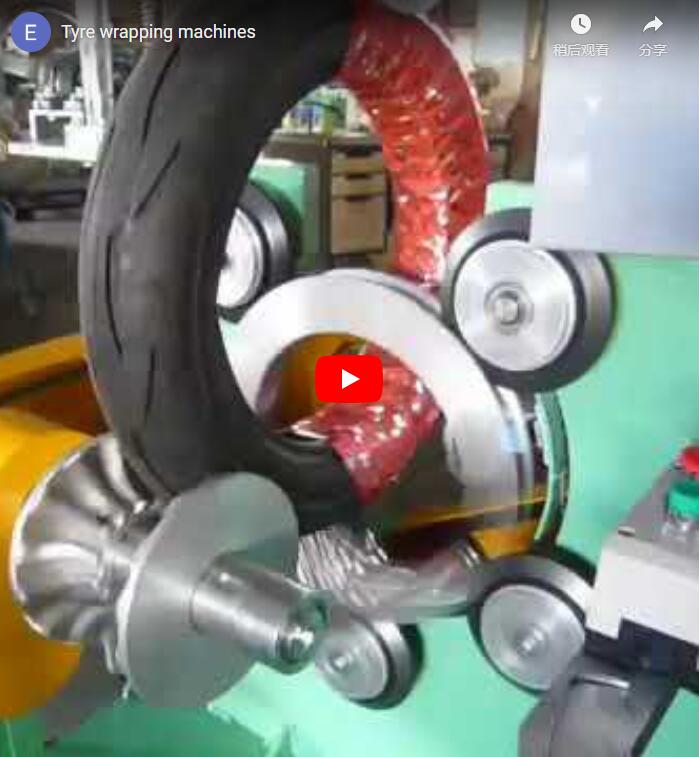
Manual or semi-automatic wrapping stations utilize rotating turntables and hand-applied film dispensers to achieve moderate throughput at low initial capital expenditure. These systems suit low-volume operations or facilities managing frequent product changeovers, though they introduce significant labor dependency and variable film consumption.
-
Operational Mechanics: An operator positions the tyre on a motorized turntable rotating at 6–12 RPM while manually applying stretch film. A semi-automatic variant adds a motorized carriage to reduce physical strain, but film tension remains operator-dependent. Pre-stretch refers to the mechanical elongation of film prior to application, which thins the material while maintaining load containment.
-
Throughput: 15–30 tyres/hour per station. Dual-shift operations may reach 480–720 units daily, but operator fatigue typically reduces second-half efficiency by 20–30%.
-
Labor Dependency: Requires 1 full-time operator per station. For continuous 24-hour coverage, facilities typically allocate 4–5 headcount per station to account for breaks and absenteeism. Estimated labor cost ranges from $0.08–$0.15 per tyre, heavily influenced by regional wage structures.
-
Material Consumption: Without mechanical pre-stretch, film elongation rarely exceeds 20–40%. Manual application frequently results in overwrapping or loose edges, generating 15–25% excess film waste. Film tensile properties should be validated against ASTM D6703/D6703M-18 to ensure elongation limits match application demands.
-
Protection Consistency: Human variability creates tension swings from 5 N to 25 N (approximately 1.1–5.6 psi of film stress). This inconsistency yields transit damage rates of 0.8–1.5%, particularly when ambient humidity alters film elasticity.
-
Initial Investment: $5,000–$12,000 per station. Low entry cost, but lacks digital connectivity for production tracking or quality control.
Key Point: Manual stations minimize upfront capital but consume 3–5× more labor and generate significantly higher film waste per unit than automated alternatives.
🔗 Related: Explore more solutions
📈 Option B: Fully Automatic Tyre Packing Line
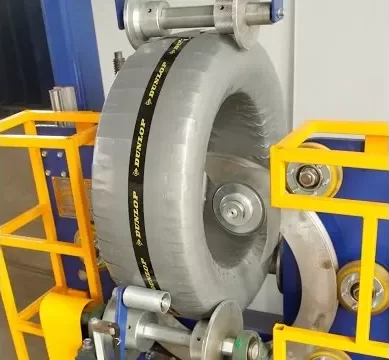
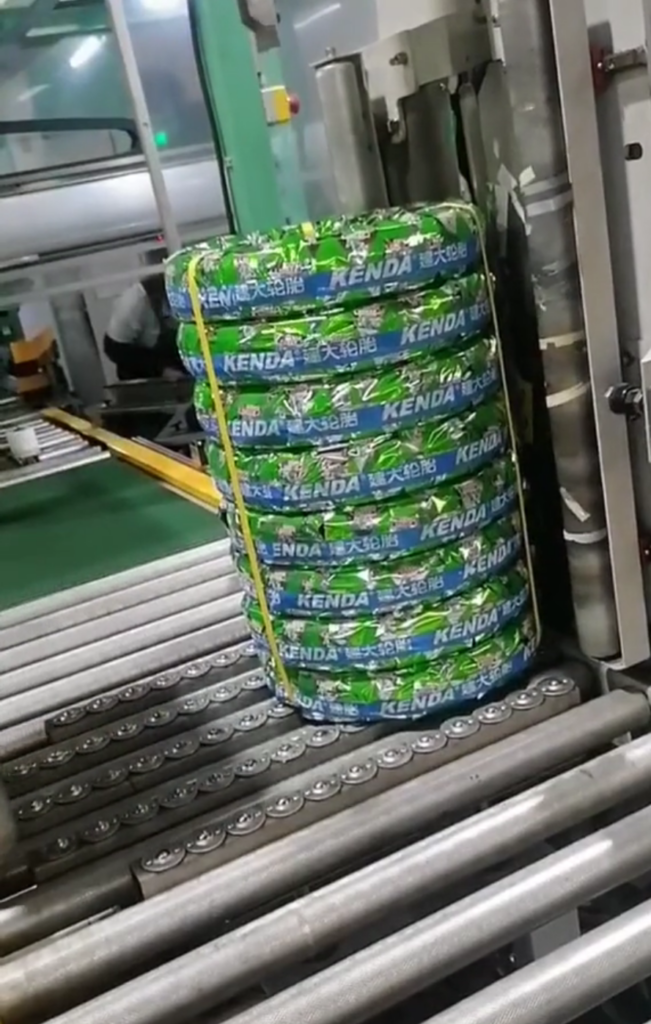
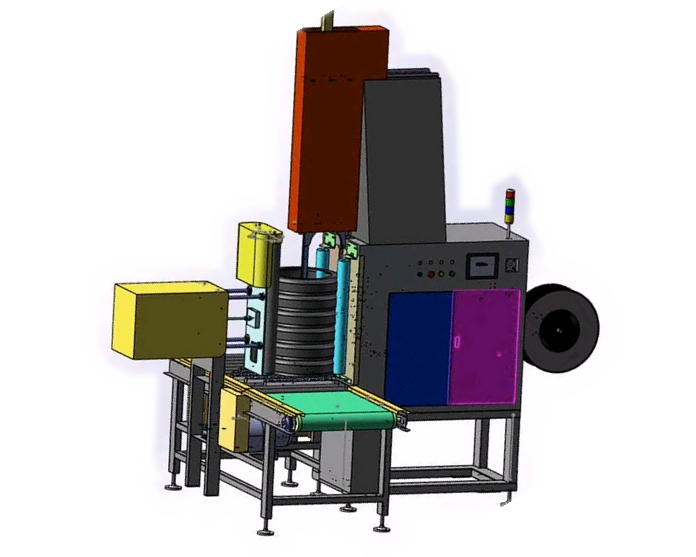
Fully automatic tyre packing lines integrate servo-driven conveyors, programmable logic controllers, and motorized pre-stretch applicators to deliver consistent high-speed output with minimal human intervention. These systems reduce film waste by nearly 30% and stabilize transit protection, justifying higher upfront investment through sustained operational savings.
-
Operational Mechanics: Tyres advance via servo-controlled conveyors. Photoelectric sensors detect diameter (±50 mm tolerance) and auto-adjust wrap parameters. PLC (Programmable Logic Controller) systems execute these adjustments with millisecond precision, ensuring repeatable cycle times. Linear tension values (8–15 N) equate to approximately 1.8–3.4 psi of film stress, ensuring uniform load containment without film rupture.
-
Throughput: Standard configurations process 60–80 tyres/hour (45–60 second cycle). Dual-station high-speed variants reach 120 tyres/hour (30-second cycle), requiring synchronized upstream in-feed systems.
-
Labor Dependency: Requires 0.25–0.5 operators per shift, as one technician typically monitors 2–3 parallel lines. Labor cost drops to $0.02–$0.04 per tyre. For a 100-tyre/hour operation, this yields estimated annual savings of $50,000–$70,000 versus manual stations.
-
Material Consumption: Mechanical pre-stretch elongates film by 60–80%, reducing consumption by 28% compared to manual methods. Servo-controlled tension maintains force within 8–15 N across all cycles. Automatic roll changeover completes in under 90 seconds, minimizing splice waste.
-
Protection Consistency: Damage rates remain below 0.5% due to uniform film coverage and real-time humidity compensation (±8% elasticity variation). Transit damage sampling should follow ISO 2859-1 protocols to statistically validate protection consistency across production lots.
-
Total Lifecycle Cost: Initial investment ranges from $25,000–$60,000 (typical industry range for mid-tier automatic models). Competitor equivalents, such as Lantech’s TL series or Orwak’s TireWrap, align within this bracket. Estimated 3-year TCO spans $85,000–$150,000, factoring in service contracts and energy draw.
Key Point: Fully automatic lines require 60% less labor and 28% less film, directly improving P&L performance for mid- to high-volume manufacturing environments.
🛡️ Comparison Table
| Criterion | Manual / Semi‑Automatic Station | Fully Automatic Packing Line |
|---|---|---|
| Throughput | 15–30 tyres/hour per operator | 60–120 tyres/hour (single/dual station) |
| Labour cost per tyre | $0.08–$0.15 | $0.02–$0.04 |
| Film consumption | Baseline (waste 15–25%) | 28% less via mechanical pre-stretch |
| Protection consistency | Tension: 5 N–25 N (variable) | Tension: 8–15 N (servo-stabilized) |
| Damage rate | 0.8–1.5% typical | <0.5% statistically validated |
| Initial investment | $5,000–$12,000 | $25,000–$60,000 |
| 3‑year TCO (100 tyres/hr equivalent) | $120,000–$180,000 | $85,000–$150,000 |
| MES integration | None | OPC UA / PLC possible |
| Changeover time (size change) | 2–5 minutes (manual adjustment) | <30 seconds (auto-parameter recall) |
🔗 See Also: Related equipment
⚙️ Selection Advice
Procurement decisions should align equipment selection with verified daily throughput requirements, capital recovery timelines, and product mix complexity. Facilities processing under 40 units daily benefit from manual flexibility, while mid-to-high volume operations require automated precision to maintain profitability and meet logistics quality standards.
-
Low volume (<40 tyres/day): Manual or semi-automatic station. Accept higher per-unit labor costs, as automated capital recovery requires sustained volume. Opt for semi-automatic models with basic pre-stretch to mitigate film waste without introducing complex maintenance.
-
Mid volume (60–80 tyres/hour required): Fully automatic standard line. This throughput justifies investment within an estimated 18–24 month payback window via labor and material savings. Verify upstream conveyor synchronization; manual feeding may extend payback by 2–3 months.
-
High volume (>100 tyres/hour): Dual-station automatic line. Ensure upstream production can sustain this rate to avoid asset idling. Request an OEE (Overall Equipment Effectiveness) simulation from the supplier, calculated against your actual shift patterns, planned maintenance, and micro-stop frequencies.
-
Mixed product types (e.g., passenger + OTR + industrial coils): Select systems with recipe-based parameter storage. Automatic lines with quick-change tooling handle diameters from 400 mm to 1200 mm in most configurations. Verify ring clearance matches your largest annular workpiece.
Warning: Avoid purchasing automated lines solely for future-proofing if current output remains below 40 tyres/hour. Fixed depreciation will inflate unit costs until volume scales. Deploy manual stations initially, then upgrade once throughput data validates the investment.
Purchase‑Decision Checklist
-
[ ] Confirm peak daily throughput (not average) – size equipment for worst-case shift scenarios.
-
[ ] Calculate labor cost per tyre including overtime premiums, turnover training, and absenteeism buffers.
-
[ ] Estimate film cost per roll and current waste percentage – conduct a physical film audit.
-
[ ] Verify maximum tyre diameter and weight – ensure machine specifications exceed your largest product dimensions.
-
[ ] Check power and compressed air requirements at installation points (typical: 380–480 V 3‑phase, 6–8 bar).
-
[ ] Request a TCO comparison from multiple suppliers, including 3‑year service contracts and critical spare parts.
-
[ ] Confirm OPC UA compatibility if tracking real-time production data or integrating with plant-wide MES networks.
🛠️ FAQ
Q: Can a semi-automatic station be upgraded to full automation later? A: Modular upgrade kits exist for some platforms, but retrofitting often costs 60–70% of a new line. Verify upgrade paths with suppliers, as standalone automatic architectures typically cannot accept manual station retrofits.
Q: How long does pre-stretched film last before roll change? A: With 60–80% pre-stretch, a standard 500 mm × 1500 m roll wraps approximately 1,800–2,200 tyres (average 600 mm diameter). High-speed models offer automatic splicing for continuous 24-hour operation.
Q: What damage rate is acceptable for recycled tyres? A: Recycled tyre shipments often tolerate up to 1.5% damage due to lower resale value. For export or retail replacement tyres, target the automatic line’s <0.5% rate to prevent logistics claims and brand depreciation.
Q: Do these machines handle carpet rolls or other cylindrical goods? A: Yes. Orbital wrap technology applies to any annular or cylindrical workpiece. Adjust film tension and overlap patterns via the control interface. Verify that the machine’s ring diameter accommodates your product’s outer dimensions (typically 800–1400 mm).
📊 Methodology & Financial Disclaimer
TCO & Labor Assumptions: Total Cost of Ownership calculations assume a 3-year operational horizon, 250 operating days per year, and standard 2-shift coverage. Labor costs are estimated based on regional manufacturing wage averages, including benefits, turnover training, and absenteeism buffers. Energy consumption factors in standard industrial electricity rates. Actual figures will vary based on facility location, union agreements, and specific utility tariffs.
Disclaimer: All financial figures, throughput metrics, and efficiency percentages represent typical industry ranges and estimated benchmarks. Actual performance, pricing, and return-on-investment timelines depend on site-specific conditions, supplier configurations, and market variables. Consult certified equipment integrators for project-specific engineering validation.