Executive summary Loose tire stacks lean and slide on pallets and in containers, so plants strap them into firm units. Our tire strapping machine in this video compresses a tire stack on the conveyor, then straps it and sends it on down the line. Strap per stack follows from the stack height and the tire OD. We set both per project.
Table of Contents
- What the video shows
- How the online strapping cycle works
- Strap use per tire stack
- Settings per tire size
- Controls and safety
- Selection checklist for an online tire strapping machine
- Engineering FAQ
- Next step
- Related reading
- Sources
What the video shows
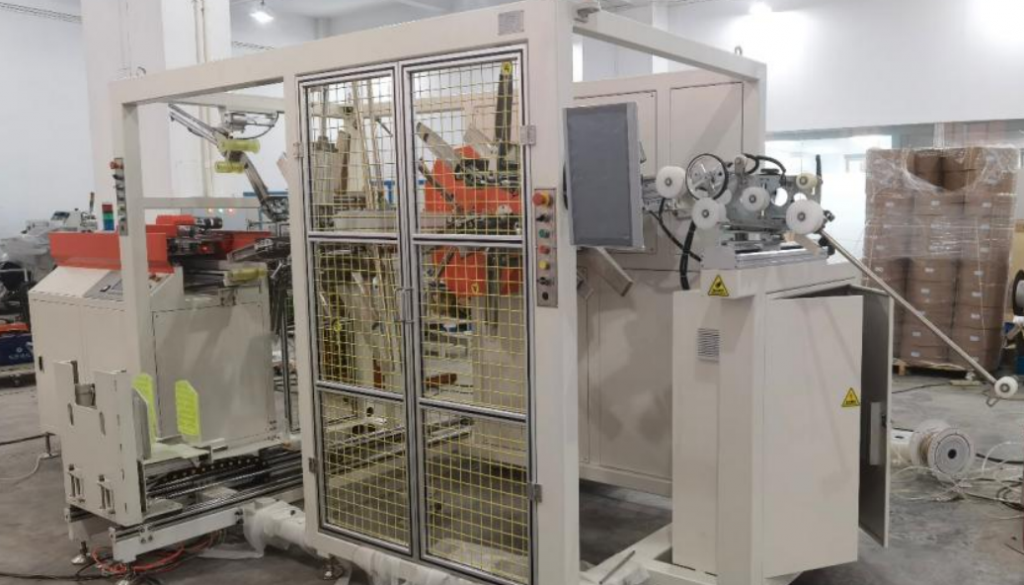
A stack of black tires stands on the conveyor under the press of our green-framed machine, with yellow safety panels around the moving parts. An operator works at the control area behind it.
The press plate comes down and compresses the stack, then the conveyor moves it to the strapping position, where a strap goes round it. The strapped stack leaves the machine, and the press and strapping unit reset for the next stack. The stack stays upright the whole time.
How the online strapping cycle works
| Step | What happens |
|---|---|
| Arrive | The tire stack stops under the press |
| Compress | The press plate comes down on the stack |
| Move | The conveyor carries the stack to the strapping position |
| Strap | A strap goes round the stack |
| Reset | The press and strapping unit reset |
| Outfeed | The strapped stack runs on |
Compressing the stack first settles the tires, so the strap goes on a firm, even stack.
Strap use per tire stack
Illustrative example with two vertical bands:
| Item | Value |
|---|---|
| Tire OD (illustrative) | 650 mm |
| Tire width (illustrative) | 200 mm |
| Stack height, 6 × 200 | 1,200 mm |
| Band length, 2 × (1,200 + 650) | 3,700 mm |
| Strap per stack, 2 × 3.7 m | 7.4 m |
Add the seal overlap to each band when you order strap.
Settings per tire size
| Setting | Why it matters |
|---|---|
| Press stroke | Matches the stack height |
| Press force | Firm stack without marking the tires |
| Bands per stack | How well the stack holds in handling |
| Conveyor stop position | Centres the stack under the press |
We set these on trial with your tire sizes and keep them as recipes. For smaller tires, see our automatic motorcycle tire strapping line.
Controls and safety
The press comes down with force and the strap is under tension. Keep hands out of the press and strapping area while the machine runs, and clear a stack only with it stopped.
The standards that apply depend on the destination market. For CE markets, ISO 12100 sets the risk-assessment method and EN 415-10 sets general requirements for packaging machines.
Selection checklist for an online tire strapping machine
- Tire OD, width and weight range.
- Tires per stack.
- Bands per stack.
- Stacks per hour.
- Conveyor height and line layout.
- Strap type and width.
Engineering FAQ
Q: Why compress the stack before strapping? A: So the tires settle and the strap goes on a firm, even stack.
Q: How much strap does a stack take? A: About 7.4 m for two bands on a 1,200 mm high stack of 650 mm OD tires in our example.
Q: Does the stack stay upright? A: Yes. It stays upright from infeed to outfeed.
Q: Can it handle different tire sizes? A: Yes, with press stroke, force and stop position stored per size.
Q: How is the machine guarded? A: Yellow safety panels cover the moving parts.
Next step
We plan your tire strapping machine in three steps:
- Submit your layout drawing with tire sizes, stacks and output to info@fhopepack.com.
- Receive a proposal within 48 hours, with the press and band plan.
- Book a site survey to check the conveyor layout.
Related reading
- Tyre packing machines
- Video: automatic tyre packing machine for inline tire wrapping
- Video: tyre packing machine for PCR tyres
Sources
- Machine content: FHOPE engineering team, 2026-10-04
- Strap example: our worked example, illustrative values
- Machine in action: our video on YouTube
- Standards scope: ISO 12100:2010, EN 415-10:2014
Last reviewed: 2026-10-04