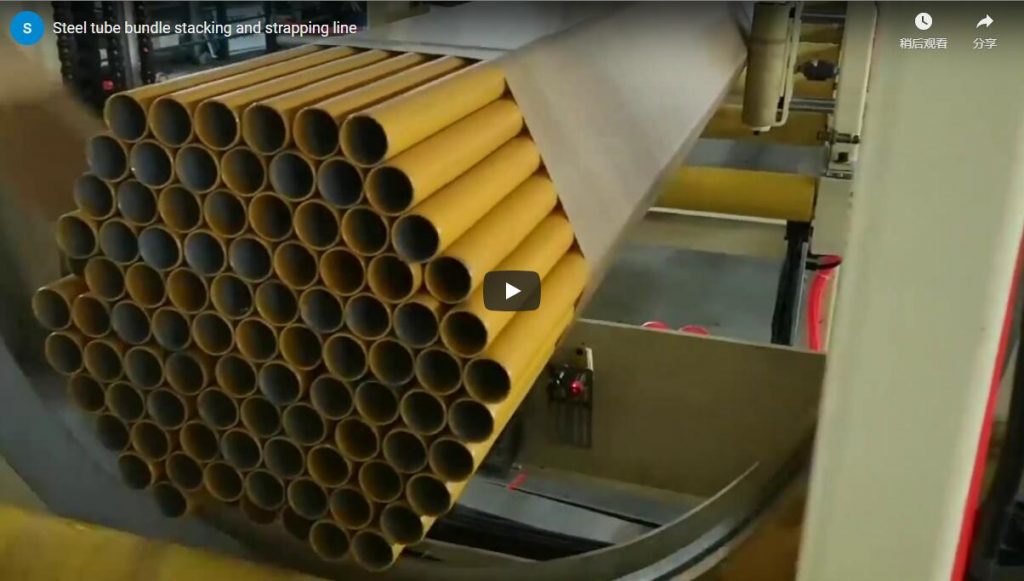
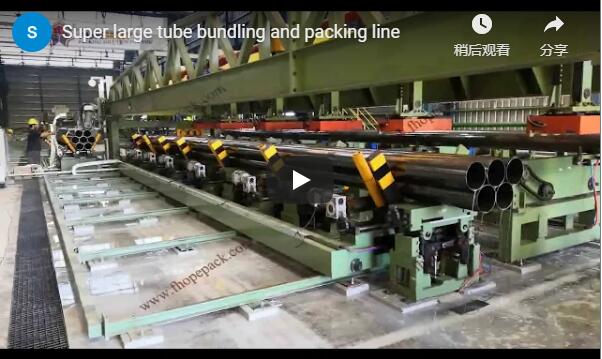
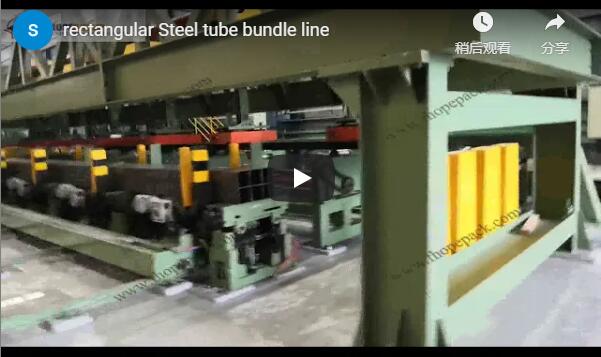
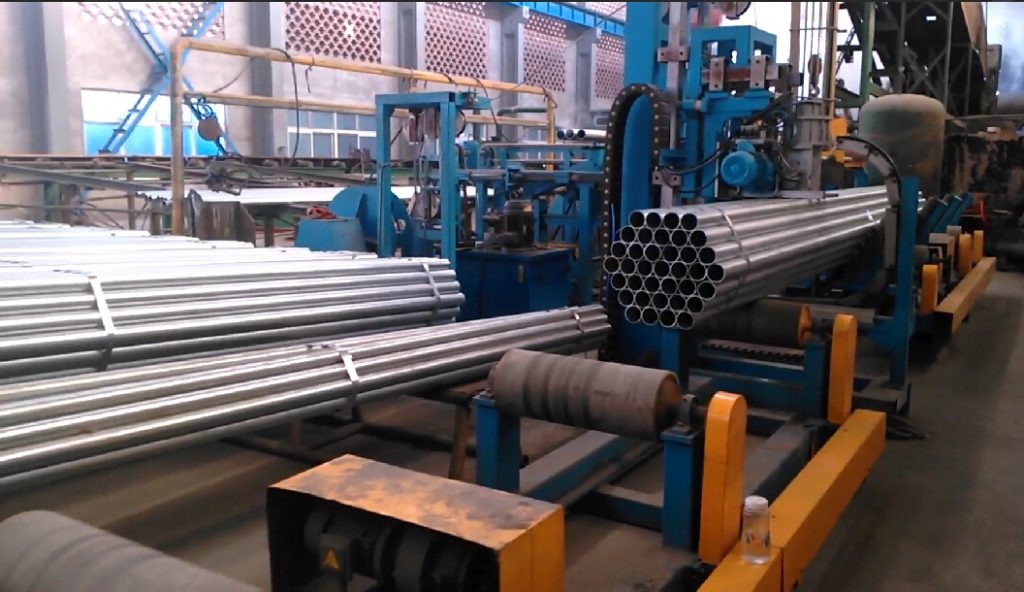
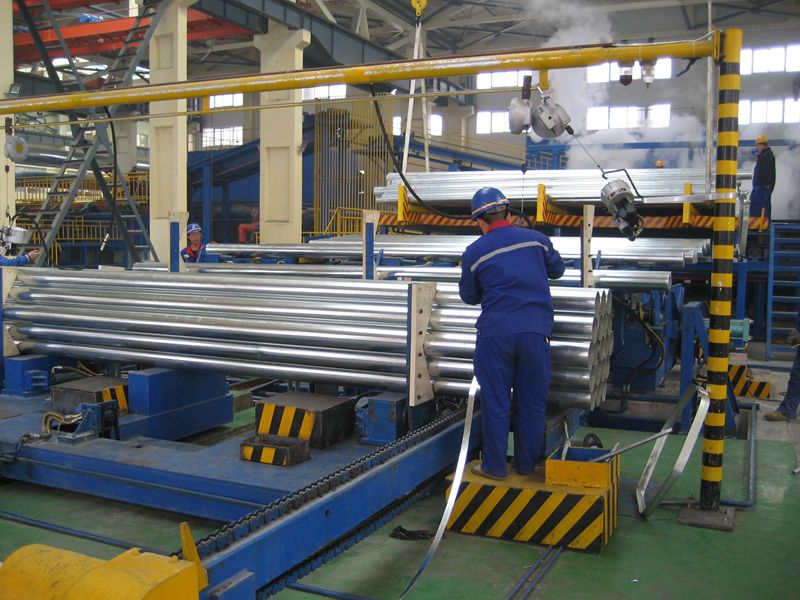
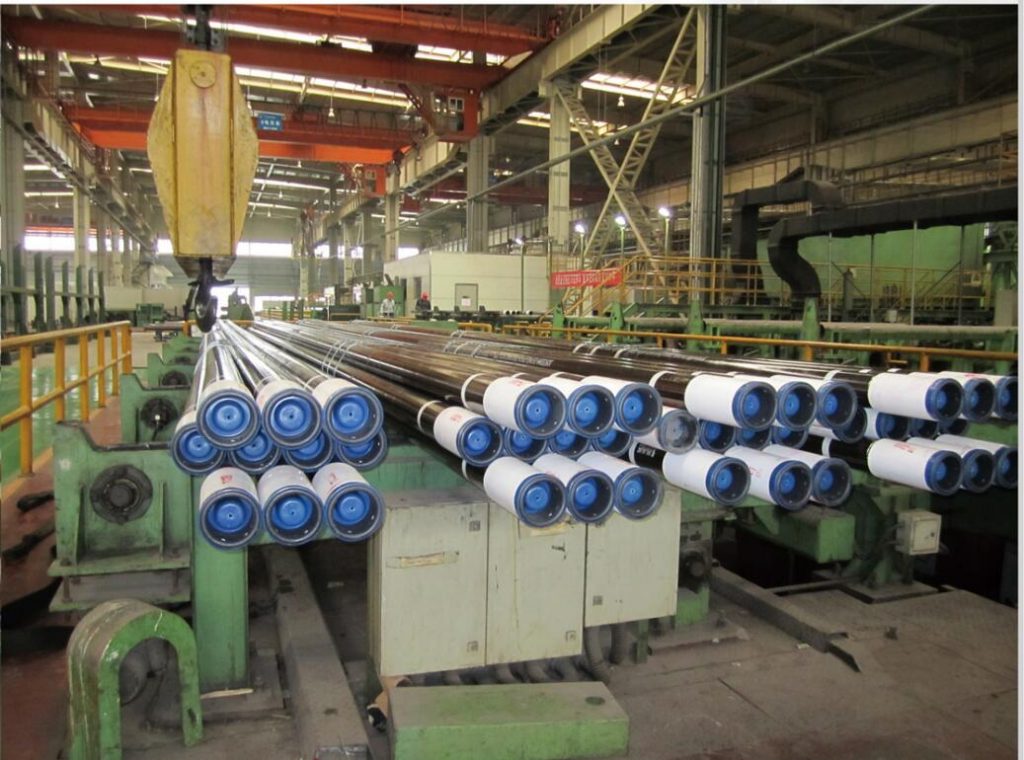
Executive summary: Manual stacking and alignment are where tube packing lines lose time and let bundles slip. This automated line replaces that: a flying saw cuts tubes from 6 m to 8 m, a disc stacking station builds the bundle layer by layer with end alignment keeping faces square, and a receiving cart indexes the finished pack into the strapper. The machine footprint is about 18 m by 7 m by 3.5 m, total installed power is about 28 kW, and control runs on a PLC with a touchscreen. The video shows the line live under hot commissioning on our shop floor.
Table of Contents
- What This Order Covers
- The Line in Five Steps
- Project Parameters
- Packing Pattern and Control
- Utilities and Installation
- Engineering FAQ
- Next Step
- Sources
- Related Reading
What This Order Covers
The line in this video is a real project under hot commissioning, built for a steel tube producer. It takes cut-length steel tubes and turns them into strapped, ready-to-ship bundles in one continuous flow.
The scope shown here covers the cut-off and stacking side of the line. The flying saw station cuts the tubes to length, a roller conveyor positions each tube onto a discharge rack, and a toothed chain transfers the tubes with counting into the stacking section. The discharge rack and the cut-off equipment are part of the line shown; the strapping machine itself is supplied by the customer and is integrated at the end of our stacking section.
The Line in Five Steps
The working cycle follows five steps:
- Cut to length. A flying saw cuts the steel tubes to the set length, from 6 m to 8 m, and positions them on the discharge rack.
- Count and feed. A toothed chain moves the tubes to the counting conveyor where the line counts them to the set programme.
- Stack with end alignment. A disc-type stacking machine lifts and shifts each batch into the stacking pocket. An end-alignment device squares every layer against the previous one, so the bundle faces stay even.
- Move to the strapper. Once the pack pattern is met, the whole bundle is placed on a receiving cart, which carries it out of the stacking pocket and indexes it into the automatic strapping machine.
- Store temporarily. The tied pack is stored temporarily, up to 3 packs, while the lift cart returns to the receiving position for the next bundle. This handover keeps the line running continuously.
Project Parameters
The parameters below are confirmed on this project and are configured per project in the engineering review:
| Parameter | Value | Meaning |
|---|---|---|
| Tube length | 6 to 8 m | cut length range on this line |
| Supply | 380 V, 50 Hz | electrical supply |
| Machine footprint | 18 m x 7 m x 3.5 m | length x width x height |
| Total installed power | about 28 kW | connected load |
| Air consumption | 1.5 m3/min | within 3 m of the strapping machine |
| Air receiver pressure | 0.6 kg/cm2 | with transient pressure drop below 10 percent |
Packing Pattern and Control
The stacking section places layers according to a pack pattern. The operator enters two numbers on the touchscreen: the number of tubes per layer and the number of layers per bundle. The line then builds the bundle automatically.
Control runs on a PLC with a touchscreen HMI. The HMI presents the packing menu for the operator; manual and automatic modes switch freely, so a single operator can set up the pattern and then run the line hands-free.
Utilities and Installation
The line needs a standard 380 V, 50 Hz supply and compressed air. Air consumption is 1.5 m3/min, measured within 3 m of the strapping machine. An air receiver is required at that point, set at 0.6 kg/cm2 with a transient pressure drop below 10 percent.
The installed footprint is about 18 m by 7 m by 3.5 m. The discharge rack and cut-off stations shown in this project are part of the demonstrated line; the strapping machine is customer supplied and connected to the stacking output. Utilities and guarding are confirmed at the engineering review.
Engineering FAQ
Q: Is the strapping machine included in this line? A: In this project the strapping machine is customer supplied. Our scope covers the flying saw positioning, counting, disc stacking with end alignment, and the receiving cart that transfers the finished pack to the strapper.
Q: What lengths of tube does this line take? A: This project runs cut lengths from 6 m to 8 m. Read the best range for your pipe at RFQ and confirm the longest cut at engineering review.
Q: How does the end alignment work? A: An end-alignment device squares each layer against the previous one during stacking, so bundle faces stay even for a clean strap line and a square bundle profile.
Q: What do we need to prepare on site? A: A 380 V, 50 Hz supply, compressed air at 1.5 m3/min within 3 m of the strapper with a 0.6 kg/cm2 receiver, and floor space for an 18 m by 7 m by 3.5 m line. Confirm the layout before installation.
Q: What should a buyer check on safety? A: The standards that apply depend on the destination market. For CE markets, ISO 12100 sets the risk-assessment method, and EN 415-10 covers the safety requirements of packaging machines. These two standards form the basis of the guarding and control scheme; confirm guarding, interlocks and lockout points with the builder.
Next Step
Selection checklist
To size a steel tube packing line for your plant, the next step is a short sequence:
- Submit your layout drawing.
- Receive a proposal within 48 hours.
- Book a site survey.
Write to info@fhopepack.com and our engineers will size the line to your tube.
Sources
- Project video (video ID u0J5wUTELok, FHOPE GROUP)
- This article is based on the real project technical scheme published with this video.
Last reviewed: 2026-10-11
Related Reading
- Automatic Steel Tube Packing Line
- Automatic Steel Tube Bundling and Strapping Solution
- Steel Pipe Bundling Line: Layering, Bundling and Strapping
- Steel Tube Bundle Packing Line: Conveying, Forming and Clamping
- Steel Pipe Bundling and Stacking Line
- Steel Tube Bundle Strapping with a Travelling Head
- PVC, PE and PPR Pipe Bundling and PP Strapping Line