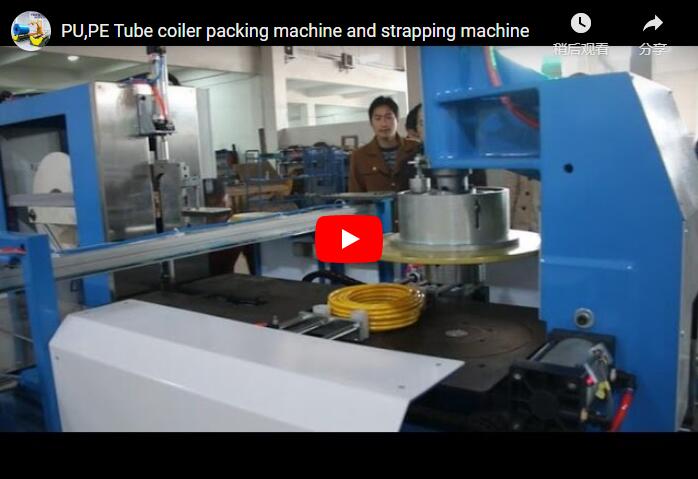
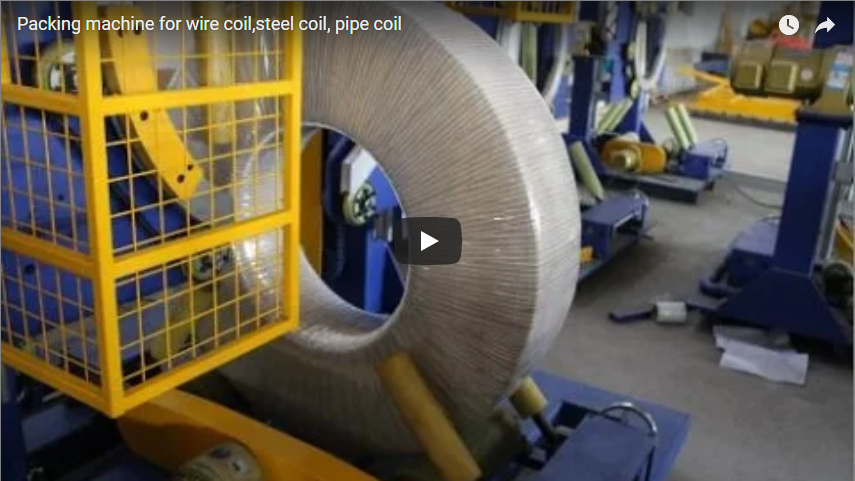
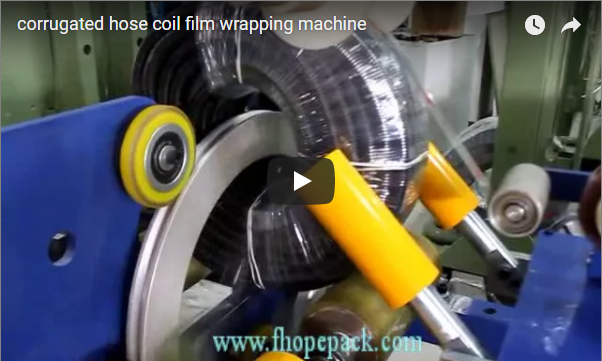
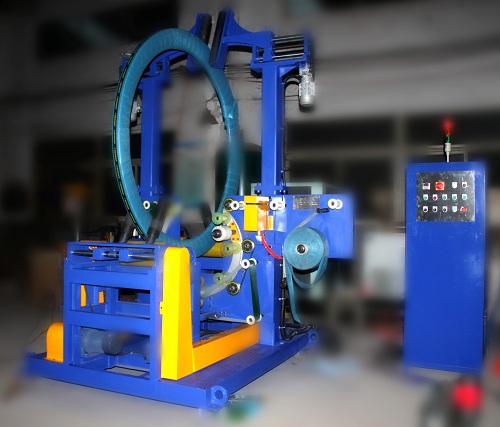
A full wrapping-through machine secures small coils by passing stretch film through the coil eye and around the outside on every turn, ensuring the entire coil is covered without the need for additional strapping. This method protects the coil during transport and storage while maintaining a clean appearance. The process relies on a ring wrapper that rotates around a coil placed on a powered roller table, allowing the film to penetrate the center and wrap the exterior simultaneously.
Overview
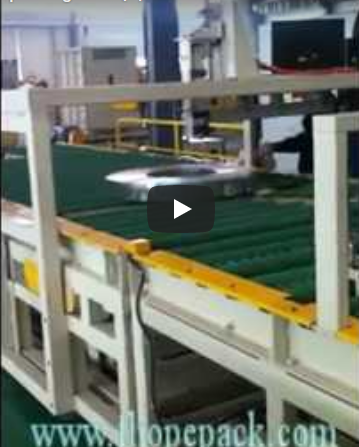
The following video demonstrates the eye-through wrapping process for small coils on a roller table.
How the Eye-Through Wrapping Process Works
The core mechanism involves a vertical ring that holds the film roll. As the ring rotates, it carries the film through the center of the coil (the eye) and back around the outside diameter. This continuous loop ensures that every turn of the ring deposits film both inside and outside the coil structure.
The coil rests flat on a powered roller table. While the ring performs the wrapping motion, the supporting rollers turn the coil slowly. This synchronized movement ensures that the film layers overlap correctly. The ring speed and roller speed are both controlled by converters, allowing operators to adjust the overlap percentage to meet specific stability requirements.
Four groups of adjustable arms secure the coil on the roller table. These arms set the coil size and center point, ensuring the coil remains stable during the wrapping cycle. The supporting rollers also help prevent the coil from shifting or shaking while the ring turns, which is critical for maintaining consistent film tension and coverage.
At the end of the wrapping cycle, the machine cuts and feeds the film. Automatic cutting and feeding is listed in the published FPCA-200 data; whether it is built in as standard or supplied as an option on a given machine is confirmed at project configuration. The entire process is controlled via a PLC and HMI, which stores recipes for different coil types, allowing for quick changeovers.
FPCA-200 Machine Specifications
The configuration on this page matches the FPCA-200 model. This model is designed for small to medium-sized coils, with specifications that must be confirmed against your specific product dimensions.
| Parameter | Published Value |
|---|---|
| Coil ID | 150–400 mm |
| Coil OD | 250–500 mm |
| Coil Width | 80–200 mm |
| Coil Weight | 2–50 kg |
| Ring Speed | 10–120 r/min |
| Wrapping Time | 20–30 s per coil |
| Overlap | 20–80% |
| Wrap Material | PE stretch film or PVC film |
| Power | 2.0 kW, AC 380 V 50 Hz or to order |
| Control | PLC and HMI with stored recipes; foot switch for manual mode |
The internal diameter (ID) and outer diameter (OD) are interdependent because the coil must have a wall thickness between them. The machine can be designed to accommodate specific coil sizes, but the combination of ID and OD must fall within the specified range. The coil weight capacity is up to 50 kg, which is suitable for many cable and wire applications.
The power requirement is 2.0 kW, typically operating on AC 380 V 50 Hz, but this can be adjusted based on local electrical standards. The control system includes a PLC and HMI with stored recipes, allowing operators to save settings for different coil types. A foot switch is provided for manual mode operation, giving operators flexibility during loading and unloading.
Calculating Production Capacity
Production capacity depends on the wrapping time and the time required for loading and unloading. The wrapping time for the FPCA-200 is typically 20–30 seconds per coil, but this is an illustrative range and must be confirmed for your specific coil type and film settings.
A worked example illustrates how capacity is calculated. If the wrapping time is 30 seconds and an operator takes approximately 10 seconds to unload and load the next coil, the total cycle time is 40 seconds. This results in a capacity of 90 coils per hour (3,600 seconds / 40 seconds).
If the wrapping time is reduced to 20 seconds, with the same 10-second loading/unloading time, the total cycle time is 30 seconds. This increases the capacity to 120 coils per hour (3,600 seconds / 30 seconds). These figures are illustrative and depend on operator speed, coil complexity, and machine configuration.
Selecting the Right Configuration
Choosing the correct machine configuration requires evaluating several factors. First, determine the coil dimensions, including ID, OD, and width. These dimensions must fall within the machine’s operational range. Second, consider the coil weight to ensure the roller table and arms can support it.
Third, decide on the film type. PE stretch film and PVC film are both supported, but the choice affects the wrapping tension and coverage. Fourth, estimate the required coils per hour. This determines whether one machine is sufficient or if multiple units are needed.
Finally, consider the loading method. Manual loading is common, but you may also link the machine to a coiler or rewinding line for continuous operation. The decision to use one or two machines depends on your throughput requirements and available floor space.
Safety and Compliance
Safety is a critical aspect of machine design. Operators must keep hands out of the ring while it is turning. In manual mode, the foot switch ensures that both hands remain clear of the moving parts. The ring soft-starts and soft-stops, reducing the risk of sudden movements and improving operator safety.
For markets requiring CE certification, the machine is designed according to ISO 12100, which provides a framework for risk assessment, and EN 415-10, which sets general requirements for packaging machinery. These standards guide the design process, but certification of the delivered machine is confirmed in the project ordering agreement. The machine is designed to meet these standards, but final compliance is verified during the project confirmation phase.
Engineering FAQ
What does full wrapping-through mean?
It means the film passes through the coil eye and around the outside on every turn, covering the entire coil.
Why does this process not need a strap?
The film enters the eye and returns round the outside on the same turn, so the wrap closes over the bore and the outer surface together and the coil is held as one unit without separate strapping.
Why must ID and OD be chosen as a pair?
The coil needs a wall between the two diameters, so the pair defines the load rather than either figure on its own. The machine can be built to your coil sizes, but the combination has to stay inside the 150–400 mm ID and 250–500 mm OD range.
What sets the overlap?
Ring speed and roller speed, both set by converters. The adjustable range is 20% to 80%.
How long does one coil take to wrap?
The published wrapping time is 20–30 seconds per coil. Your coil type and film settings decide where in that range the machine lands, so the figure is verified on a trial coil.
How many coils an hour?
In the worked example above, about 90–120 coils per hour with one operator loading and unloading. Those two numbers are arithmetic on an assumed 10-second handling time, not a quoted output.
PE or PVC?
Both are supported. The choice changes the wrapping tension and the coverage the same overlap delivers, so it belongs in the film decision, not after it.
Which safety standards apply?
For CE markets, the machine is designed to ISO 12100 and EN 415-10.
Next Step
To receive a real configuration for your production needs, please send the following data to the supplier:
- Coil Dimensions: Internal diameter, outer diameter, and width.
- Coil Weight: Maximum weight per coil.
- Film Type: Preferred film material (PE stretch or PVC).
- Throughput Requirement: Desired coils per hour.
- Loading Method: Manual loading or integration with a coiler/rewinder.
- Layout Drawing: If available, a layout of your production area.
We reply with a proposal after we confirm the details. This ensures that the machine configuration matches your specific requirements and production environment.