Executive summary A through-the-eye coil wrapper runs stretch film through the centre of a pipe coil and round its outside as the coil turns, so every face is covered. Our close-up clip, about 60 s long, follows a white PE-RT coil as film lays onto it, with a blue product tag and an operator’s hand guiding the coil. Our FPH-200 coil wrapper takes coils up to 900 mm OD and 50 kg, at 15 to 35 s per coil.
Table of Contents
- What the clip shows, in order
- Cycle time on the clip
- How through-the-eye coil wrapping works
- FPH-200 coil wrapper specifications
- Takt check
- Selection checklist for a PE pipe coil wrapper
- Controls and safety
- Engineering FAQ
- Next step
- Related reading
- Sources
What the clip shows, in order
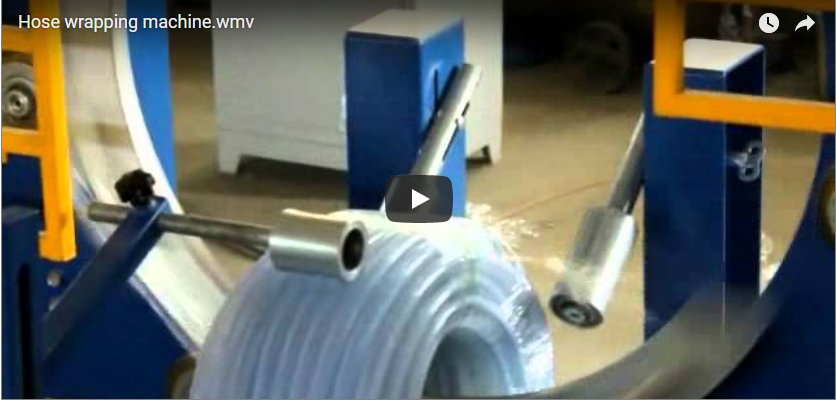
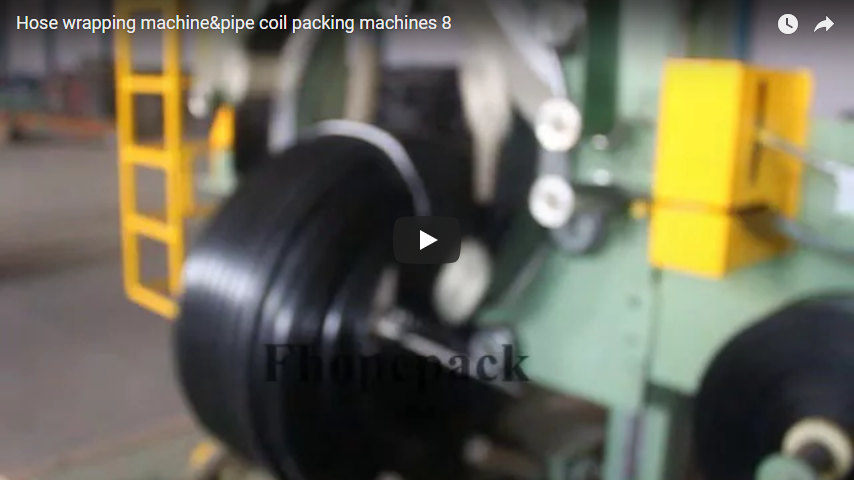
The clip is shot close up and upright from beside the machine, so it shows the coil, the film and the yellow frame rather than the whole wrapper.
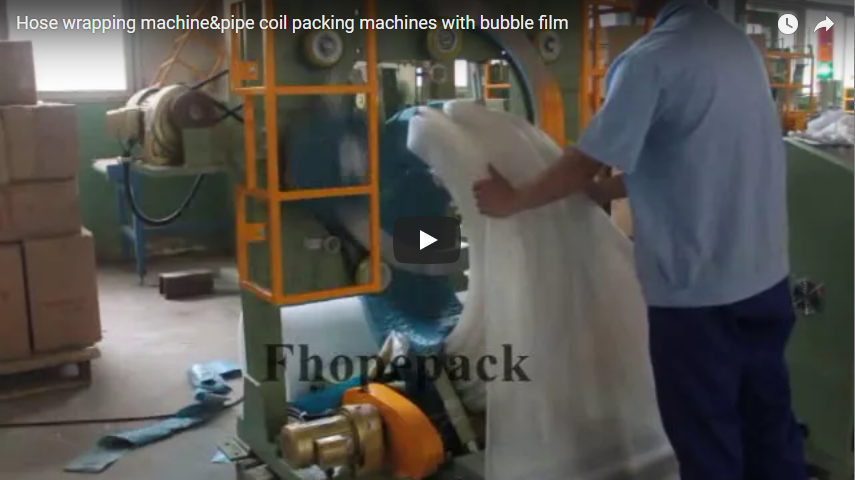
- 0 to about 4 s. The operator’s hands, in blue sleeves, guide a white PE-RT pipe coil into the yellow ring frame.
- About 7 to 19 s. A blue product tag passes with the coil, and film lays over the pipe turns as the coil moves past the ring.
- About 22 to 26 s. A hand rests on the coil to guide it while the wrap continues.
- About 30 to 45 s. Overlapping film covers the coil face, with the tag held under the film. The hand guides the coil again.
- About 52 to 56 s. The camera shows the film roll on its carriage, then a red indicator light on the side of the ring.
Cycle time on the clip
| Step on the clip | Time window | Duration |
|---|---|---|
| Coil guided in | 0 to about 4 s | about 4 s |
| Wrap with tag in place | about 7 to 45 s | about 38 s |
| Film roll and indicator | about 52 to 56 s | about 4 s |
The times come from frames about 3.7 s apart, and the camera moves during the wrap, so the windows are approximate. The wrap window runs longer than our quoted 15 to 35 s per coil, because the camera follows the coil while the operator guides it by hand.
How through-the-eye coil wrapping works
The coil stands on supportive guide rollers, and the wrapping ring passes through the coil eye. Each ring turn carries the film roll through the centre and around the outside, so the film covers the inner and outer turns and both faces in one pass.
The guide rollers turn the coil so the wrap moves round it. The overlap comes from the ring speed against the roller speed, both set by inverters, and can be set from 20% to 90%. A brake on the film roll sets the tension. Close overlap gives a sealed cover that keeps dust off the pipe in storage.
| Part | What it does |
|---|---|
| Wrapping ring | Carries the film through the coil eye |
| Film roll on the carriage | Feeds the film under brake tension |
| Supportive guide rollers | Hold and turn the coil |
| Inverters | Set ring and roller speeds |
| Alarm indicator | Shows the error when trouble occurs |
A product tag placed on the coil before the wrap sits under the film, so it stays readable and cannot fall off in transport.
FPH-200 coil wrapper specifications
| FPH-200 coil wrapper | Specification |
|---|---|
| Coil ID | 300 to 600 mm |
| Coil OD | 400 to 900 mm |
| Coil width | 50 to 200 mm |
| Coil weight | 5 to 50 kg |
| Ring speed | 20 to 90 r/min |
| Wrapping time | 15 to 35 s per coil |
| Overlap | 20% to 90% |
| Packing material | LLDPE, PE, stretch film or PVC |
| Power | 1.5 kW, 380 V, 50 Hz |
The machine runs in manual or automatic mode, and an original reset positioning system returns the ring to its start point after each wrap.
Takt check
For an illustrative PE-RT extrusion line that delivers one coil every 90 s, the takt is 90 s per coil. A wrap of 15 to 35 s leaves 55 to 75 s to load, tag and unload the coil.
That suits one operator at the wrapper. If the line makes a coil every 40 s, a 35 s wrap leaves only 5 s, so we lower the overlap or add conveyors.
Selection checklist for a PE pipe coil wrapper
- Coil ID and OD, against 300 to 600 mm and 400 to 900 mm.
- Coil width and weight, against 50 to 200 mm and 5 to 50 kg.
- Film type and overlap for storage.
- Tag or label placed before the wrap.
- Coils per hour, against 15 to 35 s per wrap.
Controls and safety
On the clip, the operator’s hand rests on the coil beside the yellow ring frame while the wrap runs. A hand on a turning coil next to the ring is the move to design out. We let the guide rollers hold the coil and keep the operator outside the ring frame once the wrap starts.
Stop, isolate and lock out the wrapper before anyone threads film, places a tag on a coil in the ring or frees a coil that has stuck. The alarm indicator shows a fault, and manual mode is for set-up only.
The standards that apply depend on the destination market. For CE markets, ISO 12100 sets the risk-assessment method, and EN 415-10 covers general requirements for packaging machines, which fixes guarding and the stop arrangement.
Engineering FAQ
Q: Why wrap PE pipe coils through the eye? A: The film covers the inner and outer turns and both faces, so the coil is sealed against dust.
Q: Can a product tag go under the film? A: Yes. On the clip a blue tag is placed on the coil and held under the film.
Q: What coils fit the FPH-200? A: Coils of 300 to 600 mm ID, 400 to 900 mm OD, 50 to 200 mm wide and 5 to 50 kg.
Next step
We size a PE pipe coil wrapping machine in three steps:
- Submit your layout drawing with the coil sizes, weights and line output, to info@fhopepack.com.
- Receive a proposal within 48 hours, with the wrapper model, the film plan and the cycle check.
- Book a site survey so we confirm the extrusion line, the tagging step and the guarded ring area.
Related reading
Sources
- Machine specifications: FPH-200 coil wrapper product page
- Clip timing: frame timings taken from our clip, about 3.7 s between frames
- Machine in action: our video on YouTube
- Standards scope: ISO 12100:2010, EN 415-10:2014
Last reviewed: 2026-10-05