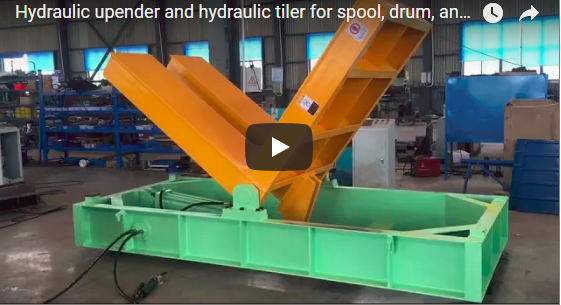
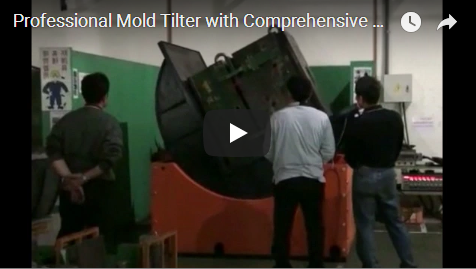
Executive summary Dies, moulds and other heavy blocks often have to be turned 90 degrees for maintenance, inspection or storage, and doing it with a crane and chains is slow and risky. Our die mould upender and tilter in this video takes the load on an orange tilting cradle on a green base and turns it toward vertical. Whether a load can be turned follows from its weight and centre of gravity. We check both per project.
Table of Contents
- What the video shows
- How the tilting cradle works
- Checking the load
- Where a die mould upender helps
- Controls and safety
- Selection checklist for a die mould upender
- Engineering FAQ
- Next step
- Related reading
- Sources
What the video shows
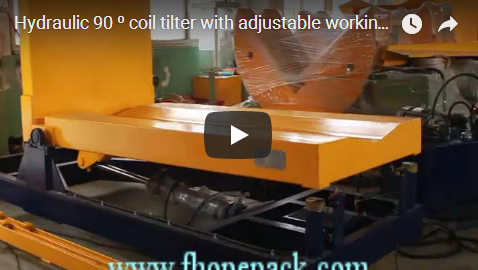
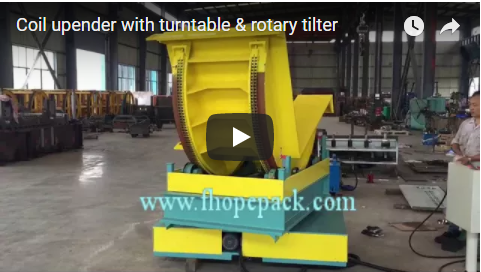
Our upender stands in the factory hall: a green base carrying an orange and red tilting cradle, with FHOPE GROUP branding on the machine. A large box-shaped load rests in the cradle.
The cradle is shown at different angles, tilted toward vertical, and later lowered flat and empty. A worker in blue coveralls stands in the background of the hall, away from the machine. The FHOPE GROUP logo also runs as an overlay on the clip.
How the tilting cradle works
| Step | What happens |
|---|---|
| Load | The load is set on the cradle |
| Secure | The load is held against the cradle faces |
| Tilt | The cradle turns the load toward vertical |
| Unload | The turned load is lifted off |
| Return | The cradle goes back to flat |
The load rests on two faces of the cradle during the turn, so it is supported all the way instead of hanging from a hook.
Checking the load
Illustrative example for a steel mould:
| Item | Value |
|---|---|
| Length × width × height (illustrative) | 1,200 × 800 × 600 mm |
| Volume, 1.2 × 0.8 × 0.6 | 0.576 m³ |
| Steel density | 7,850 kg/m³ |
| Weight if solid, 0.576 × 7,850 | about 4,522 kg |
A real mould with cavities weighs less. Send us the mould weight and drawing, and we check the cradle size and the centre of gravity.
Where a die mould upender helps
| Use | What the turn does |
|---|---|
| Mould maintenance | Presents the parting face for cleaning and repair |
| Die change | Turns the die to the press orientation |
| Inspection | Shows the underside without a crane flip |
| Storage | Stands moulds upright to save floor space |
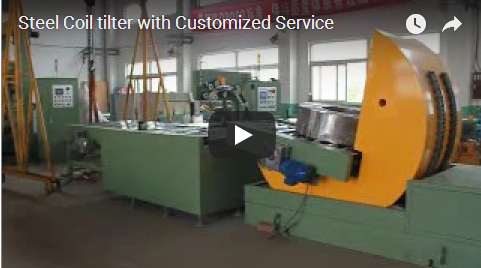
Turning on a cradle replaces crane flips, where the load swings and lands on its edge. For round loads, see our multipurpose automatic coil tilter with slide table and our large and long coil upenders.
Controls and safety
The cradle turns a heavy load. Keep people clear of the cradle and the load’s path while it tilts, and stand away from the machine as the worker in our video does.
The standards that apply depend on the destination market. For CE markets, ISO 12100 sets the risk-assessment method and EN 415-10 sets general requirements for packaging machines.
Selection checklist for a die mould upender
- Heaviest die or mould weight.
- Length, width and height of the largest load.
- Centre of gravity position.
- Turning angle needed.
- How the load arrives: crane or forklift.
- Floor space and power supply.
Engineering FAQ
Q: What does a die mould upender do? A: It turns a heavy die or mould toward vertical on a tilting cradle instead of a crane flip.
Q: How do you estimate the weight of a solid steel mould block? A: Volume times steel density: about 4,522 kg for 1,200 × 800 × 600 mm at 7,850 kg/m³ in our example; a mould with cavities weighs less.
Q: Why is a cradle safer than a crane flip? A: The load rests on two faces during the turn instead of swinging on a hook.
Q: What should I send for sizing? A: The heaviest mould weight, its drawing and centre of gravity.
Q: Does anyone stand at the machine during the tilt? A: No. Keep clear of the cradle and the load’s path.
Next step
We plan your die mould upender in three steps:
- Submit your layout drawing with mould weights, sizes and drawings to info@fhopepack.com.
- Receive a proposal within 48 hours, with the cradle size and load check.
- Book a site survey to check crane or forklift access and floor space.
Related reading
Sources
- Machine content: FHOPE engineering team, 2026-10-04
- Load example: our worked example, illustrative values; steel density 7,850 kg/m³
- Machine in action: our video on YouTube
- Standards scope: ISO 12100:2010, EN 415-10:2014
Last reviewed: 2026-10-04