Executive summary
Hose coils are heavy, they shift easily, and hand wrapping applies the film unevenly, so the load arrives loose and the film spend varies from roll to roll. This hose coil wrapping machine turns the coil on a rotating platform while a circular arm applies clear film in a spiral, giving every coil a repeatable, even wrap in one powered cycle. We build hose coil wrapping machines with a single-operator load and unload. Coil range and film setup are confirmed per project.
Table of Contents
- Why hand wrapping falls short
- What the machine does
- The wrap cycle
- One operator load and unload
- What the footage shows
- Typical configuration
- Selection checklist
- Operation and safety
- Engineering FAQ
- Next step
- Related reading
- Sources and standards
Why hand wrapping falls short
Hose coils are awkward to wrap by hand. They are heavy, they roll off the work surface, and a loose or uneven film layer lets dust and moisture in and lets the coil come apart in transit. Hand wrapping rarely applies film at a consistent tension, so some coils are over-wrapped and others are barely covered.
A machine that rotates the load while a wrapping arm applies film under tension removes that inconsistency. The wrap standard and film setup are confirmed per project.
What the machine does
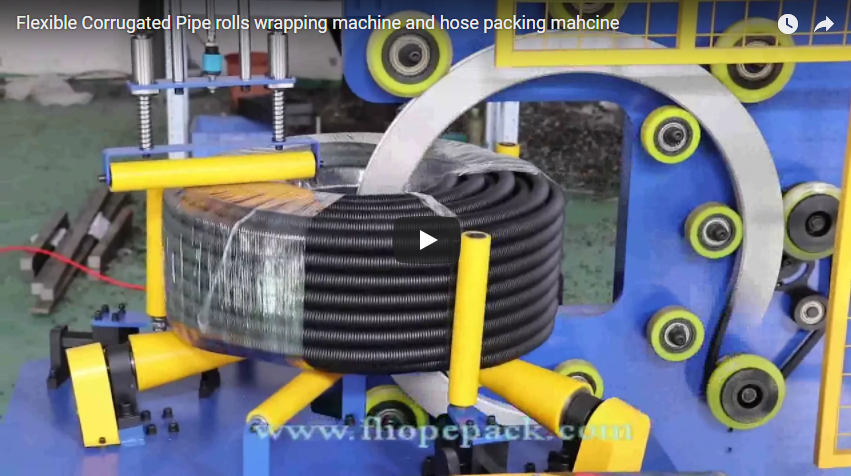
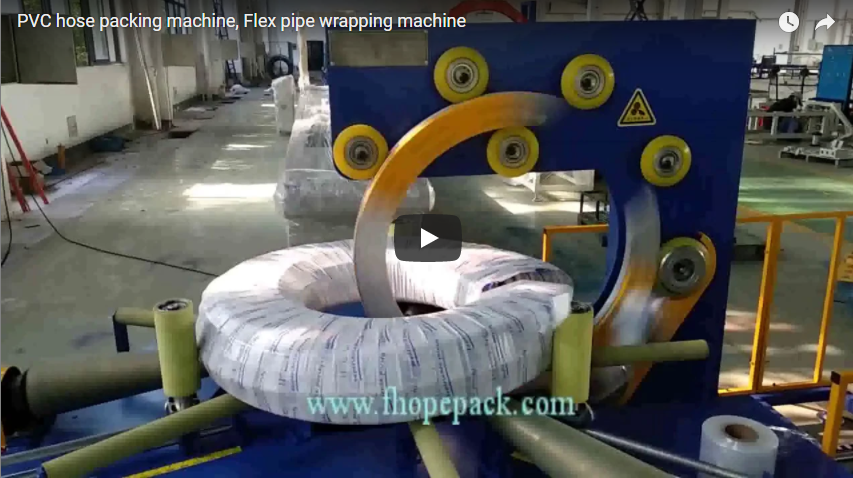
The machine wraps a single hose coil as a unit. The coil sits on a rotating platform, a large circular arm swings around the product, and a film roll on a holder feeds clear film through guide rollers onto the coil in a spiral.
The operator feeds the film at the start and removes the wrapped coil when the cycle stops. The wrap itself runs as a powered cycle, so tension and overlap stay the same from coil to coil. The coil size and its handling are confirmed per project.
The wrap cycle
The footage follows one complete cycle from feed to finished coil. The hose coil sits on the rotating platform, the arm swings around it, and the film applies in a continuous spiral as the coil turns. When the wrap completes, the arm returns to its resting position.
Because the load rotates against a moving arm, each pass overlaps the previous one and the film builds up layer by layer. The cycle steps are confirmed per project.
One operator load and unload
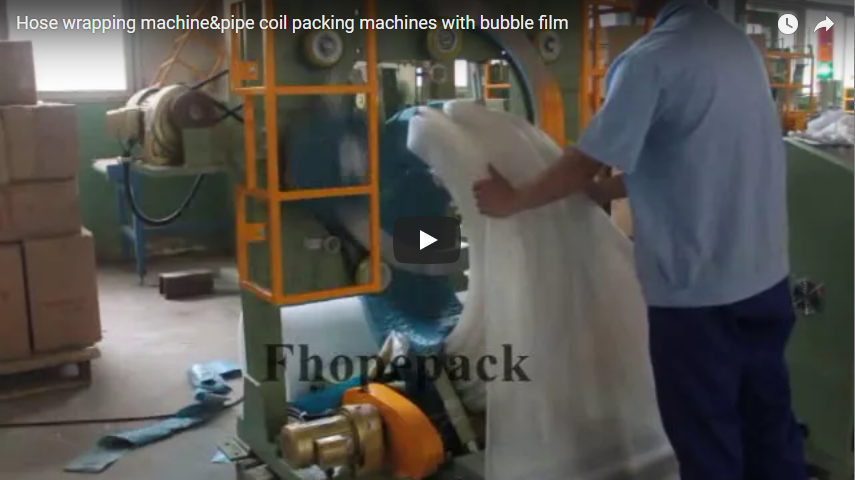
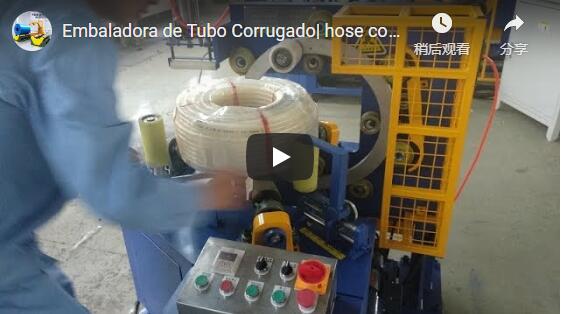
The clip shows a worker in a hard hat placing the coil and feeding the film, then inspecting the finished wrap when the cycle stops. The machine is designed so one person loads, starts and unloads, which is what makes it practical for hose and cable producers with steady but not high-volume output. The load stays within the operator’s reach and every other step runs mechanically. Operator access is confirmed per project.
What the footage shows
Our footage shows a hose coil wrapping machine applying clear film to a large silver-coloured coil of flexible hose, from feed to finished wrap. It is a general demonstration, so your coil range, film width and wrapping pattern are confirmed with us per project.
Typical configuration
Figures below list functional design boundaries rather than numeric values, and are confirmed per project.
| Parameter | Typical range, confirmed per project |
|---|---|
| Load | single hose coil, flexible or rigid |
| Turntable | rotating platform |
| Film | roll feed, spiral wrap under tension |
| Arm | circular wrapping arm |
| Loading | one operator, load and unload |
| Control | PLC |
Selection checklist
| Question | Confirm per project |
|---|---|
| Load range | coil diameter, width, weight |
| Turntable | platform size, capacity |
| Film | width, tension, wrap cycles |
| Arm | orbit clearance for the coil |
| Control | PLC options |
| Electrical supply | voltage, phase and frequency on site |
Operation and safety
Run the cycle from the panel and the platform rotates the coil while the arm applies the film. Keep clear of the platform, the arm and the film path while the machine runs, with guarding and emergency stops at the operator position. Do not reach toward the load while the arm is moving.
Routine checks cover the platform drive, the arm, film guides and control, per the machine manual. Confirm the film settings against the coil before each run so coils wrap evenly.
Engineering FAQ
Q: What does this machine do? A: It wraps a hose coil on a rotating platform with clear film applied in a spiral.
Q: Why wrap on a rotating platform? A: The coil turns so the film applies under tension in an even, overlapping layer.
Q: Is the machine automatic? A: The wrap cycle runs powered; loading, film feed and unloading are done by the operator.
Q: What does it suit? A: Coil-shaped products such as flexible hose, cable and similar rolled goods.
Q: What does the footage prove? A: A full load, wrap and unload cycle on a single hose coil in one continuous demonstration.
Next step
- Email us at info@fhopepack.com with your coil dimensions and weight.
- We send a wrapping machine proposal and a layout drawing within 48 hours.
- We arrange a site survey to confirm coil range and film requirements.
Related reading
- Hose coil wrapping machine
- Automatic pallet wrapping machine
- Stretch wrapping machines
- FHOPE packing machinery product lines
Sources and standards
- ISO 12100:2010 Safety of machinery, general principles for design and risk assessment
- EN 415-10:2014 Safety of packaging machines, general requirements
- EN ISO 13849-1:2023 Safety of machinery, safety-related parts of control systems
FHOPE hose coil wrapping machine demonstration video. Reviewed as a general demonstration; coil range and film setup confirmed per project.
Last reviewed: 2026-10-11