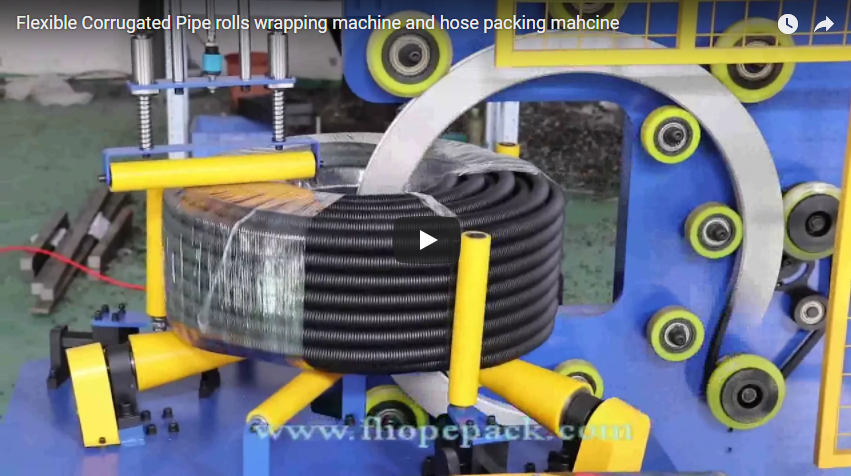
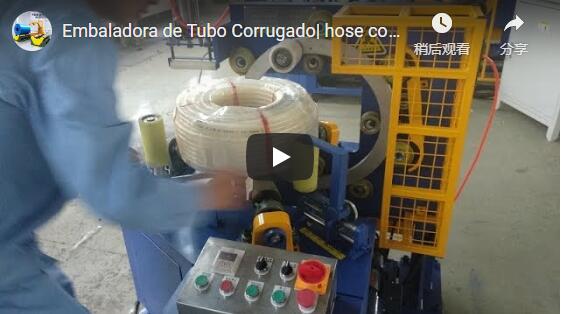
Executive summary Coiled PVC hose and flex pipe are heavy, awkward loads that spring loose when released, and hand wrapping leaves uneven coverage. Our PVC hose packing machine wraps a coiled hose in one automated pass. A rotating ring arm carries stretch film around the coil while the platform turns it, and a film cutting device at the arm finishes each cycle.
Table of Contents
- What the machine does
- How a hose coil is wrapped
- Coils it wraps
- Film feed and cutting
- Controls, safety and installation
- Selection checklist for a hose coil wrapper
- Engineering FAQ
- Next step
- Related reading
- Sources
What the machine does
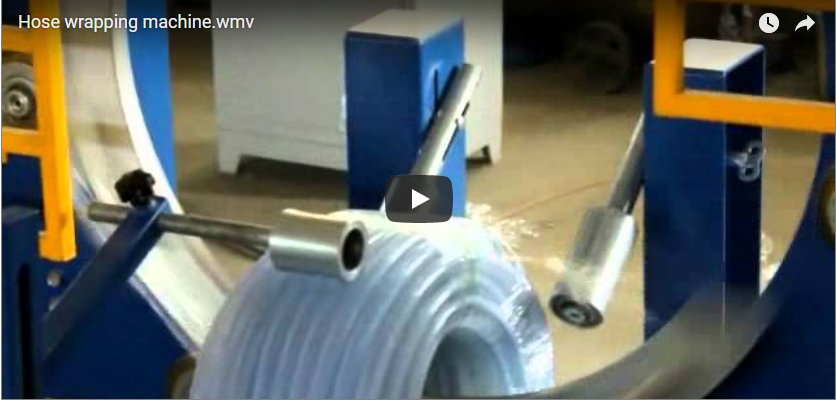
A PVC hose packing machine applies transparent stretch film to a coiled hose in a single automated pass. The coil sits on a rotating platform, and a ring-shaped arm above the work area carries the film around the coil while the platform turns it slowly. The result is an even, closed wrapping layer with no loose spots.
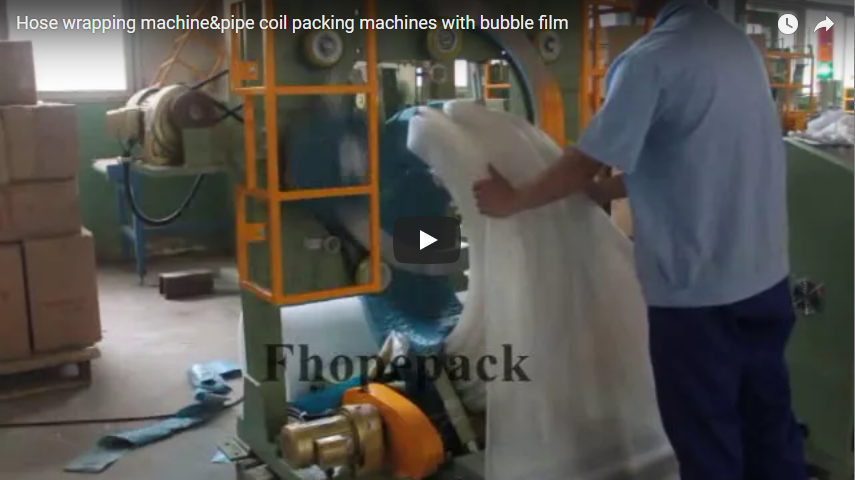
The machine uses a welded structural steel chassis anchored to a fixed base. The ring arm integrates tension rollers that guide and stabilise the film payout. A film cutting device sits at the ring arm, so the film is separated at the end of the cycle instead of being torn off by hand. In the same packing family, our hose winding and wrapping machine combines coil forming and wrapping in one unit.
How a hose coil is wrapped
- Load film. The operator feeds a roll of stretch film into the film feed point and the ring arm begins to rotate.
- Wrap. With the operator clear, the ring arm spins continuously, pulling film around the coil while the platform turns it.
- Cover. The coil becomes fully enclosed in a transparent, even layer, with no loose spots.
- Cut. The machine stops after the wrap, and the operator presses the film tail against the wrapped coil and cuts it with the film cutting device.
The ring arm and the platform work together, so the film spans the full width of the coil in a tight spiral and the finished wrap stays in place on the floor and in transit.
Coils it wraps
In our demonstration the workpiece is a large-diameter, low-height coil of silver-grey PVC hose that stays horizontal and rotates slowly on the platform. The wrap is transparent, so the hose and its internal strapping stay visible through the film.
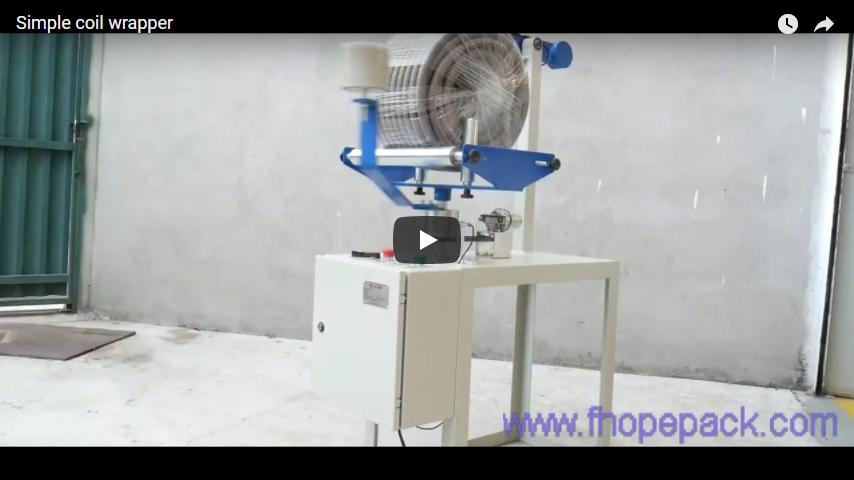
Similar cycle shapes are a typical fit: cable coils, flex-pipe and other hose coils with the same horizontal, low-height profile. Dedicated PERT pipe coil wrapping machine and HDPE pipe coil and hose wrapping machine cover those specific hose families. The coil envelope for your product is confirmed in the project scope, since the ring diameter must clear the largest coil you run.
Film feed and cutting
The film is fed from a roll at the feed point, guided and tensioned by the rollers on the ring arm as it travels around the coil. The film cutting device at the ring arm separates the tail at the end of the cycle, so the wrap ends cleanly instead of trailing.
Film type, width and overlap are set on the control for your coil sizes, so the same machine wraps different hose dimensions with the layer count and tension you select.
Controls, safety and installation
The machine runs on a PLC control. Ring speed, platform speed and the wrap pattern are set from the operator panel, with presets for your coil sizes. The guarding around the rotating parts and the warning labels on the frame mark the machine’s operating zones.
The safety design follows the destination market’s standards:
| Scope | Standard |
|---|---|
| Risk assessment for CE markets | ISO 12100 |
| General requirements for packaging machines | EN 415-10 |
| Safety-related parts of control systems | EN ISO 13849-1 |
| Guards and fixed safeguards | EN ISO 14120 |
Selection checklist for a hose coil wrapper
- Coil envelope: minimum and maximum coil diameter, height and weight.
- Throughput: coils per hour and the rated cycle time.
- Film: type, width, thickness and overlap for your hose.
- Ring and platform: ring speed, platform speed and wrap pattern settings.
- Controls: the operating interface, presets and parameter setup.
- Safety package: guarding, emergency stop and certifications.
Engineering FAQ
Q: How do the ring and platform drives work together? A: The ring arm carries the film around the coil while the platform turns the coil slowly; both speeds are set on the control so the film spans the coil face evenly.
Q: How does the film finish at the end of the cycle? A: The machine stops after the wrap and the operator presses the film tail against the coil and cuts it with the film cutting device at the ring arm.
Q: How much operator input does the cycle need? A: The operator loads the film at the start and presses and cuts the tail at the end; the wrapping itself runs automatically.
Q: What cable and hose shapes fit this wrapper? A: Horizontal, low-height coils, including PVC hose, cable and flex-pipe coils, within the coil envelope confirmed for your product.
Q: How is the wrap tensioned? A: The tension rollers on the ring arm guide the film as it travels around the coil, with tension and layer count set on the control.
Q: Why is the platform included if the ring already rotates? A: The platform turns the coil slowly while the ring spans the full width, so the film covers the coil face evenly instead of only the edges.
Q: What safety standards apply? A: For CE markets the design follows ISO 12100, EN 415-10, EN ISO 13849-1 and EN ISO 14120.
Next step
We size the hose coil wrapper to your line in three steps:
- Submit your layout drawing with coil sizes, output and film to info@fhopepack.com.
- Receive a proposal within 48 hours, with the coil envelope, wrap pattern and cycle time.
- Book a site survey to confirm ring diameter, platform size and film feed on your floor.
Related reading
- Orbital Stretch Wrapper
- Hose Packaging Machine
- Video: coil packing machine: ring wrapping through the coil eye
- Video: horizontal orbital stretch wrapper for pallet loads
- Video: automatic steel coil packaging lines
Sources
- Machine in action: our PVC hose packing machine video on YouTube
- Machine family: hose packaging machine, orbital stretch wrapper
- Standards scope: ISO 12100:2010, EN 415-10:2014, EN ISO 13849-1, EN ISO 14120
Last reviewed: 2026-10-09