Executive summary Steel plates leave cutting lines one after another, and banding them by hand at the line end is slow and risky. Our strapping machine bands plates on a roller conveyor: a gantry head comes down, presses the plate, runs a band round it and moves to the next position as the plates feed through. Strap per bundle follows from the bundle size and the number of bands. We set both per project.
Table of Contents
- Strapping cycle on the roller line
- How plate strapping works on the line
- Strap use per plate bundle
- What we set per plate size
- Controls and safety
- Selection checklist for a steel plate strapping machine
- Engineering FAQ
- Next step
- Related reading
- Sources
Strapping cycle on the roller line
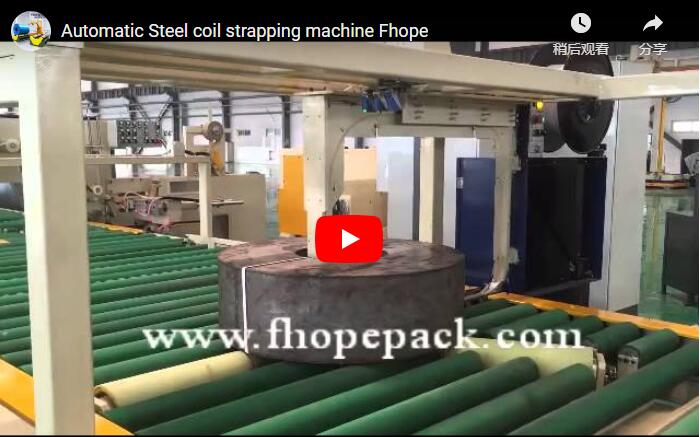
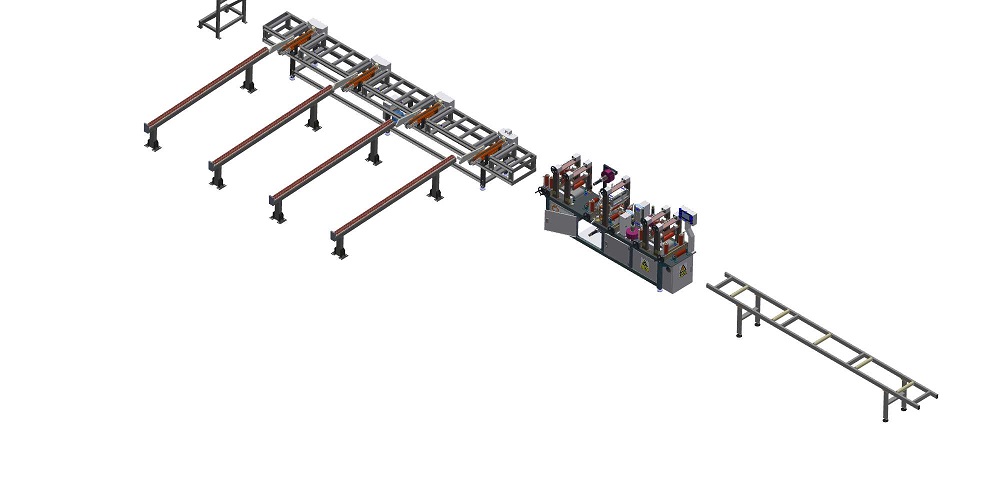
The automatic strapping system operates directly over an inline powered roller conveyor. Incoming steel plates or stacked plate bundles advance along the roller bed until they reach the designated banding station beneath the rigid gantry framework.
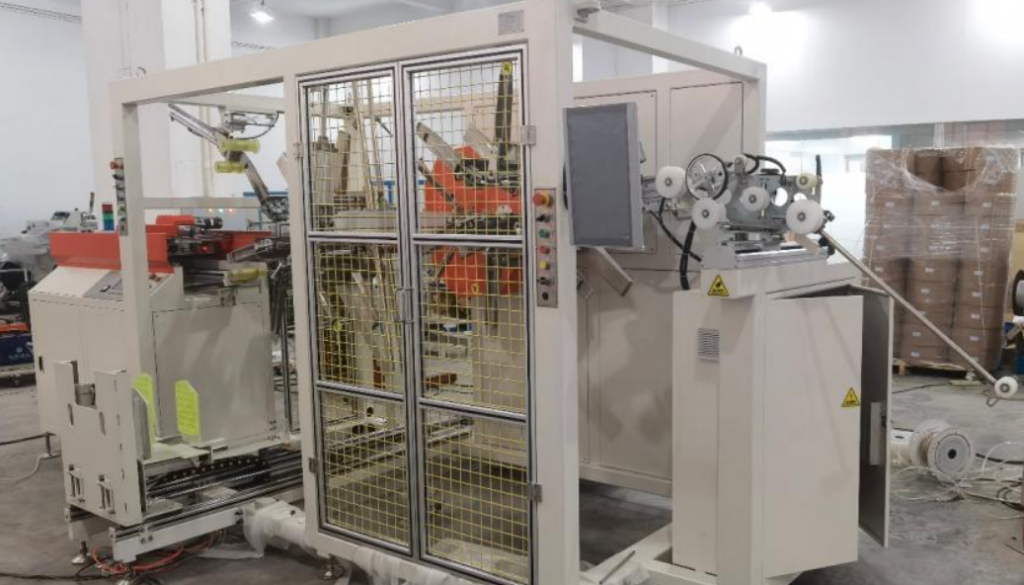
Once positioned, the overhead gantry head descends under controlled power to clamp and flatten the plate stack against the rollers. The strapping arch guides the high-tensile strap completely around the bundle profile. The strapping head feeds the strap, tensions it securely, forms the joint seal, and shears off excess material. Plates feed through continuously; each bundle is clamped beneath the gantry head while each band is applied, and then indexes forward to receive subsequent straps across its length. Heavy-duty industrial strapping heads in this equipment family utilize high-tensile steel strapping (typically 32 mm width, 0.8–1.1 mm thickness) and apply tension ratings between 4000~20000 N, operating with feed speeds around 1.5 m/s and take-up speeds around 105 mm/s under integrated PLC automation [manufacturer rating].
How plate strapping works on the line
| Step | What happens |
|---|---|
| Feed | The plate or bundle runs in on the rollers |
| Press | The gantry head comes down on it |
| Band | A band runs round and is tightened |
| Index | The head or plate moves to the next band position |
| Outfeed | The banded plate moves on |
Pressing before banding holds the plates flat, so the band sits tight when the head lifts.
Heavy-duty strapping installations in this machine class utilize expanding and shrinking strap track arches to clear diverse bundle cross-sections smoothly while maintaining high indexing speeds and positive strap containment throughout the feed-and-tension cycle [manufacturer rating].
Strap use per plate bundle
Illustrative example:
| Item | Value |
|---|---|
| Plate width (illustrative) | 800 mm |
| Bundle height (illustrative) | 200 mm |
| Band length, 2 × (800 + 200) | 2,000 mm |
| Bands per bundle (illustrative) | 3 |
| Strap per bundle, 3 × 2 m | 6 m |
Add the seal overlap to each band when you order strap.
What we set per plate size
| Setting | Why it matters |
|---|---|
| Band positions | Spaced along the plate length |
| Press force | Holds the bundle flat |
| Band tension | Tight without cutting into edges |
| Edge protectors | Shields band and plate edge |
We set these on trial with your plate sizes and keep them as recipes. Depending on your material cross-section, strap dimensions (such as standard 31.75 ± 0.127 mm × 0.8 mm high-tensile steel bands), tension thresholds, and pneumatic feed/tension profiles are configured within the PLC recipe matrix for continuous automatic line interlocking [manufacturer rating]. For heavy coils covered in steel sheet, see our roller station for big coil packing.
Controls and safety
The head comes down with force and plates move on powered rollers. Keep people outside the guard rails while the line runs, and approach only with it stopped and isolated.
The standards that apply depend on the destination market. For CE markets, ISO 12100 sets the risk-assessment method and EN 415-10 sets general requirements for packaging machines.
Selection checklist for a steel plate strapping machine
- Plate length, width and thickness.
- Bundle height and weight.
- Bands per bundle.
- Strap type and width.
- Bundles per hour.
- Roller line height and layout.
Engineering FAQ
Q: Why press the plate before banding? A: So the bundle lies flat and the band stays tight.
Q: How much strap does a bundle take? A: About 6 m for three bands on an 800 mm wide, 200 mm high bundle in our example.
Q: Does the line stop for each plate? A: Each plate is held under the head while a band goes on, then moves to the next band position.
Q: What sets the strap per bundle? A: Twice the bundle width plus height, times the bands, plus the seal overlap.
Q: Can edge protectors be added? A: Yes. We add them where bands cross sharp plate edges.
Q: Is the line guarded? A: Yes. Perimeter guard rails surround the strapping area.
Next step
We plan your steel plate strapping machine in three steps:
- Submit your layout drawing with plate sizes, bundles and output to info@fhopepack.com.
- Receive a proposal within 48 hours, with the band layout and strap plan.
- Book a site survey to check the roller line layout.
Related reading
- Automatic strapping machines
- Video: automatic steel tube bundle strapping machine
- Video: steel sheet inverter and 180-degree upender
Sources
- Machine content: FHOPE engineering team, 2026-10-04
- Heavy-duty strapping head specifications: Automatic Steel Pipe Bundle Strapping Machine
- Strap example: our worked example, illustrative values
- Standards scope: ISO 12100:2010, EN 415-10:2014
Last reviewed: 2026-10-04
Last updated: 2026-10-29