title: Automatic Board and Profile Stacking Machine on the Production Line seo_title: “A Board and Profile Stacking Machine for Production Lines” seo_desc: “An automatic board and profile stacking machine, sized up to 300 mm high x 450 mm wide x 6500 mm long, keeps conveyor-fed lines moving neatly and consistently.”
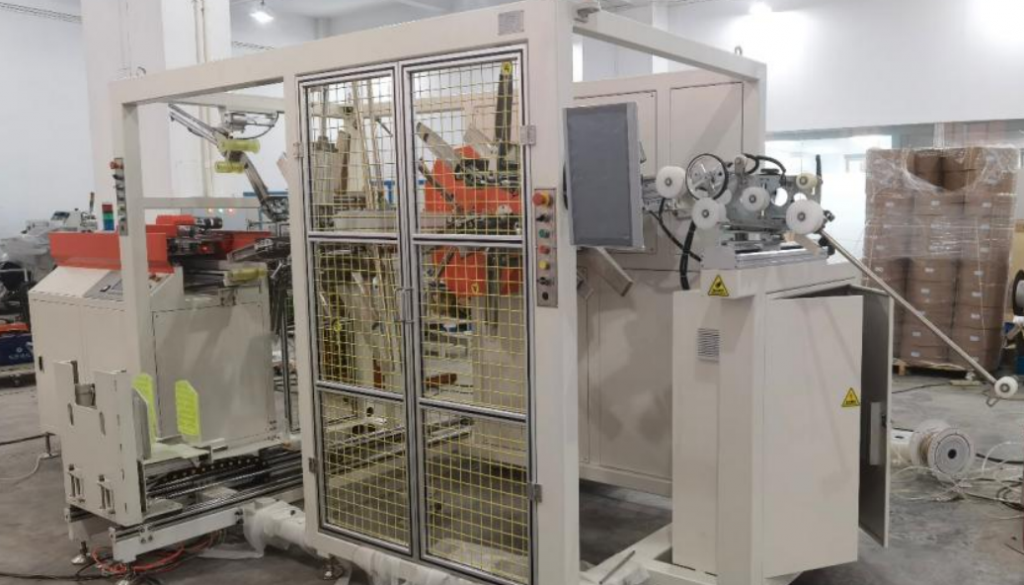
Executive summary — The automatic stacking machine for board and profile receives boards on the infeed, squares and counts each layer, and sets stable stacks on the outfeed of an automated line. Our machine is specified for board and profile sizes from 70 mm high x 450 mm wide x 5650 mm long to 300 mm high x 450 mm wide x 6500 mm long. Air supply and working length are matched to the site during layout, configured per project.
Long boards and profiles spend a large share of the working day waiting to be measured, carried and piled. An automatic stacking machine turns that waiting into a steady flow: boards arrive on a conveyor, are counted and squared, then set down in stable stacks ready for the next stage of the line. The result is a stack that looks the same at the end of the shift as it did at the start of it.
Table of Contents
- What the Clip Shows
- Machine Scope and Specifications
- How the Stacking Line Works
- Controls and Safety
- Why Automate Board Stacking
- Selection Checklist
- engineering-faq
- Next Step
- Related Reading
- Sources
What the Clip Shows
In the clip, a flat, light-coloured board is carried along a conveyor inside an automated production line. Mid-clip the view moves to a white control cabinet at floor level, closed off from the walkway by a red rope barrier. The emphasis is on orderly, continuous movement: boards feed into the line one after another and keep travelling until they reach the stacking station at the outfeed. In the closing frames, the board approaches the stacking zone and the surrounding conveyor sections keep the flow towards the station.
Machine Scope and Specifications
The automatic stacking machine for board and profile is built around the dimensions of your product. Our machine is specified for finished stack cross-sections from 70 mm high x 450 mm wide x 5650 mm long to 300 mm high x 450 mm wide x 6500 mm long. The height refers to a finished stack or layer cross-section, not to the thickness of a single board. The range is configured per project.
| Parameter | Specification |
|---|---|
| Minimum finished stack size | 70 mm high x 450 mm wide x 5650 mm long |
| Maximum finished stack size | 300 mm high x 450 mm wide x 6500 mm long |
| Standard working lengths | 5650 / 6000 / 6500 mm |
| Air supply | 6 to 8 bar |
| Electrical supply | 380 V, 3-phase, 50 Hz as standard; voltage / phase / frequency customized to local mains per project |
The working section is chosen from three standard lengths so the machine suits the space on site, and air supply is confirmed during engineering. This station can be integrated into a full aluminum profile packing line for end-to-end handling. Every machine is customised for the project, so exact values are confirmed in the proposal.
How the Stacking Line Works
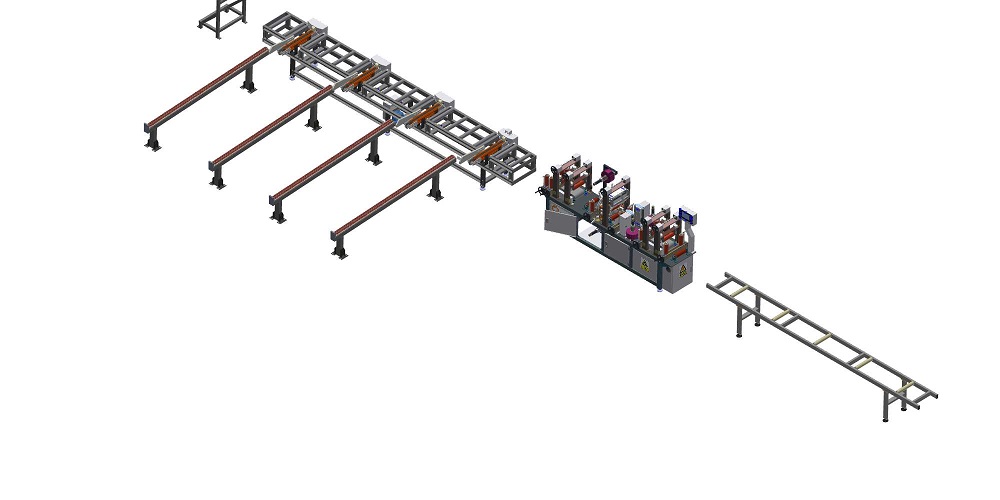
Boards leave the saw or sizing station and travel on the infeed conveyor to the stacking station. The machine squares each board against a reference edge, adds it to the layer, and sets the stack down once the layer is complete. The finished stack moves to the outfeed, ready for further handling or packaging. The transfer mechanism is selected per project, matched to the product and the surrounding line.
The pacing of the stacker follows the pace of the line. The cycle time is calculated from your target output during the layout and proposal stage, so the machine is sequenced to match the stations around it. Once your line rate is set, the proposal confirms the interval and the stacker capacity in plain numbers.
Controls and Safety
In the clip, the red rope in front of the control cabinet is a temporary floor demarcation used during testing, not a safety guard. Production safeguarding is engineered into the machine: our machines are designed with perimeter guarding and a documented risk assessment per the applicable standards. The standards that apply depend on the destination market: for CE markets, ISO 12100 sets the risk-assessment method and EN 415-10 covers the general safety requirements of packaging machines.
Operators should stay clear of the stacking zone while the machine is moving. Before any work at the load — straightening a misaligned board or clearing a jam — stop the line and isolate and lock out the energy source. Confirm the drive is at rest before entering the stacking zone. Never reach into the stacking area while the conveyor is running.
Why Automate Board Stacking
An automatic stacker takes over the most repetitive part of the line — counting, squaring and piling boards — and hands it to a machine that repeats the action consistently. Manual handling is reduced, stacks come out neater, and the next station is fed at a steady rate. Because every machine is customised to the project, the stacker is sized, sequenced and ruggedised for the specific product and site conditions.
Selection checklist for a board stacking line
When planning the stacker, a short checklist keeps the layout stage quick:
- Confirm board and profile dimensions.
- Note the site air supply and available space.
- Define the target line rate.
- Share your layout drawing for the proposal.
engineering-faq
Q: What board and profile sizes can the machine handle? A: The stacker is built around your product envelope: finished stacks from 70 mm high x 450 mm wide x 5650 mm long up to 300 mm high x 450 mm wide x 6500 mm long. That range is set per project, so if your product sits outside it, tell us during layout and we will advise on the closest configuration.
Q: What working lengths are available? A: Three standard working lengths are offered: 5650 mm, 6000 mm and 6500 mm. The right length is chosen from your product dimensions and the space available on site.
Q: What services does the station need at site? A: The station is driven pneumatically and is specified for an air supply of 6 to 8 bar. Mains supply is 380 V three-phase 50 Hz as standard; we configure voltage, phase and frequency to your local mains per project. Compressed-air feed at the stated pressure is the main utility beyond mains power; exact consumption is confirmed at the engineering stage.
Q: Can the stacker be added to an existing line? A: Yes. The machine is built for a conveyor-fed line: boards arrive on the infeed, are counted and squared, and are set down in stacks at the outfeed, so it can be sequenced between your existing stations.
Q: How is the stacking cycle time decided? A: The cycle follows your target line rate. The interval is calculated during layout and proposal so the stacker is sequenced to fit the stations around it, and the number is confirmed in writing before build.
Next Step
- Submit your layout drawing.
- Receive a proposal within 48 hours.
- Book a site survey.
Contact us at info@fhopepack.com.
Related reading
- Automatic Aluminum Profile Packaging Line for Paper Packing and Stacking
- Automatic Aluminum Stacker for Profile Lines
- Slit Coil Packing Line for Service Centers: Strapping, Eye-Through Wrapping and Stacking
- Automatic Copper Strip Coil Packing Line with Labeling, Wrapping and Stacking
- Buyer’s Guide: Integrating Stretch Wrapping and Downender Stacking for Heavy Steel Coils
- Steel Sheet Packing Line for Cut-to-Length Plates
Sources
- Product reference: Aluminum profile packing line for timber — https://www.fhopepack.com/Aluminum/Aluminum-profile-packing-line-timber.html
- Video: Automatic stacking machine for board and profile — https://www.fhopepack.com/videos/automatic-stacking-machine-for-board-and-profile/
- Sibling videos:
- Automatic Aluminum Profile Packaging Line for Paper Packing and Stacking — https://www.fhopepack.com/videos/automatic-aluminum-profile-packaging-line-for-paper-packing-and-stacking/
- Automatic Aluminum Stacker for Profile Lines — https://www.fhopepack.com/videos/automatic-aluminum-stacker/
Last reviewed: 2026-10-07