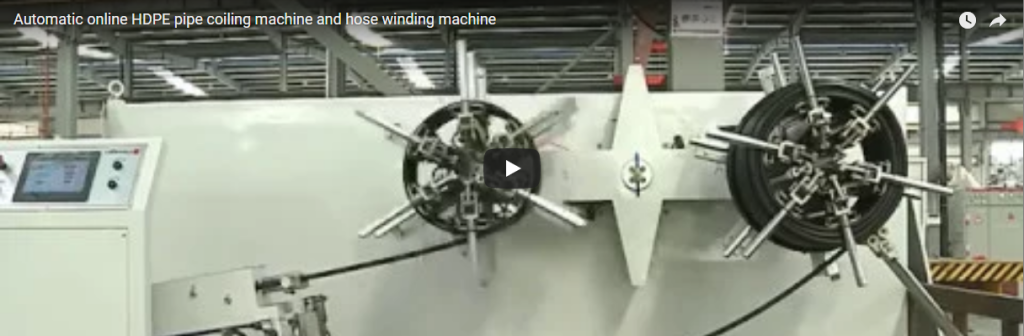
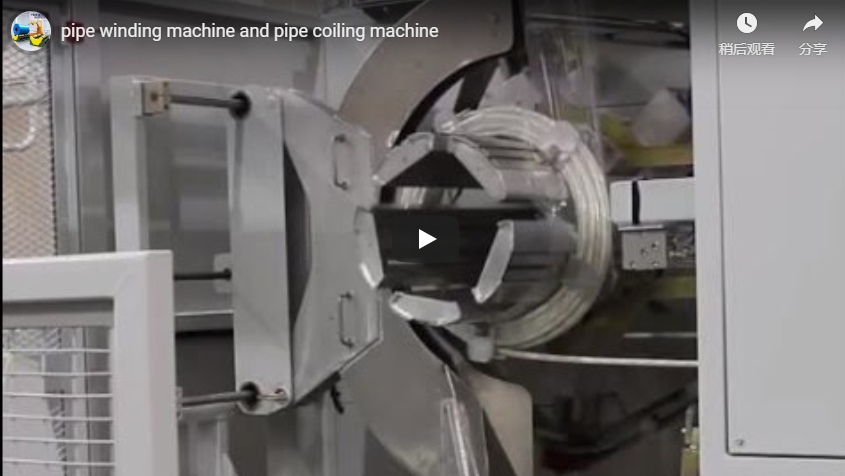
Executive summary An automatic plastic pipe coiler takes pipe straight from the extrusion line, winds it into a coil of set length, cuts it and straps the coil. Our clip, about 30 s long, shows a yellow pipe running across the hall into a white coiler with guard doors, and a finished yellow coil. Our FCL-Y1200 coils at up to 70 m/min and applies 4 or 6 straps at 14 to 19 s per strap.
Table of Contents
- What the clip shows, in order
- Cycle time on the clip
- How the pipe coiler works
- FCL-Y1200 pipe coiler specifications
- Takt check
- Selection checklist for a pipe coiler
- Controls and safety
- Engineering FAQ
- Next step
- Related reading
- Sources
What the clip shows, in order
The coiler has a white main frame with red top parts and an enclosed winding area behind clear doors with mesh panels. A control column with a screen stands at one side, and a signal tower sits on top. Yellow and white lines mark the floor.
- 0 to about 4 s. A wide view shows the coiler. A finished coil of bright yellow pipe lies on a black pallet in front of it.
- About 6 to 8 s. The camera moves to the right side of the coiler, past the guarded winding area. The signal tower changes from red to green.
- About 10 s. A close view of the control screen shows the running values.
- About 12 to 16 s. The camera pans across the hall. The yellow pipe runs along the red floor from the line to the coiler, and workers stand beside the pipe path.
- About 18 to 24 s. The pipe runs straight into the infeed of the coiler and moves on its guide rollers. The guard doors stay closed and the tower light stays green.
- About 26 to 30 s. Through the doors, orange and yellow parts move inside the winding area, and the camera passes the side of the machine.
Cycle time on the clip
| Step on the clip | Time window | Duration |
|---|---|---|
| Overview with a finished coil | 0 to about 4 s | about 4 s |
| Pipe path from the line | about 12 to 16 s | about 4 s |
| Pipe into the infeed | about 18 to 24 s | about 6 s |
| Winding area in motion | about 26 to 30 s | about 4 s |
The times come from frames 2 s apart, and the camera moves through the hall. They show where the pipe goes, not a full coil cycle.
How the pipe coiler works
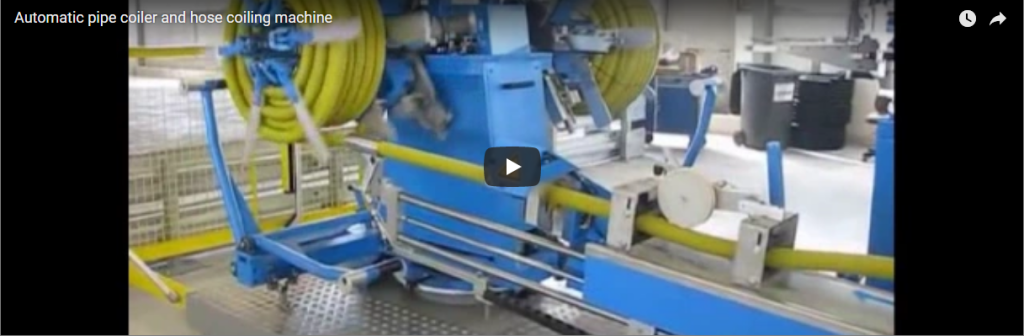
The pipe comes in online from the extruder and haul-off. It passes a tensioner and a length counter, and then goes to the coiling station. There the coiler lays the pipe in layers and builds a uniform coil.
When the counter reaches the set length, the machine cuts the pipe. It holds the coil, turns it through 180 degrees and straps it through the eye with 4 or 6 straps. The strapped coil is pushed out, and the coiler turns back 180 degrees to start the next coil.
| Step | What happens |
|---|---|
| Online infeed | Pipe arrives straight from the extrusion line |
| Tensioner and counter | Keep the pipe tight and measure the length |
| Layer and coil making | Wind the pipe in even layers |
| Cutting | Cuts the pipe at the set length |
| Turn 180 degrees | Presents the coil to the strapper |
| Eye-through strapping | Applies 4 or 6 PP straps |
| Push-out | Moves the strapped coil off the machine |
We note that one person can handle the coils of 5 to 10 extruders with this coiler, against more people with semi-automatic coilers.
FCL-Y1200 pipe coiler specifications
| FCL-Y1200 | Specification |
|---|---|
| Pipe OD | 16 to 32 mm |
| Coil ID | 400 to 540 mm |
| Coil OD | 650 to 1,150 mm |
| Coil width | 200 to 320 mm |
| Coil weight | 10 to 40 kg |
| Coiling speed | up to 70 m/min |
| Straps per coil | 4 or 6 |
| Strapping time | 14 to 19 s per strap |
| Strap | PP, 10 mm wide, 0.6 to 0.8 mm thick |
The pipe in the clip may be larger than this range. We size the coiler to the pipe on each line and confirm the model in the proposal.
Takt check
For an illustrative 100 m coil at a line speed of 20 m/min, the extruder makes one coil every 100 ÷ 20 × 60 = 300 s. Six straps at 14 to 19 s take 84 to 114 s.
So strapping and turning fit easily inside one coil time. The real limit is the line speed. At 70 m/min the same coil winds in about 86 s, while 6 straps need 84 to 114 s plus the turn. On the fastest lines we therefore plan 4 straps, at 56 to 76 s, or a pipe buffer.
Selection checklist for a pipe coiler
- Pipe OD and wall, against 16 to 32 mm.
- Coil length, ID, OD and width.
- Extrusion line speed, against 70 m/min.
- Straps per coil, 4 or 6, and the strap material.
- Coil handling after push-out: pallet, conveyor or stacking.
Controls and safety
On the clip, workers stand in the hall beside the running pipe path, close to the infeed of the coiler. A moving pipe can whip or drag at the infeed, and people beside the pipe path are the move to design out. We cover the pipe run and keep the winding area behind interlocked doors.
Stop, isolate and lock out the coiler before anyone opens the guard doors, threads a new pipe or clears the cutter or strapper. The extrusion line keeps running, so plan a pipe buffer or a cut-off while the coiler is locked out.
The standards that apply depend on the destination market. For CE markets, ISO 12100 sets the risk-assessment method, and EN 415-10 covers general requirements for packaging machines, which fixes guarding and the stop arrangement.
Engineering FAQ
Q: What pipe sizes does the FCL-Y1200 coil? A: Pipe from 16 to 32 mm OD, into coils of 400 to 540 mm ID and 650 to 1,150 mm OD, weighing 10 to 40 kg.
Q: How does the coiler know when to cut? A: A counter measures the pipe length, and the machine cuts the pipe when the set length is reached.
Q: How long does strapping take? A: Each PP strap takes 14 to 19 s, and the coil gets 4 or 6 straps.
Next step
We size an automatic plastic pipe coiler in three steps:
- Submit your layout drawing with the pipe sizes, coil lengths and line speeds, to info@fhopepack.com.
- Receive a proposal within 48 hours, with the coiler model, the strap plan and the speed check.
- Book a site survey so we confirm the extrusion line, the floor space and the guarded pipe path.
Related reading
- Automatic pipe coiler machine FCL-Y1200
- HDPE pipe coiler
- Hose winding and wrapping machine: coil first, then film wrap
Sources
- Machine specifications: automatic pipe coiler product page
- Clip timing: frame timings taken from our clip, 2 s between frames
- Machine in action: our video on YouTube
- Standards scope: ISO 12100:2010, EN 415-10:2014
Last reviewed: 2026-10-05