Automatic pipe winding and strapping machine coiler

Executive summary This video shows a fully automatic pipe coiler winding flexible yellow tubing into a tight, even roll without any operator touching the product. The footage covers feed through guide rollers, high-speed winding on a multi-arm rotating reel, clamping and top press-down for a stable finished coil, and a mesh safety guard around the working area. Specs, speeds, and strapping details are not shown — verify those with the manufacturer.

Why this video matters to buyers

If you wind hose, pipe, or tubing by hand, you already know the problems: uneven coils, sore backs, and a packaging step that never keeps up with extrusion output. This footage is worth a close look because it shows, start to finish, how an automatic coiler handles the whole job — feeding, winding, compressing, and holding a finished coil — with no human hands in the frame.

The video runs just over a minute of continuous footage. Nothing is staged in separate takes. You can watch one coil go from loose incoming tube to a dense, clamped, press-stabilized roll. That makes it a useful reference when you compare coilers from any supplier: ask each vendor to show the same sequence on your product.

What the video shows

The footage follows a single continuous cycle. Here is the timeline, based on frame-by-frame analysis:

Time What happens
~0–9s Static side view of the machine. The large yellow reel is still, the clamping arm sits at its start position, factory floor visible in the background.
~12–15s Motion begins. An orange guide/feed element on the left swings slightly; the central clamping arm moves toward the reel area.
~18–21s Multiple metal arms extend radially into the reel center, forming a star-shaped grip to hold the tube. Two light-colored support blocks sit on the lower conveyor track.
~24–33s The reel spins at speed. Yellow tubing is drawn in and wound tightly around the center, layer building on layer. The clamping arms hold pressure as the camera pans across the winding zone.
~36–42s The mesh safety door is open (or opens), revealing the reel and clamping assembly running inside. No operator enters the frame.
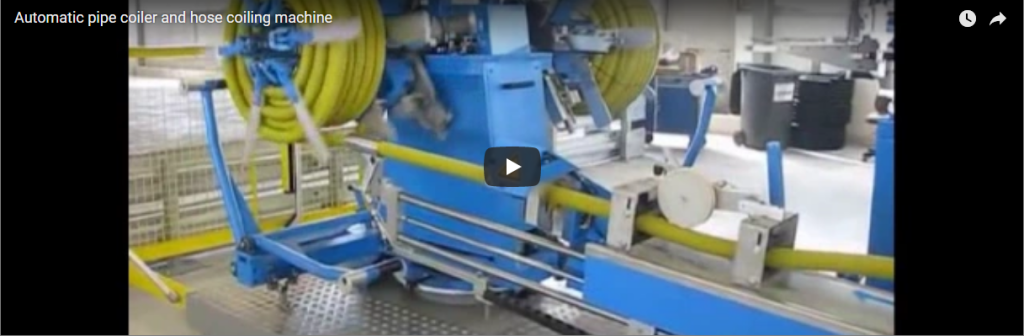
~45–72s Continuous operation: yellow hose feeds from the left through roughly four white guide rollers, curves into the rotating reel, and the coil diameter grows steadily.
~75s The reel is nearly full. A clamping/positioning mechanism with cylinder-and-slide action closes inward to lock the coil core. Metal mesh guarding is visible on the right.
~78s (end) The finished coil is held firmly. A beam-type press with two parallel bars descends on top of the roll, applying steady pressure to keep the winding dense and stop it from loosening.

Two details stand out for anyone evaluating build quality:

  • The coil itself. The finished roll is smooth, even, and tight, with no visible gaps between layers. For shipping and storage, that kind of density means fewer deformed coils and less repacking.
  • The press-down step. Many simple coilers stop at “wound and cut.” Here, a top press with two parallel bars applies pressure after winding, which suggests the machine is designed to produce coils that hold their shape before any downstream strapping or bagging.

Machine structure at a glance

From what is visible in the frames:

  • Frame: white-painted steel construction, columns and beams, adjustable leveling feet at the base.
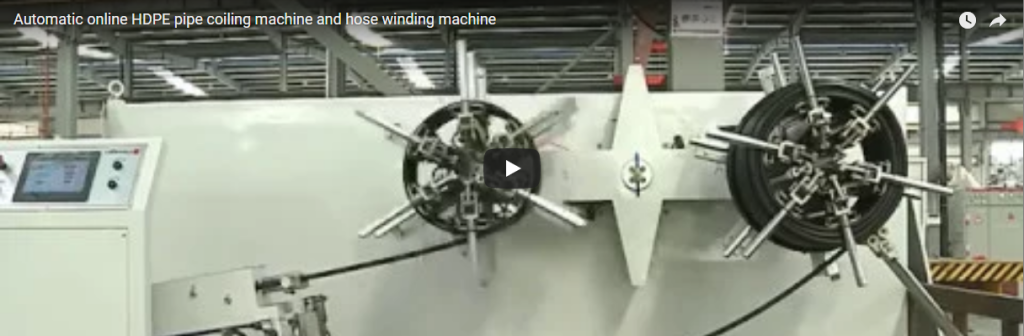
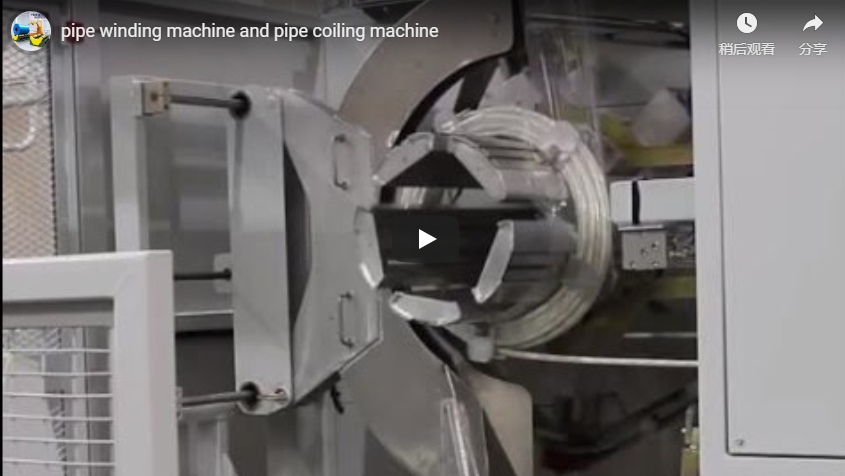
  • Reel unit: a large rotating reel with a multi-arm (star-pattern) clamping structure — roughly four to six extendable metal arms that grip the tube at the center.
  • Feed system: guide rollers on the left side (around four visible in the later frames) that bend the tubing into a smooth arc as it enters the reel.
  • Clamping/positioning: a lower mechanism with cylinder-and-slide components that closes in to fix the coil core once winding is complete.
  • Top press: a beam with two parallel pressure bars that descends onto the finished coil.
  • Guarding: full-height metal mesh safety doors around the reel and clamp area, with aluminum-style framing and a warning triangle label at the top.
  • Control panel: a cabinet with a vertical row of buttons (red, green, black), lit green indicator lamps, and a small digital display. The display content is not readable in the footage. A red warning label sits above the panel — text unreadable.

Direct observation notes

The following is a plain, near-verbatim description kept close to the frame analysis, so you can separate what is actually seen from what is inferred:

  • The machine frame is white-painted steel with columns and beams and adjustable feet at the base.
  • The main reel is a large yellow drum, roughly 1 m in diameter, with a center shaft and multi-arm clamping structure; arms extend in a radial, star-like pattern.
  • A horizontal conveyor track below carries two light-colored positioning blocks.
  • During winding, the reel spins fast and the tubing is pulled in and layered tightly; the clamping arms keep pressing as layers build.
  • The finished product is bright yellow flexible tubing with a smooth surface; in one segment the tube diameter looks around 30–40 mm, in another roughly 80–100 mm — suggesting different shots or products may be included; treat size as indicative only.
  • The mesh safety guard has double-latch doors and a red triangular warning symbol with no readable text.
  • Watermarks reading “FHOPE GROUP / FINDING SOLUTION FOR YOU” appear in the top-left corner throughout; other overlay text and all panel/label text is unreadable.
  • No operator appears at any point in the footage.

What the video does not show

This is just as important for your procurement checklist. The footage does not reveal:

  • Machine model number, rated power (kW), voltage, or frequency
  • Winding speed (rpm or m/min) or cycle time per coil
  • Maximum coil diameter, width, or weight
  • The strapping actuator itself — no banding head, tape applicator, or hot-melt unit is clearly visible in action, even though the machine is described as a winding and strapping coiler. Confirm with the manufacturer whether strapping is integrated or optional.
  • PLC type, HMI menu structure, or communication interfaces (Modbus/Profinet etc.)
  • Tension control behavior — the winding appears to run at constant speed with no visible online tension adjustment
  • Safety certifications (CE, UL, ISO marks)
  • Maintenance schedule, spare-parts list, or fault-diagnosis screens

None of these are criticisms — they are simply not observable in a one-minute clip. Ask for them in writing before you compare quotes.

How the automatic cycle works

Putting the timeline together, the operating logic appears to be:

  1. Feed and position. Tubing enters from the left, passes through guide rollers that set its path and curvature, and is gripped at the reel center by the radial arms.
  2. Wind. The reel rotates; the tube is drawn in and laid down in tight, overlapping layers. Coil diameter grows until the set size is reached.
  3. Clamp. The reel stops. A lower clamping mechanism with cylinder-driven slides closes around the coil core to lock it in place.
  4. Press. A top beam with two parallel bars descends, pressing the coil to keep the winding dense and prevent spring-back or loosening.
  5. Release/output. The finished coil is then ready for the next step (strapping, bagging, or removal). The video ends before the unloading action is fully shown, so how the coil exits the machine is a point to confirm with the manufacturer.

The whole sequence runs with no operator visible — a genuinely automatic cycle, not a semi-auto assist.

Where this type of machine fits

Based on the product seen in the footage — flexible yellow plastic tubing — typical applications for this class of automatic coiler include:

  • Hose and tube manufacturing lines, coiling product at the end of an extrusion line
  • Pneumatic and hydraulic hose packaging for distribution
  • Cable and protective sleeving winding
  • Agricultural and irrigation tubing prepared for shipping

The main qualification questions are product-related: your tube diameter, stiffness, and required coil dimensions must match the reel arm length and clamp range. If you run multiple sizes, ask whether reel arms or clamps can be changed over and how long a changeover takes.

Fit checklist before you request a quote

Use this list when you contact any supplier about a machine like this:

  • Your tube diameter range vs. the machine’s clamp/arm adjustment range
  • Whether the strapping function is integrated or an optional module
  • Required coil outer diameter, width, and weight — and the machine’s maximums
  • Winding speed and realistic cycle time for your product
  • Whether the control system supports communication with your line (PLC protocols)
  • Safety documentation: guard interlocks, e-stop locations, CE or equivalent certification
  • Changeover procedure if you run more than one product size
  • Installation space, power supply, and air supply requirements (clamping appears pneumatically actuated)

Common buyer questions

Does the machine strap the coil automatically? The footage shows winding, clamping, and press-down clearly, but no strapping actuator in action. Since the machine is described as a winding and strapping coiler, confirm directly with the manufacturer how the strapping step is performed and where it sits in the cycle.

Can it handle different tube sizes? The video shows what looks like tubing of two different diameters in different segments, which suggests flexibility, but exact adjustment range is not stated. Check with the manufacturer for the supported diameter range and changeover method.

Is it safe to run with the door open? The machine has mesh safety doors around the winding area, and one segment shows the reel spinning with the door open. Standard practice — and a question to confirm — is that guards must be closed and interlocked before the reel can run. Never reach into the reel area while it is turning.

How fast does it wind? No speed figures are shown or readable in the footage. Cycle time depends on tube size, coil size, and material. Request a test winding with your own product.

What maintenance does it need? Not covered in the video. The visible pneumatic clamping and press cylinders suggest routine checks of air supply and seals are advisable, but the actual maintenance schedule and spares list should be confirmed with the manufacturer.

What to verify with the manufacturer

Before signing anything, get written answers on:

  1. Maximum and minimum tube diameter and the adjustment mechanism
  2. Maximum coil diameter, width, and weight
  3. Winding speed and cycle time with a sample of your tubing
  4. Strapping integration: method, strap type, and position in the cycle
  5. Control interface options and alarm/fault diagnostics
  6. Guard interlock logic and safety certification documents

Related reading

More FHOPE packaging and coiling solutions you may find useful:

Next step

The fastest way to know whether this coiler fits your product is a test winding with your own tubing. Send FHOPE your tube diameter, coil size target, and hourly output requirement through the contact page, and ask for the specifications listed above along with a demo video on your material.


Source and method: this article is based on the YouTube video embedded above. The footage was analyzed frame-by-frame with a vision model on sampled frames; the video contains background music only, with no narration or speech, so no transcript was used. All factual claims come from what is visible in the frames; items that could not be observed are explicitly listed and marked for confirmation with the manufacturer.

Published: 2026-09-03