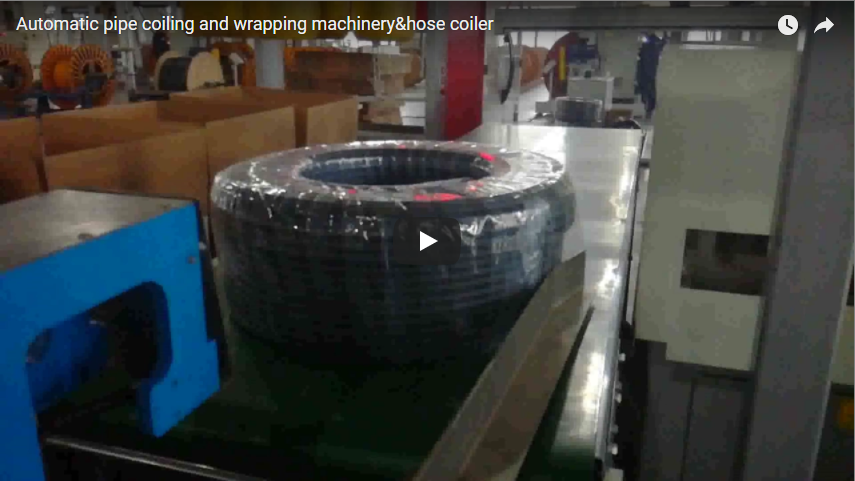
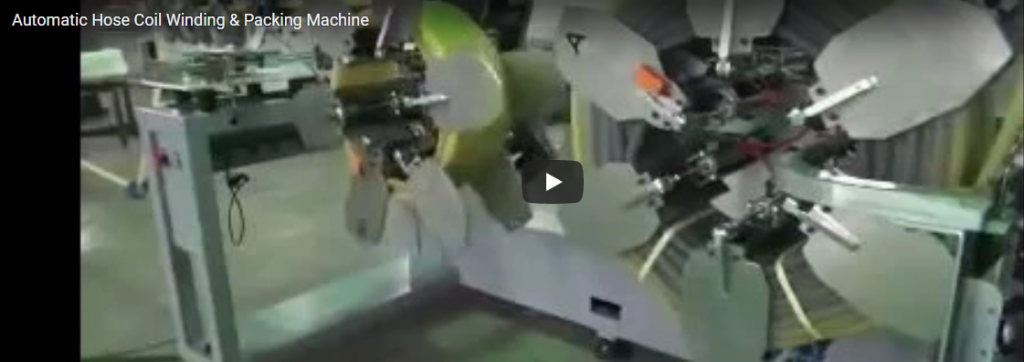
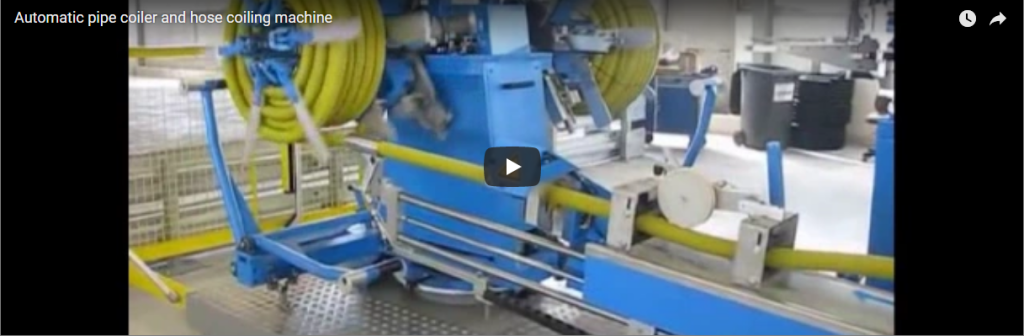
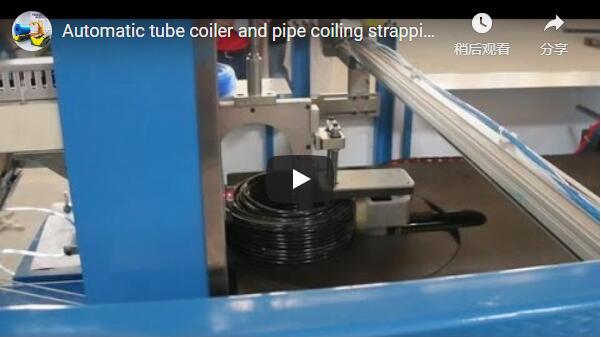
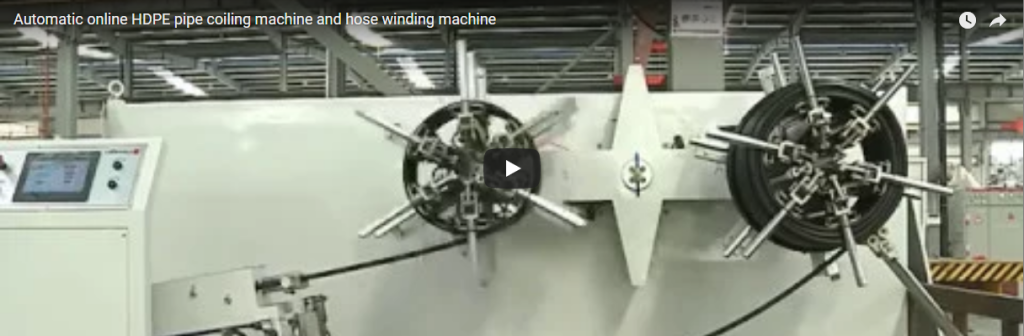
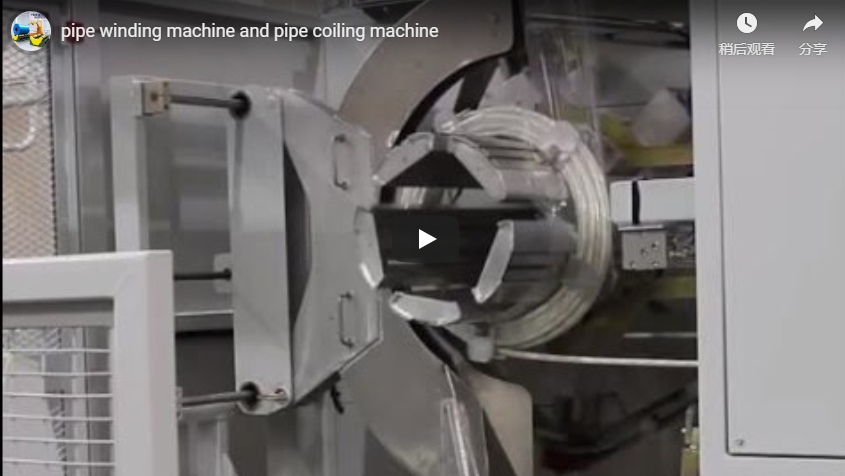
Automatic pipe coiler and strapping machine

Executive summary This video shows a fully automatic pipe coiling and strapping machine from FHOPE in operation. White flexible plastic pipe is fed in, clamped, wound into a tight, even coil, strapped, and released — with no manual intervention visible in the coiling and strapping sequence. The footage covers feeding, winding, radial compaction, strapping, and unloading stages across roughly 108 seconds.

If you produce flexible plastic pipe — corrugated conduit, cable protection sleeve, irrigation hose, or similar extruded tubing — you already know the pain point at the end of the line: someone has to wind hundreds of meters of pipe into a neat coil and strap it so it does not spring apart in transit. Doing this by hand is slow, inconsistent, and hard on operators. The machine in this video addresses exactly that step, automatically.

What the video shows

The footage runs about 108 seconds and follows one complete workflow through its main stages:

  • t≈0–12s — Standby and feeding. A wide shot shows the whole machine in the plant. A length of white flexible pipe sits ready on the left side. The signal tower at the top of the machine shows a steady green light, indicating the machine is in a ready state.
  • t≈16–20s — Positioning and clamping. The camera moves inside the safety guarding. The end of the pipe is captured by a multi-arm clamping mechanism and fixed at the center of the winding reel.
  • t≈20–48s — Winding. The arms rotate with the reel, and the pipe is wound layer upon layer into a large coil. On the right side, the strapping mechanism moves into position as the coil grows.
  • t≈40–52s — Strapping. Once the coil diameter reaches its set value, a strapping arm extends, wraps banding material around the finished coil, and tightens it.
  • t≈52–56s — Unloading. A mechanical arm removes the strapped finished coil from the reel and moves it out toward a conveyor or pallet position.
  • t≈60–108s — A second, closer look. The video returns to the reel, now loaded with pipe. At t≈92s the reel begins rotating counter-clockwise; a clamping arm extends from the right and presses against the coil edge to prevent drift. Between t≈96s and t≈104s, five radial arms contract inward, compressing the pipe layers into a dense, tight coil. At t≈108s the reel stops, the clamp releases, and the finished coil rests as a stable, even ring.

One detail worth noting: at no point in the coiling and strapping sequence is an operator’s hand inside the machine. A person in an orange vest is visible standing behind the guarding early in the video, observing — which is exactly where you want them.

The machine in action: how the parts work together

The machine follows a “control on the left, work in the middle, output on the right” layout, which is common for coiling lines and keeps the operator at a safe distance from the rotating reel.

Component What it does in the video
Feed and guide system (left) Feeds pipe from a supply roller through guide wheels into the winding zone
Multi-arm winding head (center) Clamps the pipe end and rotates, building the coil in concentric layers
Radial compaction arms Contract inward during winding to press layers together into a dense coil
Clamping/holding arm (right) Presses the coil edge during winding to prevent offset; releases when done
Strapping unit (right) Wraps banding around the finished coil and tightens it
Output rail (bottom) Carries the finished coil away
Control panel (left column) Houses the emergency stop, mode buttons, and a small touchscreen

The clamped, multi-arm winding head is the heart of the design. Because the arms grip the pipe end rather than relying on manual threading and holding, the start of each coil is consistent — and a consistent start is what produces a coil that does not loosen or tangle later.

Direct observation notes

The following observations are kept close to what is actually visible in the footage:

  • The machine body is a white painted steel cabinet with some silver-gray aluminum structural framing; guarding consists of transparent/translucent panels plus yellow-framed metal mesh.
  • The control panel is mounted vertically on the left cabinet door: a red mushroom-head emergency stop at the top, followed by a black knob, blue/yellow/white round buttons, a green start button, and a small touchscreen below. The screen content is not readable in the footage.
  • A signal tower on top of the machine shows a steady green light during standby; the red light is off.
  • The pipe is white, smooth-surfaced flexible plastic, wound into concentric layers. Estimated pipe outer diameter in the second sequence is roughly 20–30 mm; the finished coil is roughly 1.2 m in diameter with an estimated 20–30 layers. These are visual estimates only.
  • Fine dark tick marks are occasionally visible on the pipe surface — possibly printed section markings — but their content cannot be identified.
  • “FHOPE” branding is visible on the cabinet side and control panel; an “FHOPE GROUP” watermark appears in the upper-left corner of the footage.
  • Metal mesh safety fencing surrounds the moving parts. No light curtains, interlock hardware, or readable warning signage are clearly visible in the footage.
  • A second control console with an LCD screen, green start and red stop buttons, and a knob appears near the end of the video.
  • No model number, electrical ratings, certification marks (CE/UL/ISO), or readable parameter labels appear anywhere in the video.

Why automatic coiling and strapping matters

The value of a machine like this is easiest to see by thinking about what the coil has to survive. A loosely wound coil will spring open, layers will snag, and the pipe can kink during handling. The video shows three features that directly address this:

  1. Radial compaction during winding. The arms press inward as the reel turns, so layers are packed tight rather than loosely stacked. In the footage, the gap between layers visibly shrinks as the arms contract (t≈96–104s).
  2. Edge clamping during the cycle. The right-side arm holds the coil edge under pressure throughout winding, keeping the coil aligned on the reel instead of drifting sideways.
  3. Strapping before release. The coil is banded while still held by the machine, so it keeps its shape the moment it leaves the reel.

Beyond coil quality, the automation removes the most repetitive task at the end of a pipe extrusion line. Consistency comes from the machine, not from whoever happens to be on shift.

Applications this machine suits

Based on what is visible — smooth, flexible, small-diameter white plastic pipe wound into dense coils — typical fit includes:

  • Cable and wire protection conduit (corrugated or smooth-bore PE/PP type products)
  • Irrigation and garden hose in coiled retail or industrial lengths
  • Small-bore utility and ducting pipe supplied in coils to installers
  • Any flexible extruded product that ships coiled and needs a stable, strapped form

Where the fit is less obvious: large-diameter pipe, rigid pipe, or non-round profiles would likely need different clamping and reel arrangements. Confirm your product’s diameter range and stiffness with the manufacturer before assuming compatibility.

What the video does not show

Honest limits matter when you are evaluating equipment from footage alone. The video does not show:

  • Rated power, motor speed, or electrical specifications
  • Maximum coil diameter, coil weight, or pipe diameter range
  • Actual cycle time per coil (the video includes edited pauses; it is not a continuous real-time cycle)
  • The machine model number
  • Safety certifications, interlock design, or light curtain presence
  • Maintenance points, lubrication schedule, or spare parts list
  • Control system details — PLC platform, HMI menu structure, or communication interfaces
  • Whether multi-size changeover is automatic or requires tooling changes

Any of these can be decisive in a purchase decision, so treat them as open questions until confirmed.

What to verify with the manufacturer

Before shortlisting this type of machine, ask:

  • Which pipe outer diameters and materials does the clamping/winding head accept, and how is changeover done?
  • What is the real cycle time per coil at my pipe diameter and coil length?
  • Does the strapping unit use plastic strapping or tape, and what banding material is required?
  • What guarding, interlocks, and safety certifications (e.g., CE) are provided?
  • Can the control system integrate with an existing line (communication protocols, remote diagnostics)?
  • What are the warranty terms, spare parts availability, and commissioning/training support?

Care and safe operation basics

These points follow from what is visible in the footage plus standard practice for rotating-coil machinery. Treat them as orientation, not a substitute for the manufacturer’s manual.

  • Keep the mesh guarding closed before starting the cycle. The multi-arm winding head rotates and closes radially — reach-in during operation is the obvious hazard.
  • Test the red emergency stop button periodically. It is prominently placed on the left control column, which only helps if it works.
  • Confirm arms are fully retracted and in their home position before loading a new pipe end.
  • Have a qualified person verify that the sequence logic prevents reel rotation unless the clamping arm is engaged — the video suggests such an interlock exists (clamp first, then rotate), but confirm it in the control specification.
  • Keep the touchscreen console protected; panel labels and screens should stay legible for troubleshooting.

Frequently asked questions

Does the machine strap the coil automatically? Yes. The video shows a strapping arm extend, wrap banding around the coil, and tighten it once the coil reaches diameter (t≈40–52s). The exact banding material and strap tension settings — check with the manufacturer.

Can one operator run it? The footage shows personnel only observing from behind the guarding; the coiling, compaction, strapping, and unloading sequence runs without visible manual handling. Whether loading of a new pipe end is fully automatic or requires an operator — check with the manufacturer; the video shows the pipe pre-threaded at the start.

What pipe sizes does it handle? The video shows small-diameter flexible plastic pipe (visually estimated around 20–50 mm outer diameter) and coils of roughly 0.8–1.2 m diameter. These are visual estimates from the footage, not specifications. For the actual working range, check with the manufacturer.

Is there a touchscreen? Yes. A small touchscreen sits on the left control panel, and a second console with an LCD screen appears near the end of the video. The on-screen content is not readable in the footage, so HMI functions cannot be confirmed from the video.

What safety features are visible? Metal mesh fencing around the moving parts, a red mushroom-head emergency stop on the control panel, and operators positioned behind the guarding. No light curtains or interlock hardware are clearly visible; safety certification status is not shown.

Is it fully automatic? The winding, compaction, strapping, and unloading sequence shown in the video runs with no manual intervention. Whether the complete upstream-to-downstream flow (feeding raw pipe through palletizing finished coils) is unattended depends on how the machine is integrated into your line — discuss the layout with the manufacturer.

Related reading

Next step

The video gives you a clear picture of how this machine coils, compacts, straps, and releases flexible pipe — but your product’s diameter, coil weight, and required cycle time determine whether it fits your line. Send FHOPE your pipe specifications and target coil dimensions via the contact page, and request the working range, cycle time, and safety documentation for your application.


Source and method: This article is based solely on the embedded product video. The footage was analyzed frame-by-frame using a local vision-language model (Qwen3-VL) on sampled frames; the video contains background music only, with no narration or speech, so no audio transcription was used. All observations above come from what is visible on screen; measurements are visual estimates and specifications are intentionally omitted where the video provides no evidence.

Published: 2026-09-03