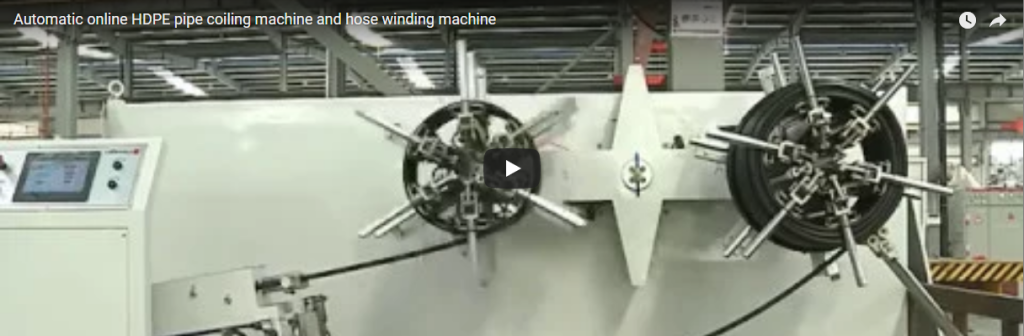
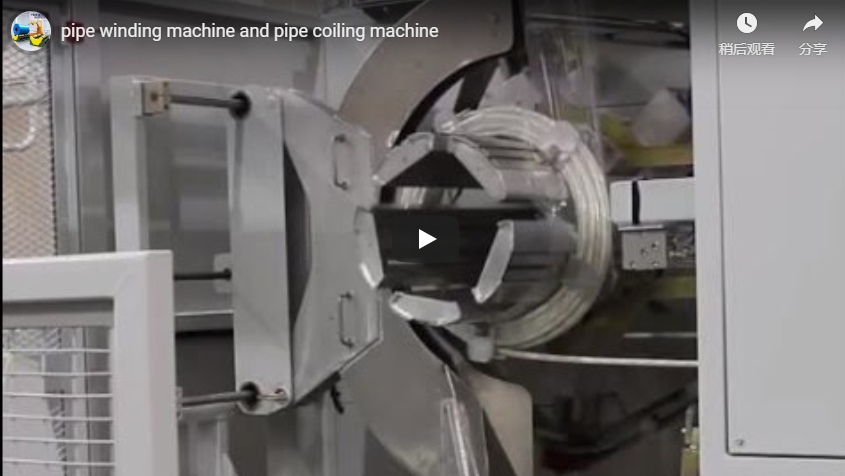
Executive summary An automatic hose winding and wrapping machine coils the hose on a drum to a set length, then wraps the finished coil in stretch film through its eye. This clip shows the winding drum with its expanding arms, the machine inside a mesh guard, and stacks of finished film-wrapped black hose coils. Our equivalent solution pairs a coiling machine for 5 to 35 kg coils at 1 to 60 m per minute with the FPH-200N coil wrapper at 20 to 35 s per coil.
Table of Contents
- What the clip shows
- From hose to wrapped coil
- Specifications of our equivalent solution
- Takt check
- Selection checklist for a hose winding and wrapping machine
- Controls and safety
- Engineering FAQ
- Next step
- Related reading
- Sources
What the clip shows
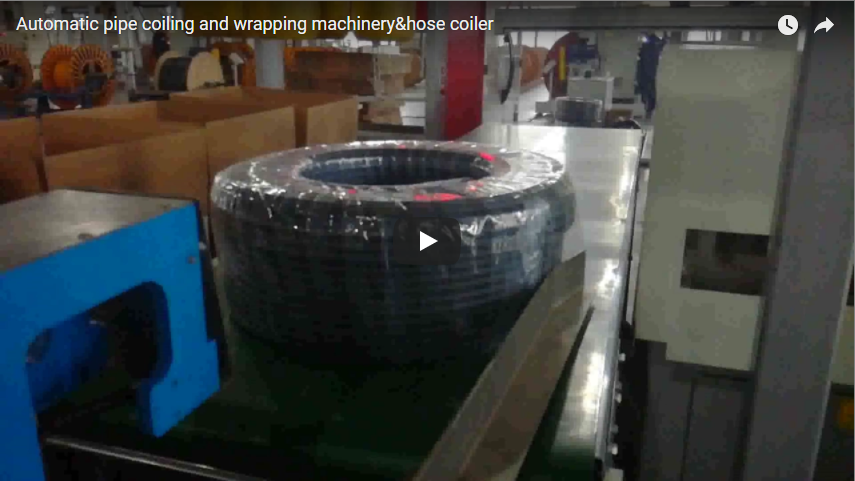
- Finished coils. Two stacks of black hose coils stand on the shop floor. Each coil is wrapped in clear film and carries a white label. More coils sit on pallets in the background.
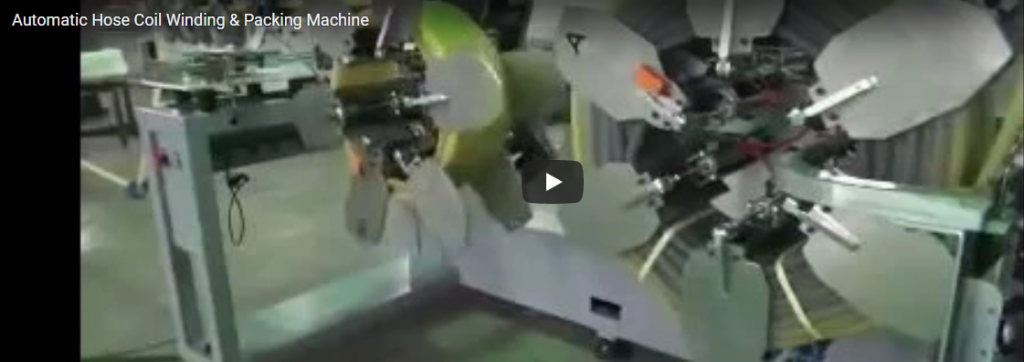
- The winding drum. A large white disc carries a ring of radial arms with green blocks around a central hub. The arms form the drum that the hose is wound onto, and a feed rod reaches in from the right.
- Winding. The drum turns and builds the thick black hose into a tight round coil, while a guide arm lays each turn in place.
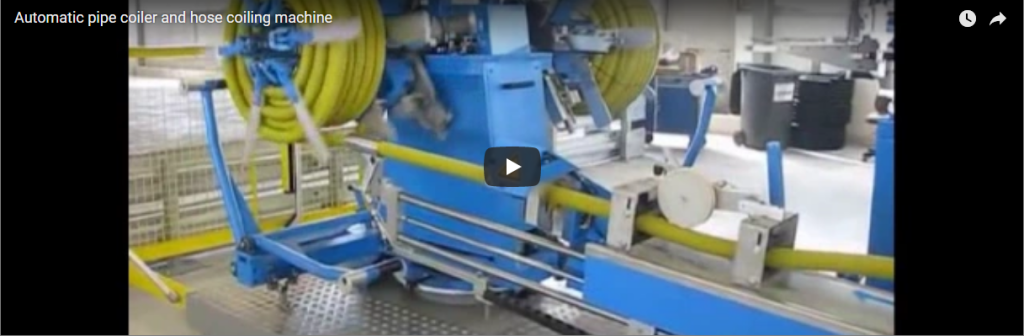
- The machine inside its guard. A wider view shows the blue and silver machine frame behind a welded mesh fence, with guide rails and a table at the front.
The wrapping step falls outside the footage, but the finished coils show its result: a closed film cover with a label on top.
From hose to wrapped coil
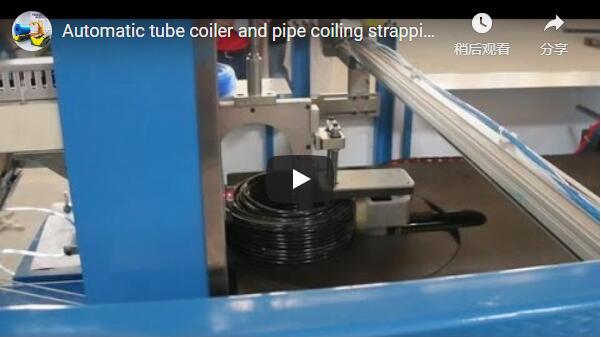
Hose arrives from the extruder as one continuous length. The coiling machine winds it to a set length on a drum, cuts it and releases the coil. The coil is strapped to hold its shape, then the arms on the drum move in to let it slide off and move out again for the next one.
The strapped coil then goes to the wrapper. A film ring passes through the eye of the coil and lays stretch film over its section, turn by turn, until the coil is closed. The film keeps the coil tight, keeps dirt off the hose and gives a flat face for the label.
| Step | Machine | What happens |
|---|---|---|
| Coiling | Hose coiling machine | Winds the hose on a drum to the set length |
| Cutting and release | Hose coiling machine | Cuts the hose, arms move in, coil comes off |
| Strapping | Hose coiling machine | Straps the coil to hold its shape |
| Wrapping | FPH-200N coil wrapper | Stretch film through the eye and around the coil |
| Labelling and stacking | Manual or automatic | Label on the film, coils stacked or palletised |
Specifications of our equivalent solution
| Hose coiling and strapping machine | Specification |
|---|---|
| Coil inner diameter | 350 to 550 mm |
| Coil outer diameter | 500 to 800 mm |
| Coil width | 150 to 300 mm |
| Coil weight | 5 to 35 kg |
| Coiling speed | 1 to 60 m per minute, high and low |
| Coiling stations | 2 |
| Power | 4.5 kW, 380 V, 60 Hz, 3 phase |
| Strapping belt | 0.6 to 0.75 mm thick, 12 to 13 mm wide |
| FPH-200N hose coil wrapper | Specification |
|---|---|
| Coil inner diameter | 250 to 650 mm |
| Coil outer diameter | 450 to 800 mm |
| Coil width | 120 to 280 mm |
| Coil weight | 5 to 30 kg |
| Wrapping speed | 20 to 35 s per coil |
| Ring speed | up to 100 rpm |
| Power | 1.5 kW, 380 V, 60 Hz, 3 phase |
| Film | 50 mm core, 100 to 140 mm OD, 60 to 80 mm wide; paper optional |
Where both machines run together, the common window is 350 to 550 mm ID, 500 to 800 mm OD, 150 to 280 mm width and 5 to 30 kg. Coils above 30 kg or 280 mm need a larger wrapper, which we size per project.
Takt check
The coiling speed sets the pace. At 60 m per minute, a 50 m coil takes 50 ÷ 60 × 60 = 50 s to wind. A 100 m coil takes 100 s.
With two coiling stations, one station winds while the other releases and straps, so the line delivers a coil about every winding time. The FPH-200N wraps in 20 to 35 s, which is well inside a 50 s coil interval. One wrapper therefore keeps up with the coiler, and we add a short conveyor between them as a buffer.
The coil lengths here are illustrative. We run the check with your hose length, diameter and line speed in the proposal.
Selection checklist for a hose winding and wrapping machine
- Hose diameter, coil length and coil weight.
- Coil ID, OD, width and weight, against the common window of both machines.
- Extrusion line speed, compared with the 1 to 60 m per minute coiling speed.
- Strapping before the wrap, and the strap count.
- Film or paper wrap, labelling and stacking.
Controls and safety
The winding drum, its arms and the film ring all move fast, and the hose feed can pull a hand in. On the clip the machine stands inside a welded mesh fence, which is the arrangement we keep on our equivalent solution. Nobody reaches into the drum or the ring while they can move, and that reach is the move to design out.
Stop, isolate and lock out the machine before anyone threads a new hose end, clears a jam on the drum or changes a film roll. Restart only after the fence is closed.
The standards that apply depend on the destination market. For CE markets, ISO 12100 sets the risk-assessment method and EN 415-10 covers general requirements for packaging machines, which fixes guarding and the stop arrangement.
Engineering FAQ
Q: How fast does the hose coiling machine wind? A: At 1 to 60 m per minute, with high and low speed settings, on two coiling stations.
Q: Which coils fit the FPH-200N wrapper? A: Coils of 250 to 650 mm ID, 450 to 800 mm OD, 120 to 280 mm width and 5 to 30 kg, at 20 to 35 s per coil.
Q: Can the coil be wrapped in paper instead of film? A: Yes. The FPH-200N runs stretch film as standard, with paper as an option.
Next step
We size a hose winding and wrapping machine in three steps:
- Submit your layout drawing with the hose diameter, coil length, coil size, line speed and wrapping material, to info@fhopepack.com.
- Receive a proposal within 48 hours, with the coiler and wrapper arrangement and the cycle check against your extrusion speed.
- Book a site survey so we confirm the line end, the floor space and the operator position.
Related reading
- Hose coiling and strapping machine
- Hose coil wrapper FPH-200N
- Wire coil wrapping machine with paper
- Razor wire packing machine
Sources
- Coiling machine specifications: hose coiling and strapping machine product page
- Wrapper specifications: FPH-200N hose coil wrapper product page
- Machine in action: the video on YouTube
- Standards scope: ISO 12100:2010, EN 415-10:2014
Last reviewed: 2026-10-05