Executive summary
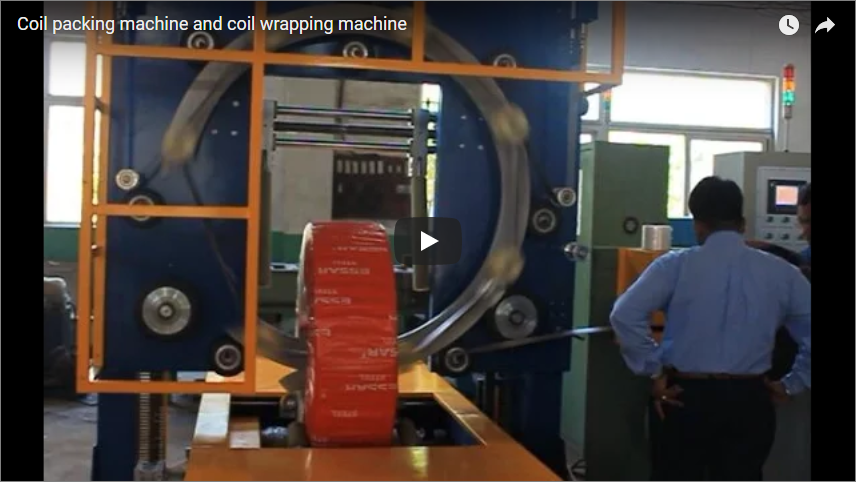
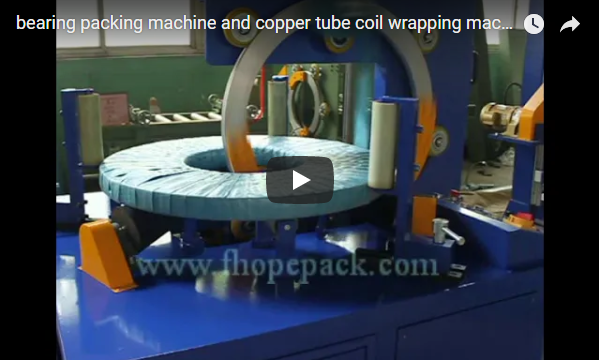
The video shows a wire coil wrapping machine covering a large copper coil with blue band material. A mechanical arm with rollers rotates around the coil while the coil itself turns, wrapping the outer surface evenly. This article breaks down the machine structure and where it fits in a wire or coil shop.
What the video shows
The video is a shop-floor demonstration with background music and no narration. All descriptions below come from visual observation, sampled frame by frame.
- A large copper coil sits fixed at the machine center and rotates slowly (0–6 s).
- A mechanical arm carrying blue band material rotates around the coil (0–6 s).
- The arm’s rollers and guides route the band tightly onto the coil surface (6–12 s).
- Band coverage builds until the coil’s outer surface is fully wrapped (12–18 s).
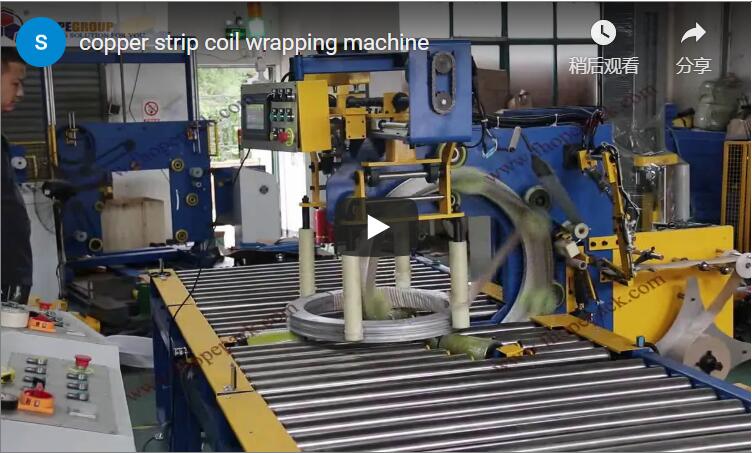
- Two workers in blue workwear handle a finished wrapped coil beside the machine (12–18 s).
- The yellow control box and safety fence are visible through the run.
Direct observation notes
The following structure observations are taken directly from the video frames. Details that could not be read in the footage are marked as such.
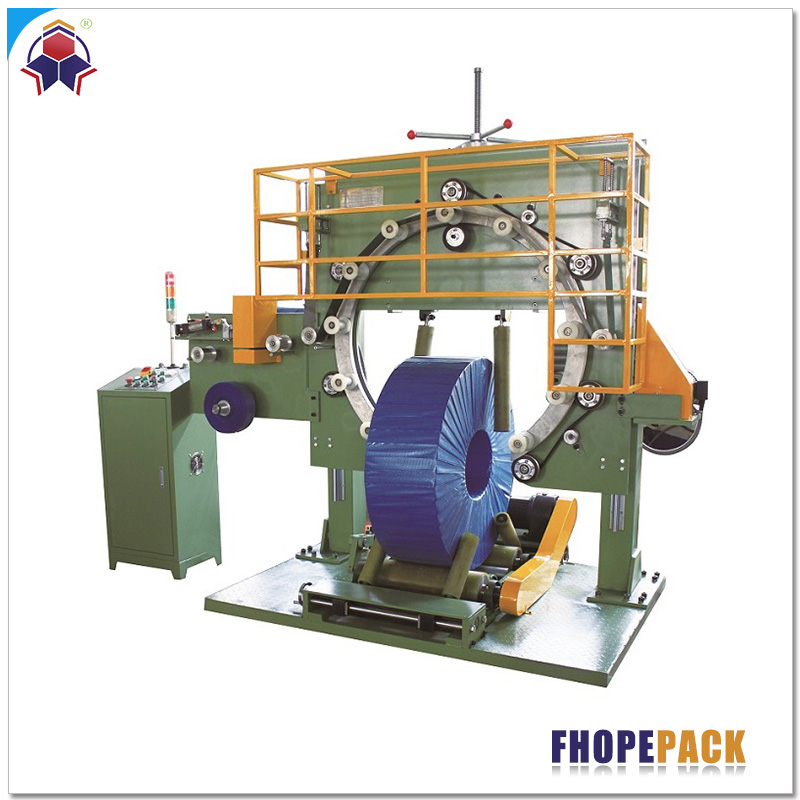
- Frame: green metal frame with yellow painted sections used for the safety fence and guards.
- Coil mount: a large circular coil is fixed at the machine center and can rotate.
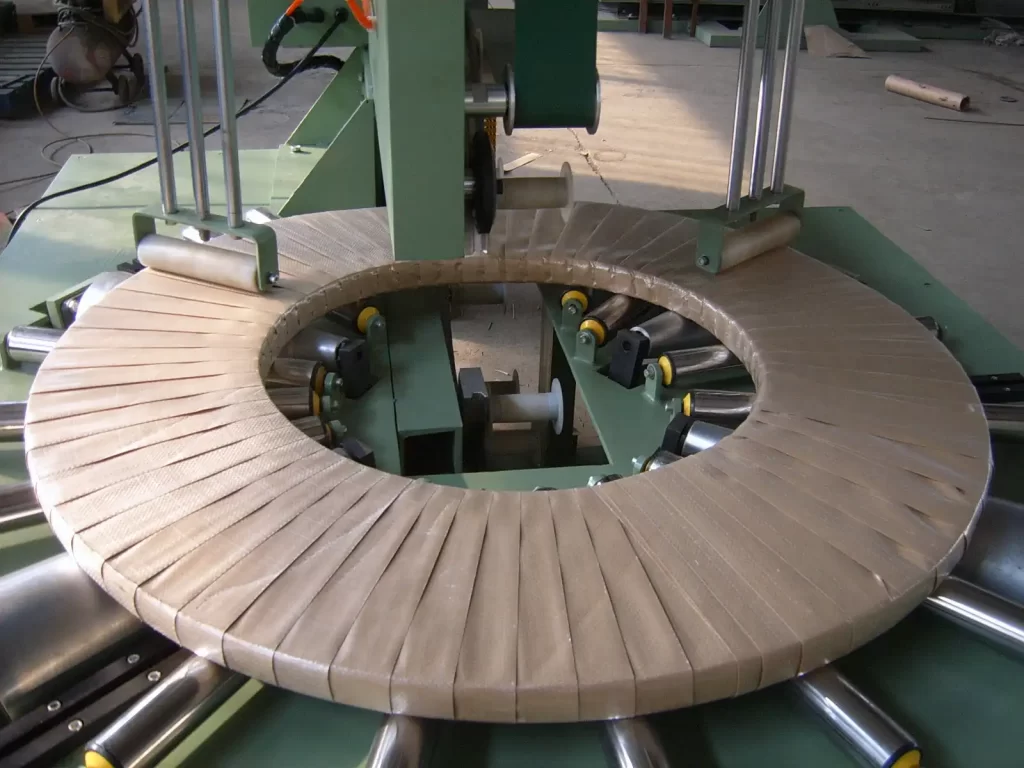
- Wrap arm: a mechanical arm system with rollers and guides rotates around the coil to apply the band.
- Band supply: blue band material feeds from a reel on the right through guide rollers into the arm.
- Control box: yellow enclosure on the right containing the control panel.
- Control panel: buttons (red and green visible) and indicator lights inside the yellow box; a digital display shows “40000”.
- Safety fence: yellow fence surrounds the hazardous zone around the coil.
- Layout: L-shaped — coil at the center, wrap arm working above and at the side, control panel on the right for the operator.
Machine structure breakdown
| Component | Observed in video | What it does |
|---|---|---|
| Coil mount | Large circular coil, rotates | Holds the coil and turns it for even wrapping |
| Wrap arm | Rotates around the coil | Carries the band around the outer surface |
| Rollers and guides | On the arm, route the band | Keep band tension and position consistent |
| Band reel | Right side of the machine | Supplies the blue band material |
| Control box | Yellow, on the right | Houses the panel and display |
| Digital display | Shows “40000” | Indicates a counter or setting value |
| Safety fence | Yellow, around the hazard zone | Keeps operators clear of moving parts |
What the video does not show
The footage demonstrates the mechanism, not the specification. It does not show:
- Maximum coil diameter, width, and weight.
- Winding speed and wrap-layer settings.
- Cycle time per coil.
- Model numbers, power draw, or certifications.
- Band material and width.
- Emergency stop, light curtains, or interlocks.
- Maintenance requirements.
How the wrap runs
The wrap combines two rotations:
- Mount — the coil is fixed at the center.
- Feed band — band leaves the right-side reel through the guides.
- Rotate arm — the wrap arm travels around the coil.
- Rotate coil — the coil turns in sync so the band lays evenly.
- Finish — the outer surface is fully covered; the coil moves out for handling.
Both motions run together in the footage, which is what produces the even blue layer.
Where the machine fits
This wrap style suits round, ring-shaped coils:
| Application | Why it fits |
|---|---|
| Transformer and motor coils | Round form, needs surface protection |
| Copper wire coils | Soft surface, benefits from band protection |
| Steel wire coils | Round form, easy to mount |
| Inductor and cable coils | Consistent round shape for arm wrap |
If your product is not round or the coil cannot rotate, an arm-based wrapper may not be the right shape.
What to verify with the manufacturer
- Coil envelope — maximum OD, width, and weight.
- Band spec — material, width, and wrap layers.
- Cycle time — coils per hour at your size.
- Controls — what the display shows and how settings are stored.
- Safety — fence, emergency stop, and certifications.
- Support — spare parts, service, and training.
Buyer questions
What coil sizes fit the machine? Confirm OD, width, and weight against your mix.
What band material is used? Ask whether the blue band is tape, film, or woven material, and the width range.
Can the wrap count be changed? Ask how layers and tension are set per product.
How fast is a cycle? Ask for coils per hour including coil handling.
What does the display show? The footage shows “40000”; ask what the counter tracks.
What safety equipment is fitted? Confirm the fence, emergency stop, and certifications.
Common mistakes to avoid
- Assuming the coil cannot rotate. This machine wraps both ways — arm and coil — confirm the drive matches your coil weight.
- Skipping the band test. Run your actual band and coil to check adhesion and wrap quality.
- Ignoring the control readout. A counter or setting shown on the display matters for traceability; ask what it records.
- Forgetting the fence. The yellow fence is the main guard; confirm it is interlocked.
- Underestimating coil handling. The video shows workers handling finished coils; plan lifting and transfer.
Why this machine earns its place
For a coil shop, an arm wrapper removes the repetitive, uneven part of hand wrapping. The video shows the machine doing two synchronized jobs — rotating the arm and rotating the coil — which is hard to match by hand.
The honest caveat is the same as any demo: you are watching capability, not specification. Rated sizes, cycle time, and safety features come from the manufacturer’s data, so confirm them before you plan the machine into your floor.
Related reading
- coil packing machine
- Wire Wrapping Machine for Steel Wire or Copper Wire
- Steel Wire Coil Wrapping Machine and Packing Machine
- Coil Packing Machine and Coil Wrapping Machine for Copper
- Automatic Copper Tube Coil Packing Machine
Next step
Contact the FHOPE sales team with your coil sizes and band requirements for a wrap machine fit check. Use the contact page to start the conversation.
Last updated: 2026-08-22.