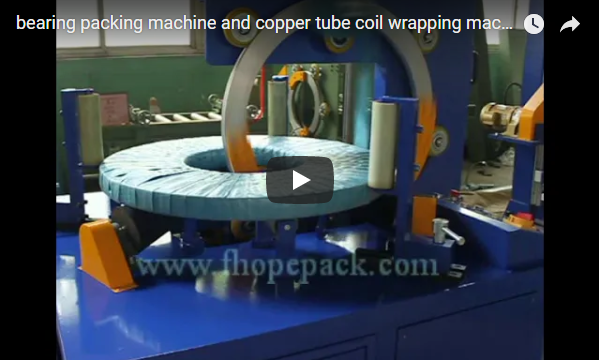
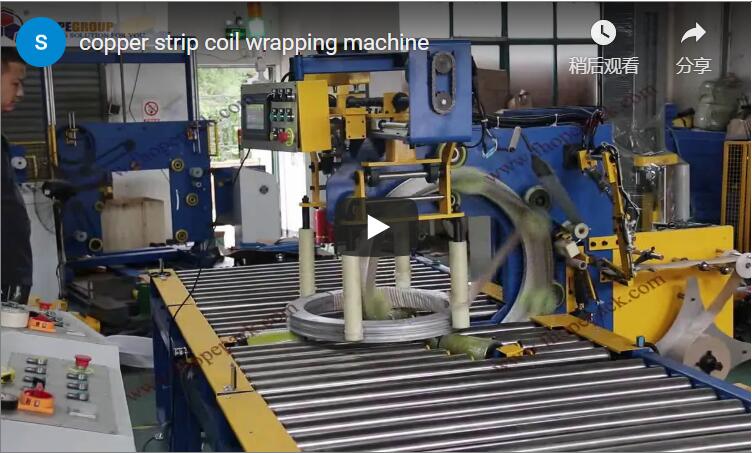
Executive summary A coil packing machine of the ring type wraps a coil standing on edge, with the ring passing through the coil eye and laying material over its section. Our own clip, about 125 s long, shows a blue-framed ring wrapper with an orange guard frame and an operator who positions the coil by hand. For this class our FPS-300 takes coils of 508 to 610 mm ID, 600 to 1,200 mm OD and 20 to 1,000 kg.
Table of Contents
- What the clip shows
- How a ring coil wrapper works
- FPS-300 specifications
- Choosing the wrapping material
- Takt check
- Selection checklist for a coil packing machine
- Controls and safety
- Engineering FAQ
- Next step
- Related reading
- Sources
What the clip shows
Over about 125 s, sampled every 5 s, the clip moves between the machine, the coil and the operator.
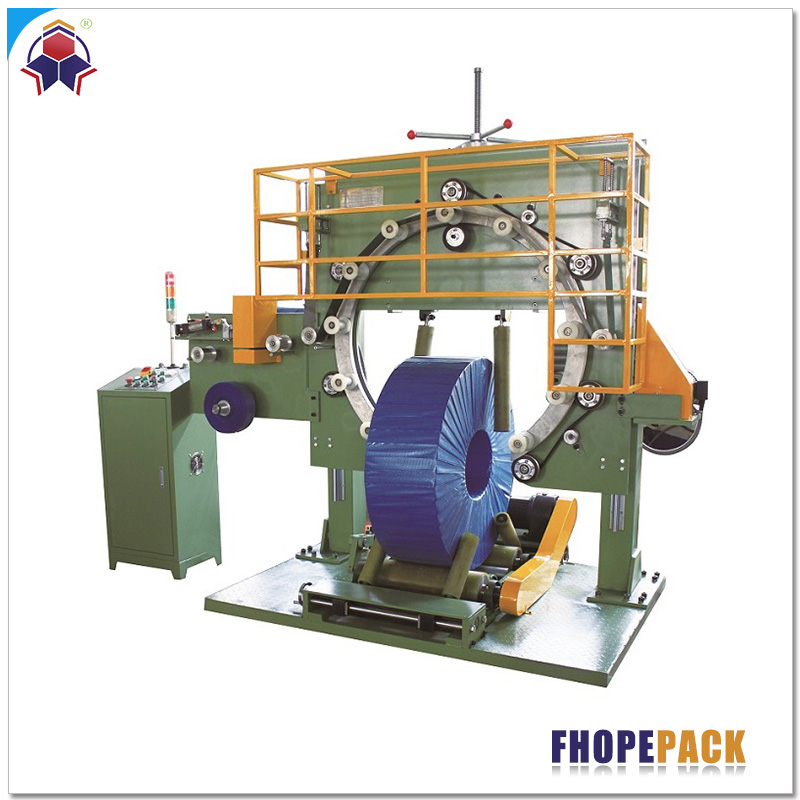
The machine has a blue steel frame with a large vertical ring, guide rollers around the ring and an orange guard frame in front. The coil sits on edge on an orange saddle under the ring. A green control cabinet with a touch panel stands to the right, and a signal lamp column sits behind the machine.
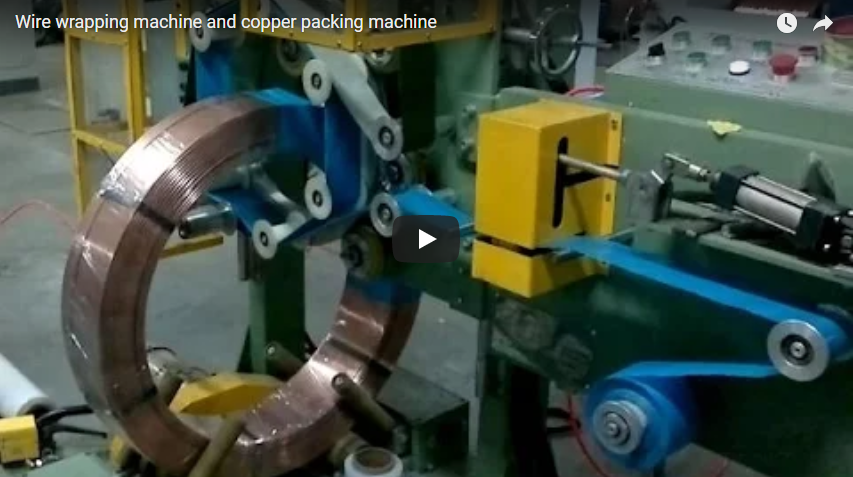
- A wrapped coil at the ring. At the start a coil already covered in a red band stands in the machine, with the operator standing beside the cabinet.
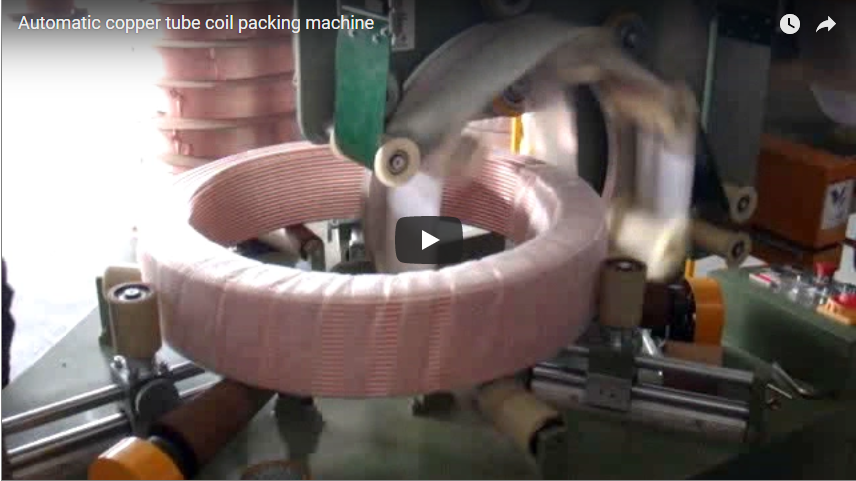
- Loading and guiding. The operator puts his hands on a light-coloured coil with layered, paper-like sides and guides it, and the packing material, through the ring area.
- Wrapping. The ring runs around the section of the coil and lays clear film over it while the coil sits on the saddle.
- Standing by. Later in the clip the operator stands back from the machine, at one point on the phone, while the ring area holds the coil.
The coil in the demonstration has a light, layered, paper-like surface. The same ring wrapper class handles copper, steel and other coils, as long as the coil fits the ID, OD and weight window.
How a ring coil wrapper works
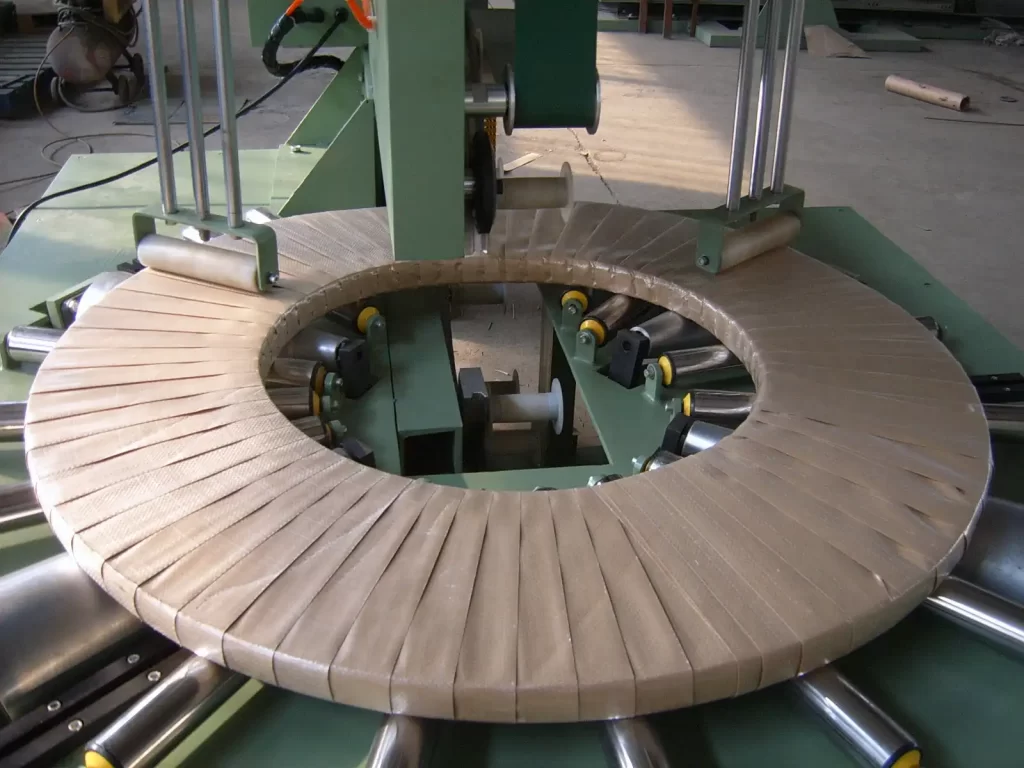
The coil stands on edge with its eye in line with the ring. The rotating ring carries the material through the eye, around the section and back out on the outside. As the coil turns on its saddle rollers, each turn of material overlaps the last and the cover closes around the whole coil.
| Part on the machine | What it does |
|---|---|
| Vertical ring with guide rollers | Carries the material through the eye and around the section |
| Saddle with rollers | Holds the coil on edge and turns it during the wrap |
| Material holder on the ring | Releases film or paper under tension |
| Guard frame | Keeps people away from the ring while it runs |
| Control cabinet with touch panel | Sets overlap and starts the cycle |
FPS-300 specifications
Our FPS-300 is the economic steel coil wrapping machine in this class. It is the closest match on our product pages to the machine in the clip. We confirm the coil size before we propose it.
| FPS-300 coil wrapping machine | Specification |
|---|---|
| Coil inner diameter | 508 to 610 mm |
| Coil outer diameter | 600 to 1,200 mm |
| Coil width | 100 to 300 mm |
| Coil weight | 20 to 1,000 kg |
| Packing material | PVC, LLDPE, PE, paper or HDPE |
| Material roll | 50 mm core, 100 to 450 mm OD, 100 to 150 mm wide |
| Overlap rate | 10% to 90% |
| Power | 1.5 kW, 380 V, 50 Hz, 3 phase, can be customised |
| Air supply | 4 to 6 bar |
Coils above this window move to our FPS-400, rated for 800 to 1,400 mm OD and 100 to 2,000 kg.
Choosing the wrapping material
Clear film is the usual first layer. It closes the coil against dust and moisture and lets the coil label show through. Paper or HDPE goes on top when the coil needs abrasion or outdoor protection, or when the customer asks for a paper finish.
The overlap rate sets the cover. A higher overlap lays more layers and gives a tighter seal, but it uses more material and lengthens the wrap. We set the overlap per coil type, then fix it in the recipe so every coil of that type gets the same cover.
Takt check
The clip is a demonstration rather than a timed production run, so we size the machine from the target output. For an illustrative target of 20 coils per hour, the takt is 3,600 ÷ 20 = 180 s per coil.
That 180 s covers loading the coil onto the saddle, starting the wrap, the wrap itself, cutting the material and unloading. With manual loading by crane or forklift, the handling steps usually set the pace, not the ring. At higher outputs we add a powered infeed and outfeed so the next coil is staged while the ring runs.
Selection checklist for a coil packing machine
- Coil ID, OD, width and weight against the FPS-300 window, or the FPS-400 above it.
- Material: film only, or film plus paper or HDPE, and the overlap.
- Output target per hour and how coils arrive and leave.
- Guarding and the operator position during loading.
- Downstream steps: labelling, strapping, stacking on pallets.
Controls and safety
On the clip the operator handles the coil and the material by hand inside the ring area. A hand near the ring or the saddle rollers while they can move is the move to design out. Loading, threading the material and any adjustment on the coil happen only with the machine stopped at rest.
Stop, isolate and lock out the machine before anyone reaches into the guard frame, clears a material break, changes a material roll or works on the ring. The guard frame and the lamp column stay in place on our equivalent design.
The standards that apply depend on the destination market. For CE markets, ISO 12100 sets the risk-assessment method and EN 415-10 covers general requirements for packaging machines, which fixes guarding and the stop arrangement.
Engineering FAQ
Q: What does a ring-type coil packing machine do? A: It wraps a coil standing on edge by passing a ring through the coil eye, laying film or paper over the section turn by turn until the coil is covered.
Q: Which coils fit the FPS-300? A: Coils of 508 to 610 mm ID, 600 to 1,200 mm OD, 100 to 300 mm width and 20 to 1,000 kg.
Q: Can the same machine wrap in film and paper? A: Yes. It takes PVC, LLDPE, PE, paper or HDPE, with an overlap rate of 10% to 90%.
Next step
We size a coil packing machine in three steps:
- Submit your layout drawing with the coil ID, OD, width, weight, wrapping material and output target, to info@fhopepack.com.
- Receive a proposal within 48 hours, with the machine arrangement, the guarding and the cycle check against your takt.
- Book a site survey so we confirm the loading method, the floor space and the operator position.
Related reading
- Steel coil wrapping machine FPS-300
- Steel coil packing machine FPS-400
- Coil packing machines
- Coil wrapping machine with taping and label printer
Sources
- Machine specifications: FPS-300 steel coil wrapping machine product page and FPS-400 product page
- Clip content: frames taken from our clip, 5 s between frames
- Machine in action: our video on YouTube
- Standards scope: ISO 12100:2010, EN 415-10:2014
Last reviewed: 2026-10-05