Executive summary
A steel coil leaves the mill worth far more than its packing, yet most transport damage comes from weak packing: rust from moisture, crushed edges, and coils that telescope when straps slip. Good practice builds the pack in layers: edge protection, VCI paper or film, an outer cover, then radial and circumferential straps. This page explains each layer, how our automatic circumferential strapping machine fits into the line, and how to work out strap use per coil.
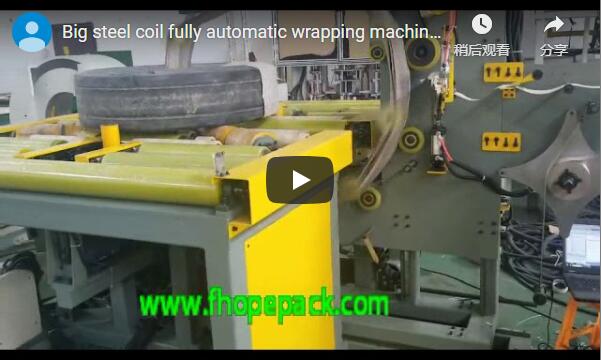
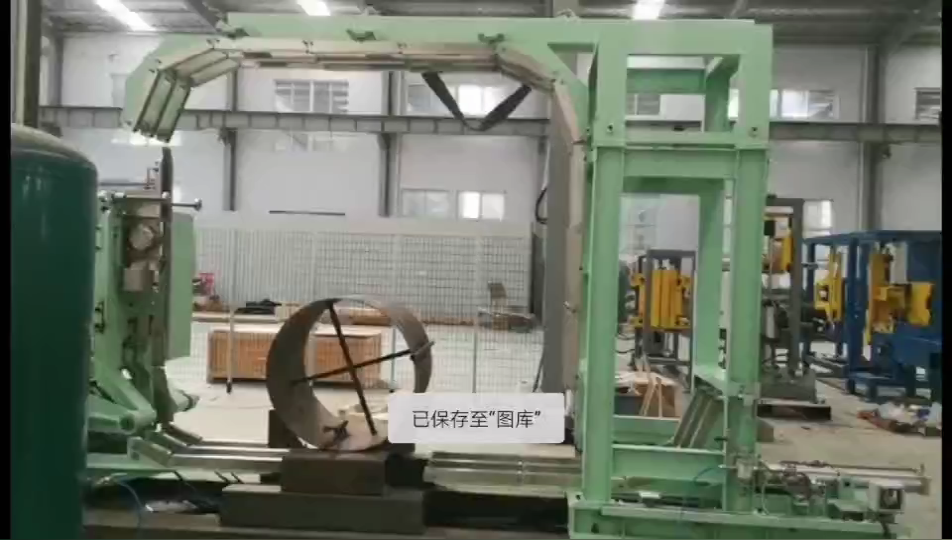
The coil arrives eye-horizontal on a coil car and stops inside a green steel gantry. The strapping head moves in to the coil OD; once it reaches the coil surface, the strap is fed around the outside of the coil, tensioned and sealed. The strap passes under the coil through a fixed dispenser, so no one has to thread it by hand.
Table of Contents
- What goes wrong in transport
- The packing layers, in order
- Circumferential and radial strapping
- How the circumferential strapper works
- Strap use per coil
- Where it sits in a packing line
- Selection checklist
- Safety
- Engineering FAQ
- Next step
- Related reading
- Sources
What goes wrong in transport
| Damage | Cause | Packing answer |
|---|---|---|
| Rust and white rust | moisture and condensation | VCI paper or film, sealed cover |
| Crushed edges | handling and stacking | ID and OD edge protectors |
| Telescoping | layers slide sideways | radial straps through the eye |
| Loose outer wraps | coil springs open | circumferential straps around the OD |
| Coil moves on pallet | weak tie-down | bands from coil to pallet |
The packing layers, in order
- ID protection: ID hole protector and ID edge protector, so the forklift or C-hook cannot cut the inner wraps.
- OD edge protection: steel or cardboard edge protectors on both outer edges.
- Corrosion protection: VCI paper covering, or VCI stretch film wrapped with pre-stretch up to 50%.
- Outer cover: cardboard or steel sheet OD covering and side covers.
- Strapping: radial straps through the ID and circumferential straps around the OD.
- Labels: one on the end sidewall and one on the OD.
Not every coil needs every layer. Domestic cold-rolled coil may only need VCI and straps; export coil going by sea needs the full set.
Circumferential and radial strapping
| Type | Path | Job |
|---|---|---|
| Circumferential | around the OD | holds outer wraps and edge protectors; in our palletized cold-rolled line, 4 or more bands also pass around the pallet to tie coil and pallet together |
| Radial | through the eye | stops telescoping; 2 straps typical, up to 6 on our radial strapper |
Our radial strapper runs 19–32 mm steel belt with 2, 3, 4 or 6 belts per coil. Most export coils need both types.
How the circumferential strapper works
- The coil car brings the coil, aligned with the centre of the line.
- The head adjusts automatically to the coil OD.
- On contact with the coil surface, strapping starts.
- The strap runs from a fixed dispenser through the bottom of the coil, around the OD, and is tensioned and sealed.
- For several bands, the head steps to the next position across the width.
A double head is available for wide coils. It suits galvanized, cold-rolled, hot-rolled and aluminium coil, with a strapping success rate up to 99%.
Strap use per coil
Circumferential band ≈ 3.14 × OD + sealing overlap. Radial loop ≈ 2 × width + (OD − ID) + overlap. For a 1,600 mm OD, 508 mm ID, 1,250 mm wide coil with a 0.2 m overlap (example only):
| Check | Calculation | Result |
|---|---|---|
| One circumferential band | 3.14 × 1.6 + 0.2 | about 5.2 m |
| 4 circumferential bands | 4 × 5.2 | 20.8 m |
| One radial loop | 2 × 1.25 + (1.6 − 0.508) + 0.2 | about 3.8 m |
| 2 radial loops | 2 × 3.8 | 7.6 m |
| Total per coil | 20.8 + 7.6 | about 28.4 m |
Multiply by coils per year and your strap price to compare steel and PET strap.
Where it sits in a packing line
In a full line the coil first passes a weigh scale with label printer and an ID and OD scanner that sets up the wrapper. It then moves through the protection stations and radial and circumferential strapping, into an exit queue for up to 4 palletized coils. Our full cold-rolled coil line runs at about 15 kW with 0.6 MPa air. A single circumferential strapper can also stand alone on an existing coil car line.
Selection checklist
- Coil OD, ID, width and weight range?
- Loading by crane or coil car?
- Strap type and width?
- How many circumferential and radial bands?
- Which protection layers before strapping?
- Coils per hour?
Safety
The machine is designed to EN ISO 12100:2010 for risk assessment, EN 415-10 for packaging machine safety and EN 60204-1 for electrical equipment. The moving head, the strap path and the coil car are the main hazards, so the area is fenced and the head stops on contact.
Engineering FAQ
Q: Do I need both radial and circumferential straps? A: For export coil, usually yes: radial stops telescoping, circumferential holds the outer wraps.
Q: How many circumferential bands? A: Four or more when the bands also tie the coil to the pallet.
Q: Does the head adjust to each coil? A: Yes, it adjusts automatically to the OD.
Q: What should I send for a quote? A: Min and max OD, ID and weight, loading method and strapping layout.
Next step
- Send your coil range, loading method and strap layout to info@fhopepack.com.
- We design the strapping and packing stations.
- We reply within 24 hours with a proposal and quotation.
Related reading
- Circumference steel coil strapping machine (product)
- Radial steel coil strapping machine (product)
- Steel coil wrapping machine FPS-300 (product)
Sources
- FHOPE product pages: circumference and radial steel coil strapping machines; cold-rolled steel coil strapping packing line
- EN ISO 12100:2010; EN 415-10; EN 60204-1
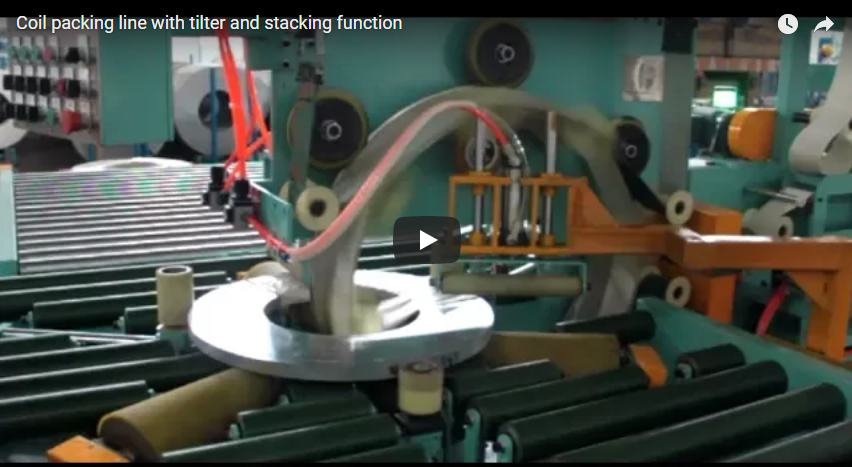
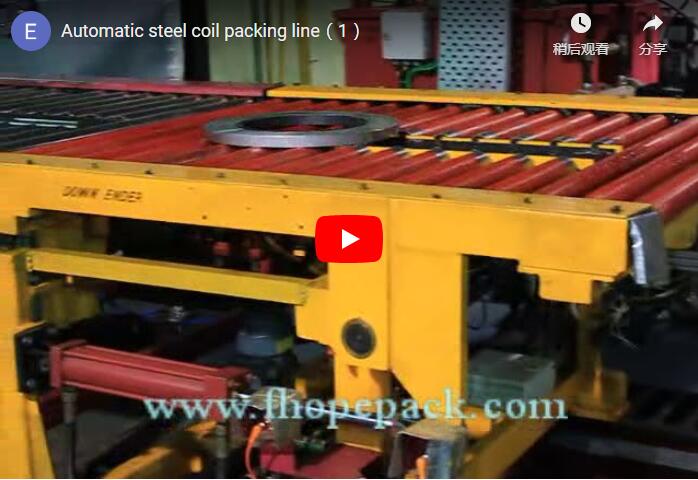
- The circumferential coil strapping machine shown above
Last reviewed: 2026-10-19