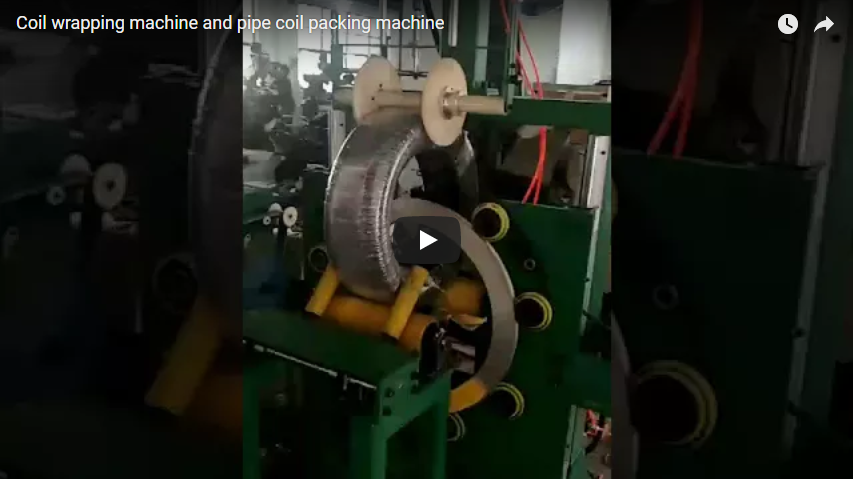
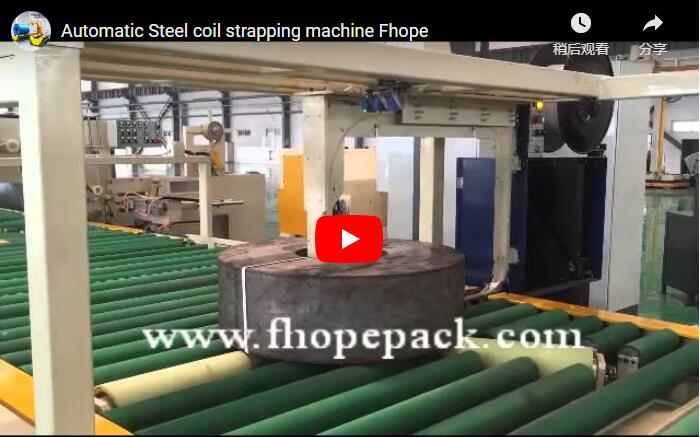
How To Do Tyre Online Packing By Automatic Line

Executive summary This video shows an automatic tyre packing line in operation: stacked tyres are clamped, wrapped in black stretch film by an overhead mechanism, and conveyed away in a continuous flow — with no operator visible on the line. The footage covers clamping, wrapping, and discharge over roughly 100 seconds. What it does not show includes cycle time, capacity, film specifications, and safety certification — all items to verify with the manufacturer before purchase.

If you run a tyre plant, a warehouse, or a distribution centre, you already know the pain of manual tyre wrapping: heavy lifting, inconsistent film coverage, and a packaging step that struggles to keep pace with production. The video on this page shows one answer — an automatic online packing line where tyres travel down a roller conveyor and leave the line already wrapped. This article walks through what the footage actually shows, what it deliberately does not, and what questions you should ask before specifying a similar line.

What the video shows

The footage is a single continuous view of a packing line, sampled at four-second intervals in our analysis. The sequence breaks down like this:

Time What happens
0–8s Two to three stacked black tyres rest on the roller conveyor at the packing station. An orange and white machine frame sits above them, with yellow cylindrical clamping rollers on both sides. No movement yet.
12–20s The overhead mechanism lowers. The yellow clamping elements close inward and grip the tyre stack firmly. The tyres stay essentially in place on the conveyor.
24–32s Black film is dispensed from above and around the stack. The semi-transparent film shows visible wrinkles as it is drawn tight against the tyre surface; film edges drape down toward the conveyor.
36–44s Wrapping is complete. The mechanism lifts, and the tyre stack stands fully enclosed in black plastic film at the same station.
48–60s The wrapped stack travels right along the roller conveyor, leaving the packing station. The frame briefly shows an empty line with black-and-yellow floor warning posts.
60–100s A second view follows a large wrapped cylindrical load moving down the main conveyor. A white control cabinet with orange branding appears at the mid-line, a metal control panel with multiple rows of buttons and knobs is visible, red/green indicator lights flash above the line, and an inclined conveyor appears near the line’s end. The load keeps moving without pauses.

Two things stand out in that second segment. First, the flow is genuinely continuous — the wrapped tyre moves through transitions and toward the discharge end without stopping. Second, the line is unstaffed in every frame we sampled: no operator appears anywhere in the footage.

The machine in action: step by step

Combining both camera passes, the working cycle looks like this:

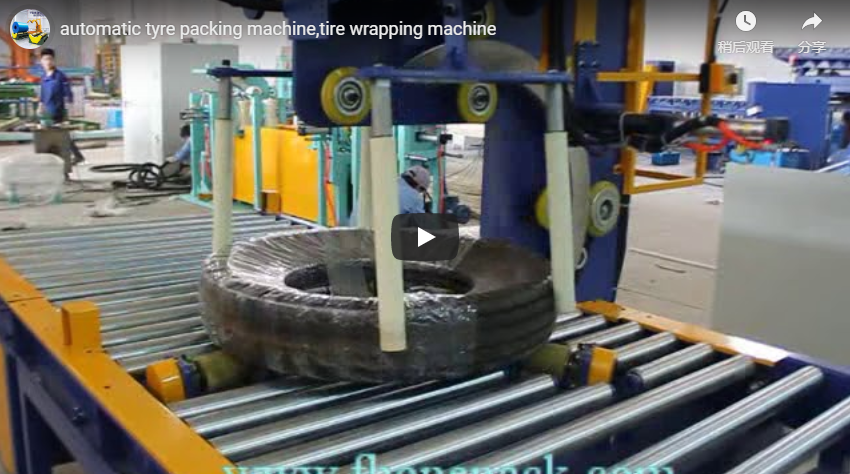
  1. Infeed. Tyres arrive stacked (two to three high, centres aligned) on the roller conveyor at the packing station.
  2. Clamping. The overhead assembly descends and the yellow side clamps close, holding the stack steady.
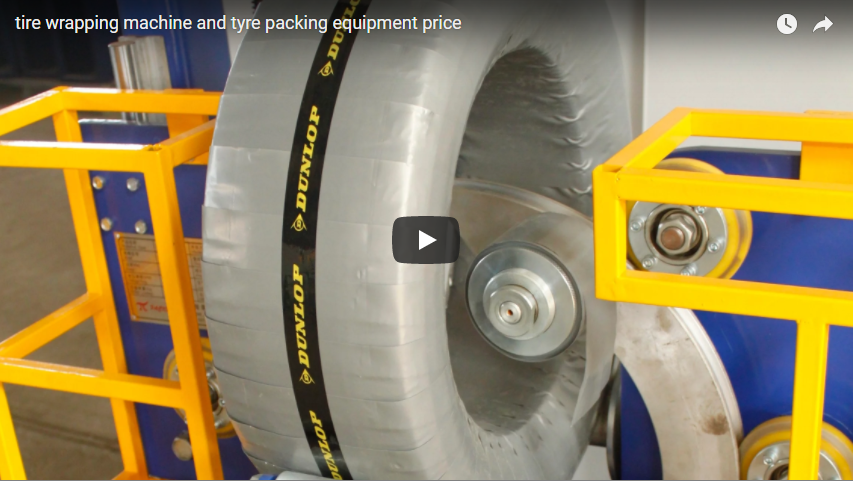
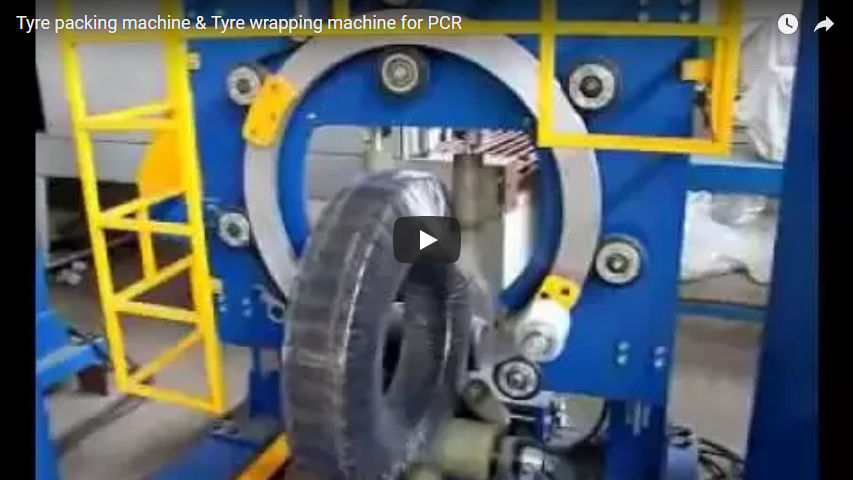
  3. Wrapping. Film is drawn from above and around the load. The black, semi-transparent stretch film conforms to the tyre profile, leaving the characteristic vertical wrinkles of tensioned film.
  4. Release. The mechanism lifts and the clamps open. The wrapped stack is released onto the conveyor.
  5. Discharge. The wrapped load conveys away to the right, passing a transition section and continuing toward the end of the line, where an inclined conveyor and indicator lights mark the exit area.

The video shows the wrapping station completing its basic job — online film application — and the conveyor system moving finished loads out. No labelling, sealing, or cutting step is visible; whether those happen downstream or are handled by other equipment is not shown.

Direct observation notes

The following observations stay close to the frame-by-frame analysis, with only light grammatical editing:

  • The machine frame is white/light-grey painted metal; safety guarding near the mechanism is orange metal mesh; clamping rollers and columns are bright yellow.
  • The conveyor is a multi-section roller line (metal rollers with white side panels) running left to right through the frame.
  • A white cabinet-style control cabinet with vents, latches, and cable glands stands mid-line. A separate silver-grey metal control panel, embedded and holding roughly 12–16 buttons/knobs across at least two rows, with small LED indicators above, is visible; no large touchscreen or digital display was seen, and no labels were readable.
  • An inclined conveyor sits to the right rear of the main line; a white vertical unit with red/green signal lights appears near the line’s end.
  • Tyres in the footage are standard black rubber tyres, roughly 60–80 cm in diameter and 50–70 cm tall by visual proportion, lying with the tread face forward; they never flip or rotate — only slight drift occurs at transitions.
  • Wrapped loads show tight, vertically wrinkled, semi-transparent black film with bright reflective streaks; no tears, stains, or gaps were visible.
  • An orange mesh guard covers part of the mechanism’s travel area; a green glowing device near the inclined conveyor entrance may be a light-curtain indicator. No red emergency-stop button or clear warning signage was visible in sampled frames.
  • Readable text on the equipment includes the manufacturer’s marking on the machine frame; a small white label reading “PACKING MACHINE FOR TIRE” appears on a tyre in one frame; a word on the wrapped film is partially legible but blurred.

What the video does not show

For a buyer, the gaps matter as much as the visuals. The footage does not reveal:

  • Model designation or machine naming.
  • Cycle time per tyre stack, or rated capacity in pieces per hour.
  • Film specification: width, thickness, material (PE/PO/LLDPE), or how film tension is controlled.
  • Power, air, and voltage requirements — no nameplate values are readable.
  • Tyre size range the machine accepts (e.g., which diameters and widths, or whether speciality/off-road tyres are compatible).
  • Control details: PLC type, HMI language options, alarm codes, or fault self-diagnostics.
  • Safety certification marks (CE, UL, or others) — nothing was legible.
  • Maintenance intervals or spare-parts lists.
  • Any sealing, cutting, printing, or weighing step.

Each of these is a genuine selection factor. Treat the video as proof of concept and operating principle, not as a specification sheet.

Why online automatic packing matters for tyres

Tyres are heavy, dark, dust-attracting products that must stay clean and dry through long storage and shipping. Manual wrapping of a stacked set is slow, physically demanding, and inconsistent — coverage depends on whoever holds the film roll. The line in this video addresses those problems in three visible ways:

  • Consistency. Every wrapped load in the footage shows the same full, tensioned film coverage with no gaps.
  • Continuous flow. Loads move through wrap and discharge without stopping, which is what “online” packing means: the packaging step sits inside the material flow rather than beside it.
  • Reduced handling. Nobody touches the tyres during the cycle, which lowers both labour intensity and the risk of scuffed sidewalls or dirty treads.

These are qualitative observations from the footage, not measured productivity claims — ask the manufacturer for cycle-time and capacity figures for your tyre sizes.

Fit checklist: is a line like this right for you?

Use this list before requesting a quotation:

  • Your products are standard cylindrical tyre stacks (the footage shows standard tyre geometry, not speciality shapes).
  • You need dust/moisture protection rather than hermetic sealing (the process shown is stretch wrapping, not vacuum or shrink packing).
  • You can feed the line with stacked tyres, either manually at the infeed or from upstream equipment.
  • You have floor space for a straight-through conveyor layout with a control cabinet at mid-line.
  • You have confirmed cycle time, film spec, and tyre-size range with the manufacturer for your actual products.
  • You have reviewed the guarding and emergency-stop arrangement against your local safety regulations — the video does not show every safety device.

FAQ

Does the machine rotate the tyre while wrapping? No. The footage shows the tyre stack held stationary and vertical while film is applied around it; the load never flips or spins on screen.

Does the line seal or cut the film? No sealing, cutting, or labelling step appears in the video. Only wrapping and conveying are shown — check with the manufacturer how film ends are secured.

Is an operator needed? No operator appears in any sampled frame. The level of supervision and infeed handling required is not shown — confirm with the manufacturer.

What film does it use? Not observable. Film width, thickness, and material must be confirmed with the manufacturer.

What tyre sizes can it handle? The wrapped tyres in the video look like standard automotive/truck tyres of roughly 60–80 cm diameter, but the acceptable size range is not stated — verify with the manufacturer.

Related reading

Next step

The clearest way to judge whether this line suits your tyres is to see it running with products like yours. Contact us to discuss your tyre sizes, output targets, and packing requirements — and to get the cycle-time, film, and safety specifications the video cannot show.


Source and method: this article is based on the video above. Analysis was performed by a vision model on sampled frames; the video contains background music only, with no narration or speech to transcribe. All factual statements trace to visible footage; anything not observable is flagged for confirmation with the manufacturer.

Published: 2026-09-03