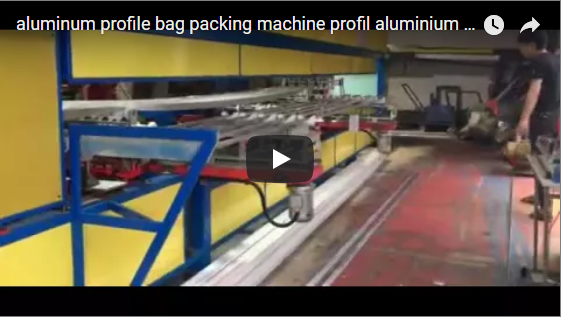
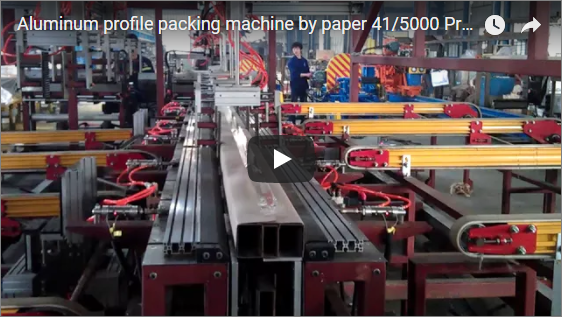
Aluminum extrusion packaging.

Executive summary This video shows a shrink film packaging line for long aluminum extrusion profiles: each profile rides a roller conveyor into a white machine, is wrapped in film that pulls tight against the surface, and is trimmed at a cutter station carrying a Chinese safety warning. At the outfeed a worker in light clothing lifts the wrapped profile off and stacks it by hand onto a wooden pallet, so palletizing in the clip is manual. The footage does not reveal capacity, dimensions, power, or certifications; orbital stretch wrapping figures quoted later come from the manufacturer’s published description and must be confirmed before purchase.

What the video shows

The clip follows a continuous packaging pass for long aluminum profiles on a compact, linear line. The table maps the main observable moments to their approximate timestamps, based on a frame every four seconds.

Time Station Observation
0:00 – 0:08 Infeed Silver-grey profiles are placed on a roller conveyor and carried into the machine.
0:04 – 0:24 Film application White film is applied over each profile and tightened against the surface.
Not time-stamped Cutting A cutter station with a Chinese warning sign handles film trimming.
0:08 – 0:16 Outfeed A worker in light clothing removes the wrapped profile by hand.
120 s – 148 s Repetition The closing footage repeats an earlier segment of dark grey aluminum sheets on a conveyor.

The machine on screen is a shrink film wrapper, not an orbital stretch wrapper. An orbital system holds the bundle still while a film ring rotates around it; here the profiles keep moving through a fixed application zone, and the film is shrunk tight around each profile as it passes. The difference matters for buyers, because the two machines solve different problems: one tensions film around a fixed bundle, the other sealed the surface of a moving profile.

The visible cycle is short and the clip loops. Apart from the opening seconds and the worker at the outfeed, most of the footage is the same pass repeated, and the final frames show a stack of dark grey aluminum sheets moving on a conveyor rather than a new station. What you can rely on from this video is the sequence: feed, film application and tightening, film cutting, manual removal, manual palletizing.

Direct observation notes

These notes describe only what is visible in the footage.

  • Infeed: Long, silver-grey aluminum extrusion profiles enter on a silver metal roller conveyor.
  • Machine color: The body is white, consistent with painted metal or engineering plastic.
  • Film roll: Rolls of white film sit in the supply area in the background.
  • Film behavior: The white film is applied over each profile and conforms closely to the surface, with some wrinkles at the wrapped edges.
  • Cutter station: A horizontal slot and cutter are visible at the machine front.
  • Warning sign: The sign reads 「严禁将手伸入切刀」(strictly do not put your hands into the cutter).
  • Worker role: A worker in light clothing takes wrapped profiles off at the conveyor end.
  • Palletizing: The worker stacks the wrapped profiles by hand on a wooden pallet that already holds other wrapped profiles.
  • Late footage: The final frames show a stack of dark grey rectangular aluminum sheets moving on the conveyor; no worker is present.

Machine structure and layout notes

The line has a linear layout, with the silver roller conveyor running through the whole unit from infeed to outfeed. The white body carries a film supply structure on top, and the film rolls feed continuous wrapping. A cutter station sits at the front of the machine, marked by the Chinese safety sign at the cutting point. No operator screen or control panel is clearly shown in the footage, and no automatic palletizing robot appears at the output. Most elements match a compact film wrapping and shrinking unit rather than a large multi-station line.

What the video does not show

The clip is visual evidence of a wrapping cycle, not a specification sheet.

  • Machine model and brand: Not displayed on the machine body.
  • Rated capacity: Packaging rate per hour is not observable.
  • Cycle time: Time per profile is not shown.
  • Dimensions: Length, width, and height are not measurable from the footage.
  • Power requirements: Voltage and consumption are absent.
  • Certifications: CE, UL, or other marks are not visible.
  • Film type: The specific film material (such as PE or PVC) is not identified.
  • Control system: PLC or HMI details are not shown.
  • Automatic palletizing: The clip shows manual stacking; no auto-stack option appears.

Film wrapping methods: shrink versus orbital — which fits?

The video demonstrates shrink film wrapping, while the site article also covers horizontal orbital stretch wrapping. The table compares the two at the level a buyer can act on.

Criterion Shrink wrapping (this video) Orbital stretch wrapping
Film application A sleeve or bag is applied, then tightened by shrink. A film ring rotates around the stationary bundle.
Fit on the profile Film conforms tightly to the surface shape. Fit depends on stretch and tension control.
Environmental protection Good dust and moisture seal. Good stability; a weaker seal against moisture.
Film economy Higher film usage is expected. High pre-stretch cuts film use (per manufacturer).
Automation Semi-automatic around the manual outfeed shown here. Often fully automatic for long, linear profiles.

Figures for the orbital route come from the published product description rather than this clip. The manufacturer reports mechanical pre-stretch of up to 300%, cutting film consumption by about 40%, with PLC-controlled variable tension and an overlap range of 10% to 80%. Standard machines handle profiles from 2 to 6 meters, extendable to 12 meters, and replacing manual wrapping is said to return on the investment in roughly 12 to 18 months. None of these numbers are visible in the video, so they should be treated as manufacturer data to confirm with a quote.

The operator’s role in this line

The footage makes the manual steps explicit. At the outfeed, a worker in light clothing removes each wrapped profile from the conveyor end and carries it to a wooden pallet, where it is stacked on top of already wrapped profiles. On the infeed side, profiles are placed onto the conveyor, indicating manual loading as well. This is a semi-automatic line: the machine applies, shrinks, and cuts the film automatically, but staffing is still needed on both ends. Buyers planning for labor, floor space, and throughput should factor these manual steps into the comparison against a fully automated line.

What to verify with the manufacturer

Before ordering, confirm the following points with the supplier:

  1. Rated capacity: How many profiles per hour can the line handle?
  2. Cycle time: What is the time per profile, including the shrink step?
  3. Profile size range: Maximum length, width, height, and weight.
  4. Power requirements: Voltage, phases, and consumption.
  5. Certifications: CE, UL, or local compliance marks.
  6. Film type: Recommended film and its cost per profile.
  7. Automation options: Is automatic palletizing or feeding available as an option?
  8. Support: Spare parts, service, and warranty terms.

Frequently asked questions

Is this machine an orbital stretch wrapper? No. The video shows a shrink film wrapping machine. Orbital wrappers rotate a film ring around a stationary bundle, which is not what appears in this clip.

Does the line palletize automatically? Not in the footage. A worker removes the wrapped profiles and stacks them on a wooden pallet by hand. Ask whether an automatic palletizing option exists.

What profile sizes can it handle? The video does not state lengths or cross-sections. The site article, based on the manufacturer’s published description, cites 2 to 6 meter standard lengths extendable to 12 meters — confirm this for your profiles.

Is the shrink film moisture proof? Shrink film forms a tight, closed cover around the profile, which supports a good dust and moisture seal. Formal water or vapor barrier ratings must be confirmed with the manufacturer.

What safety features are visible? The only confirmed safety element is the Chinese warning sign at the cutter station:「严禁将手伸入切刀」, which prohibits reaching into the cutter. Emergency stops, guards, and light curtains are not shown in the frame-by-frame review.

Why film wrapping matters for aluminum profiles

Aluminum extrusions scratch and dent easily during handling, storage, and transport, and a damaged finish leads to rework, scrap, or rejected deliveries. A film layer separated from the surface is a simple physical guard: it keeps abrasive contact away from the extrusion and, with shrink film, closes the cover against dust and moisture. For profiles that will sit in open air for weeks or ship long distances, the cost of the film is small compared with the cost of scrapping a long, high-value extrusion. Whether shrink film or orbital stretch film fits better depends on how the product is stored and shipped, which is exactly the point to settle with the manufacturer.

Related reading

Source and method

This article is based on a frame-by-frame visual analysis of YouTube video YGlYeHwj_YU. A vision language model processed one frame every four seconds (38 frames in total) and the observations were cross-checked against an enlarged pass of the key frames, with the text on the machine signs verified independently. The video contains background music but no voiceover narration. Because the source is 320 × 240 resolution and the later part of the clip loops, all observations are limited to what is visibly present, and technical specifications that are not shown must be confirmed with the manufacturer.

Next step

To size a shrink film or orbital wrapping line for your aluminum profiles, contact our sales team for specifications and a quotation.

Contact Us

Last updated: 2026-08-31.