Executive Summary
Automated tire wrapping equipment replaces slow, inconsistent manual packing by applying orbital and toroidal stretch wrapping to passenger, truck, and heavy-duty OTR tires. Selecting the correct machine requires balancing the tire’s dimensional envelope—Outer Diameter (OD), Inner Diameter (ID), cross-sectional width, and weight—against line cycle times (18 to 50 seconds per unit). Equipment pricing reflects physical ring clearance, structural load capacity, installed drive power, and upstream automation integration, with investment payback achieved through direct labor reduction and high-ratio film pre-stretch savings.
Handling and packaging tires, hose reels, coiled tubing, and circular elastomeric products presents distinct engineering challenges in production and logistics facilities. Conventional manual packaging methods are slow, ergonomically hazardous, and variable, frequently causing transit abrasion, moisture contamination, and erratic material waste. The specialized tire wrapping machine—also designated as an orbital tyre packing machine or toroidal wrapper—is engineered specifically to resolve these physical bottlenecks.
In modern packaging lines, transitioning from manual wrapping to automated ring packaging delivers immediate, measurable gains in cycle throughput, load containment integrity, and resin consumption. This engineering guide details the mechanical principles, operational advantages, sizing parameters, and cost drivers essential for plant managers and packaging engineers specifying equipment.
(Terminology note: This guide uses the U.S. spelling “tire” throughout its technical analysis, while retaining the international and OEM catalog spelling “tyre” within direct citations, formal model designations, and linked reference documentation.)
[ Rotating Toroidal Ring ] / \ +—-/———————–+ | | Tire Cross- | | Film carriage orbits through | | Section Envelope | | the tire bore (Rim ID) while | +———-+———-+ | polyurethane trunnion rollers | | | rotate the carcass on its axis. +————–|————–+ [Driven Rollers]
1. The Core Problem: Why Manual Tire Packaging Falls Short
Tire manufacturing plants, retreading facilities, and distribution hubs face recurring logistical failure modes when relying on manual or semi-manual pallet-turntable wrapping:
- Geometric Inconsistency: Manual film application cannot maintain uniform radial pre-stretch or consistent layer overlap (typically varying from 15% to 70%). This inconsistency leads to moisture ingress, unravelling, and unstable storage stacks.
- High Ergonomic and Labor Burden: Handling passenger tires (8–15 kg) repeatedly causes strain injuries, while commercial truck tires (30–80 kg) and heavy OTR units present severe occupational hazards under plant safety guidelines.
- Film Overconsumption: Hand application cannot achieve mechanical neck-down control or dynamic pre-stretch, consuming up to 3× more Linear Low-Density Polyethylene (LLDPE) than automated powered-carriage systems.
- Surface and Bead Degradation: Inadequate film containment allows UV degradation, ozone cracking, grease contamination, and bead-seat scuffing during intermodal shipping.
- Line Throughput Imbalance: Manual wrapping stations require 90 to 180 seconds per tire, creating an operational choke point behind high-speed curing presses or automated finishing cells.
2.
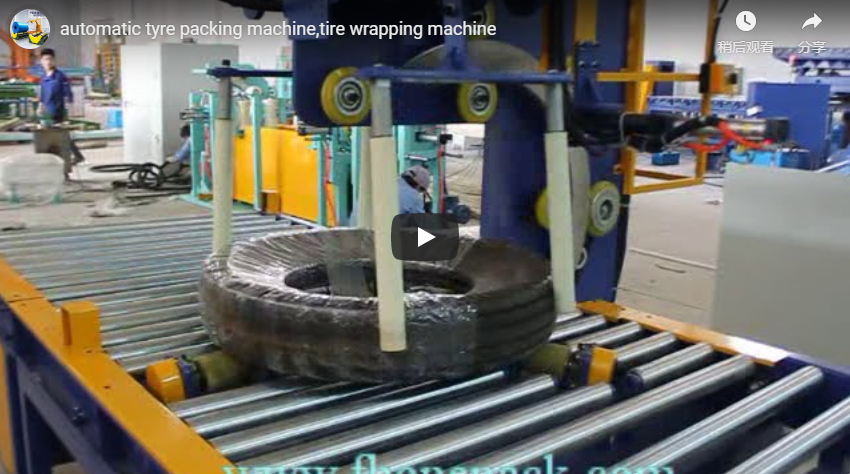
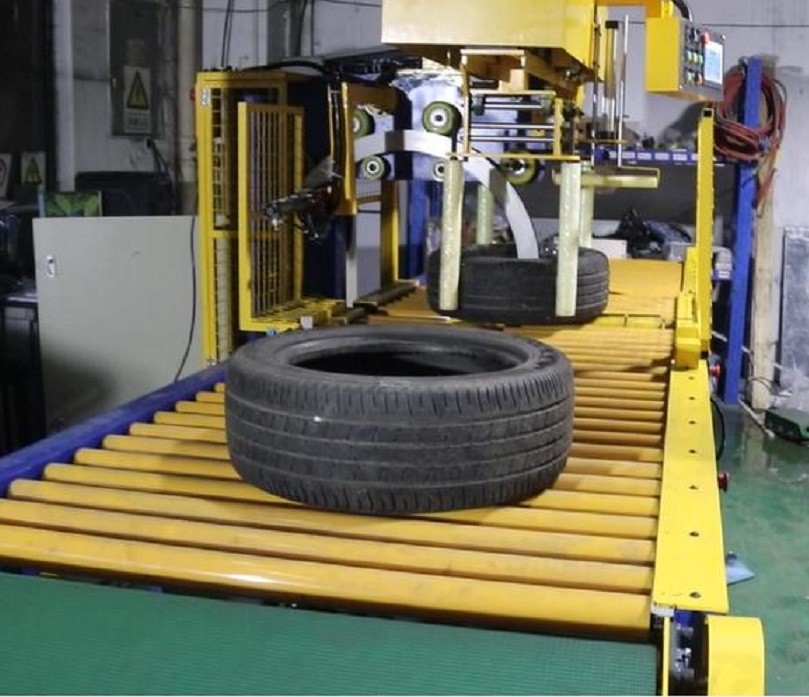
- Infeed & Alignment: The tire enters via gravity-fed, powered roller, or overhead drop-in conveyors, settling into dual polyurethane-coated support rollers that center the carcass relative to the ring’s radial plane.
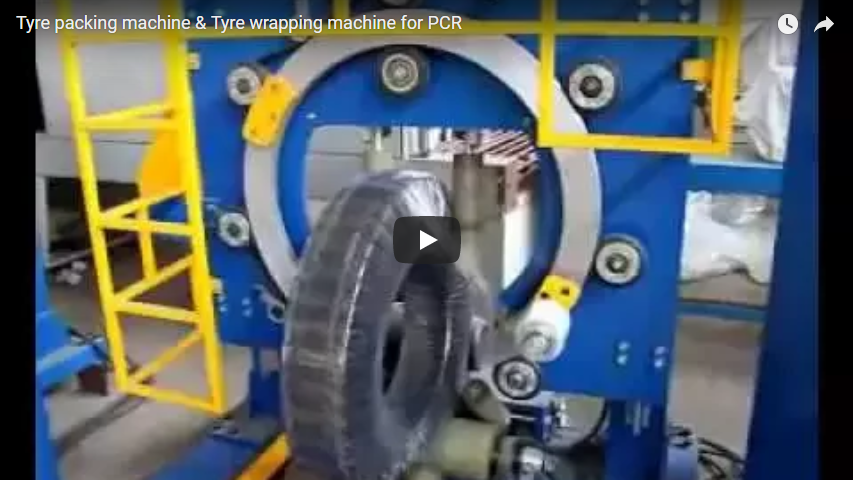
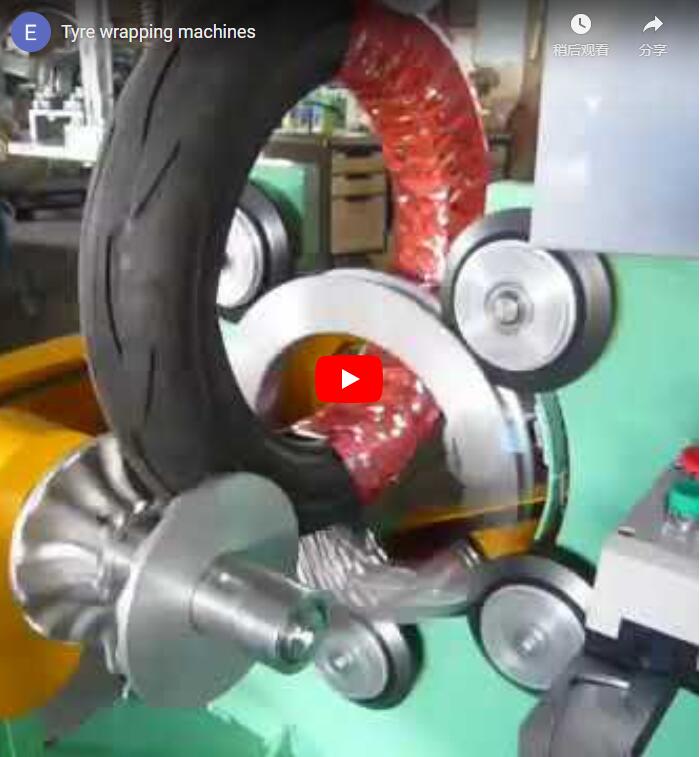
- Toroidal Shuttle Engagement: The rotating ring accelerates to set operational speed, guiding the film dispensing head through the tire’s inner bore and across the outer tread circumference.
- Coordinated Dual-Axis Motion: Surface speed of the driven support rollers matches the ring rotation speed to produce an electronically synchronized overlap ratio:
Overlap Ratio (%) = [1 - (V_tire_surface / (Film_Width × ω_ring))] × 100 - Tension-Controlled Pre-Stretch: A motorized roller system prestretches the film prior to exit. Constant load regulation stabilizes winding tension, preventing bead deformation on unmounted casings.
- Pneumatic Cut & Seal / Taping: At cycle completion, an automated pneumatic arm grips the film, a hot-wire or serrated blade severs the web, and an automated wiping or taping mechanism fixes the film tail securely against the tire tread outer diameter (OD).
- Ejection: Powered pneumatic lift arms or tilting trunnions kick the wrapped product onto the outfeed accumulation conveyor.
3. Key Technical Specifications and Engineering Features
When assessing machinery specifications against plant requirements, focus on kinematic configuration, ring clearances, and structural ratings. FHOPE manufactures dedicated standalone wrapping units tailored to specific product dimensions:
| Parameter | FPT-200 | FPT-300 | FPT-400 |
|---|---|---|---|
| Compatible Tyre ID | 300–700 mm | 500–900 mm | 750–1200 mm |
| Compatible Tyre OD | 510–800 mm | 800–1200 mm | 1000–1400 mm |
| Max Tyre Width | 40–250 mm | 80–300 mm | 80–400 mm |
| Tire Weight Capacity | 10–30 kg | 10–100 kg | 20–120 kg |
| Ring Rotation Speed | 0–120 r/min | 30–110 r/min | 30–80 r/min |
| Cycle Packing Speed | 18–30 s/pcs | 25–40 s/pcs | 35–50 s/pcs |
| Film Overlap Range | 10–80% | 20–80% | 20–80% |
| Installed Drive Power | 1.5 kW | 2.0 kW | 2.5 kW |
| Power Supply | AC 380V / 50Hz | AC 380V / 50Hz | AC 380V / 50Hz |
- Clearance Dimensional Envelope: The wrapping ring’s inner diameter (
D_ring) must comfortably clear the tire cross-section and the revolving carriage footprint:D_ring ≥ Carcass_Height + Carriage_Radial_Projection + Clearance_MarginCrucially, the tire inner diameter (Rim ID) must clear the shuttle carriage profile:Tire_ID_min ≥ Shuttle_Thickness + Film_Spool_Width + clearance(clearance confirmed against the carriage drawing) - Control Integration: PLCs tied to a touch-panel HMI enable operators to store custom wrap recipes (ring r/min, roller drive speed, overlap percentage, reinforcement wraps) by SKU.
- Material Versatility: Standard carriages accept blown or cast LLDPE stretch film, HDPE, PP tape or VCI anti-corrosion film; film thickness and roll size are specified per project.
4. Model Selection: Matching Equipment to Line Geometry
Equipment selection depends strictly on dimensional envelope boundaries, production cadence, and whether standalone operation or continuous inline packaging is required.
Standalone Machine vs. Continuous Automated Line Selection Rule
To determine whether an application requires an individual toroidal wrapping station or an inline continuous packaging system, apply the following operational envelope thresholds:
- Specify an Automatic Tire Packing Line: Select the complete automated line if production fits the standardized operational window:
- Tire Weight: 5–100 kg
- Tire Height (Width): 150–300 mm
- Tire Outer Diameter (OD): 600–1000 mm
- Tire Inner Diameter (ID): 150–500 mm
- Continuous Line Target: 30–35 s/pcs cycle rate
- Plant Infrastructure: Inline powered roller conveyors operating at 2–4 m/min, compressed air supply of 5–7 bar, and electrical connection of approximately 2.2 kW (380V / 50Hz / 3ph). The line carriage utilizes standard stretch film rolls with ID 50 mm, OD 80–120 mm, and width 60–70 mm.
- Specify a Standalone Wrapper (FPT Series): If products fall outside this envelope—such as narrow tires below 150 mm width, large casings with OD up to 1400 mm, internal bores requiring clearances up to 1200 mm ID, or high-mix lines with frequent manual staging—select a dedicated standalone machine:
- Small passenger and motorcycle tires (OD 510–800 mm, weight 10–30 kg): Choose FPT-200.
- Standard passenger, commercial, and light van tires (OD 800–1200 mm, weight 10–100 kg): Choose FPT-300.
- Heavy commercial, bus radial (TBR), and small agricultural tires (OD 1000–1400 mm, weight 20–120 kg): Choose FPT-400.
5. What Drives the Price of a Tire Packing Machine?
The capital acquisition cost for tire packaging equipment reflects machine structural rigidity, mechanical sizing, and automation level. Major pricing variables include:
- Ring Diameter and Structural Frame Rigidity: Larger structural rings designed to wrap casings up to 1400 mm OD require wider fabricated ring gearings, oversized guide wheels, and heavier structural frames to dissipate dynamic centrifugal forces.
- Drive Systems and Dynamic Payload: Moving a 30 kg tire requires moderate torque, whereas rotating a 120 kg commercial tire at high speed demands heavy-duty gearboxes and upgraded variable frequency drives. This drive progression scales directly with installed motor capacity: 1.5 kW on the FPT-200, 2.0 kW on the FPT-300, and 2.5 kW on the heavy-duty FPT-400.
- Automation and Material Handling Upgrades: Standalone operator-loaded stations represent the most economical capital outlay. Upgrading to a continuous automated packaging line (rated at approximately 2.2 kW base drive power) introduces integrated powered conveying systems, 5–7 bar pneumatic centering arms, automated film cutting and clamping mechanisms, and optical sensor positioning.
- Pre-Stretch Carriage Engineering: Basic mechanical friction-brake carriages have a lower initial cost but lack pre-stretch control. Motorized dual-roller powered pre-stretch carriages maximize film yield (delivering up to 200%–300% stretch), cutting long-term resin expenditure.
- Specialized Material and Multi-Dispenser Systems: Carriages engineered to run alternative substrates—such as woven PP tape, reinforced paper, or VCI rust-inhibiting material alongside stretch film—require multi-reel shuttles and dedicated constant-tension brake assemblies.
6. Practical Engineering Purchasing Checklist
Before approving capital expenditure (CapEx) for a tire packaging machine, review this technical criteria checklist:
- Define Product Boundary Dimensions: Document minimum and maximum tire OD, ID, cross-section width, and wet/dry casing weights across all production SKUs.
- Verify Bore Radial Clearance: Confirm that
Tire_ID_min - Shuttle_Profile_Width ≥ 50 mmto prevent mechanical interference during ring rotation. - Calculate Line Tact Time: Verify that machine cycle times (18–30 s on FPT-200, 25–40 s on FPT-300, 35–50 s on FPT-400, or 30–35 s on automated lines) match target hourly cell outputs with a 15% operational buffer.
- Evaluate System Architecture: Match facility layout to either a self-contained standalone wrapping unit or a fully conveyorized automated packing line.
- Verify Pneumatic and Electrical Supplies: Ensure utility feeds support 380V 50Hz 3-phase power and 5–7 bar clean compressed air for automatic cut-and-clamp circuits.
- Audit Film Specifications: Confirm core and roll compatibility (e.g., standard LLDPE or 50 mm ID core, 80–120 mm OD roll for compact shuttles).
7. Conclusion: Specify by Line Parameters, Not Catalog Standards
Selecting the proper tire packaging system requires balancing key physical variables: outer and inner clearance envelopes, casing weights, and line automation levels. Specifying an undersized wrapper causes physical shuttle collisions inside the tire bore, while selecting an oversized machine for small production volumes introduces unnecessary floor space allocation and capital cost.
Review product dimensional limits, verify that the wrapping shuttle clears the minimum tire rim bore, and compare standalone units against integrated packaging lines. FHOPE provides complete mechanical layout drawings, cycle time assessments, and equipment proposals delivered within 24 to 48 hours to match specific plant throughput and dimensional constraints.
Last reviewed: 2026-11-05