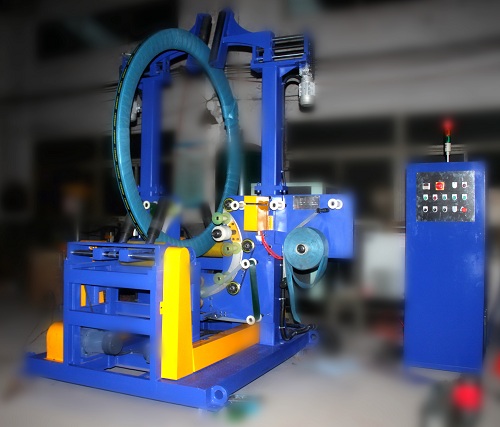
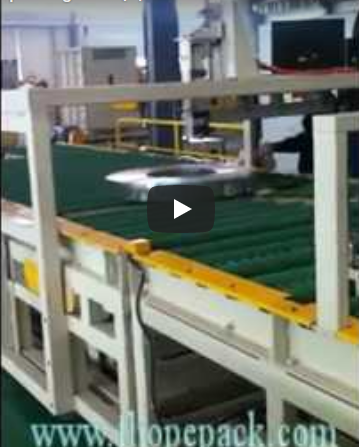
Executive summary A razor wire packing machine wraps a coil of razor or barbed wire in film so the blades are covered before handling and shipping. In this clip the wrap runs from about 4 s to about 20 s, roughly 16 s per coil, inside a yellow mesh guard. Our equivalent solution, the FPW-200W, is specified for 10 to 100 kg coils of 450 to 800 mm OD at 20 to 35 s per coil, configured per project.
Table of Contents
- What the clip shows, in order
- Why razor wire coils are wrapped
- Wrapping cycle time on the clip
- FPW-200W specifications
- Takt check
- Selection checklist for a razor wire packing machine
- Controls and safety
- Engineering FAQ
- Next step
- Related reading
- Sources
What the clip shows, in order
The machine stands inside a yellow welded-mesh guard on a blue base, with a grey control cabinet on the right. The cabinet carries red, green and black buttons, a red, yellow and green lamp column and a red mushroom-head emergency stop.
- 0 to 2 s. The machine is at rest. An operator in a red hard hat places a silver razor wire coil at the wrapping position inside the guard.
- About 4 to 6 s. The operator has stepped back to the control cabinet outside the guard. The machine starts, the coil turns and white film starts to cover the wire.
- About 8 to 18 s. Wrapping continues and the film builds up into a continuous spiral layer. The operator watches from the cabinet and does not intervene.
- About 20 to 28 s. The wrap is complete and the coil rests on the lower support rollers, fully covered.
- About 30 to 46 s. Another wrap runs inside the guard while the operator watches from beside the cabinet.
- About 48 s. The operator bends down and reaches toward the base of the machine while the film is still being wound.
- About 50 s. With the machine at rest, the operator loads a new roll of white strip at the top feed.
Why razor wire coils are wrapped
Razor wire carries sharp blades along its whole length, so every manual touch of a bare coil risks cuts, and loose coils snag on each other in transport. A film wrap covers the blades and holds the coil together, so it can be stacked, labelled and lifted without anyone handling the wire itself.
Our FPW-200W wraps in two layers when needed: an inner layer of stretch film against the wire, and an outer layer of crepe paper, woven belt or HDPE for abrasion and UV protection.
| Wrapping layer | Material on our FPW-200W | Purpose |
|---|---|---|
| Inner | Stretch film (LLDPE) | Covers the blades, holds the coil |
| Outer | Crepe paper, woven belt or HDPE | Abrasion and outdoor protection |
Wrapping cycle time on the clip
| Step on the clip | Time window | Duration |
|---|---|---|
| Loading with the machine at rest | 0 to about 2 s | about 2 s |
| Start and first film layer | about 4 to 6 s | about 2 s |
| Wrapping | about 4 to 20 s | about 16 s |
| Coil at rest, wrapped | about 20 to 28 s | unloading window |
The 16 s wrap on the clip is faster than the 20 to 35 s per coil we quote for our FPW-200W, and we plan with the quoted figure. Overlap is the main lever: a higher overlap gives more film layers and a longer cycle.
FPW-200W specifications
| FPW-200W razor wire wrapping machine | Specification |
|---|---|
| Coil weight | 10 to 100 kg |
| Coil outer diameter | 450 to 800 mm |
| Coil inner diameter | 400 to 600 mm |
| Wrapping speed | 20 to 35 s per coil |
| Overlap rate | 10% to 90%, adjustable |
| Power supply | 380 V, 50 Hz, 3 phase, customisable |
| Control | PLC with HMI touch screen |
Takt check
For an illustrative target of 60 coils per hour, the takt is 3,600 ÷ 60 = 60 s per coil. With a wrap of 20 to 35 s, there are 25 to 40 s left for manual loading and unloading. That fits a single operator who loads the next coil while the wrapped one is lifted out. Above that rate we add a powered infeed and outfeed so loading runs while the ring wraps.
Selection checklist for a razor wire packing machine
- Coil OD, ID and weight range, within 450 to 800 mm OD and 10 to 100 kg on the FPW-200W.
- Inner and outer wrapping material, and overlap.
- Output target per hour and the loading method.
- Guard layout and the operator position for loading.
- Labelling and stacking after the wrap.
Controls and safety
On the clip the operator loads the coil only while the machine is at rest, then steps outside the guard before it starts. That is the rule we build into our equivalent solution. The mesh guard keeps hands away from the turning coil and the film ring, and the red mushroom head stops the machine.
The reach toward the base at about 48 s, with the machine still running, is the move to design out: nobody reaches toward the base or the ring until the machine has stopped. Routine loading and roll changes, as at about 50 s, happen only with the machine stopped at rest.
Stop, isolate and lock out the machine before anyone enters the guard to clear a film break, change the film roll or work on the ring. Wear cut-resistant gloves and sleeves for any contact with an unwrapped razor wire coil.
The standards that apply depend on the destination market. For CE markets, ISO 12100 sets the risk-assessment method and EN 415-10 covers general requirements for packaging machines, which fixes guarding and the emergency-stop arrangement.
Engineering FAQ
Q: How long does it take to wrap a razor wire coil? A: On the clip the wrap takes about 16 s. Our FPW-200W is quoted at 20 to 35 s per coil, depending on coil size and overlap.
Q: What coil sizes fit the FPW-200W? A: Coils of 10 to 100 kg, 450 to 800 mm OD and 400 to 600 mm ID, with overlap adjustable from 10% to 90%.
Q: Which wrapping materials can be used? A: Stretch film for the inner layer, and crepe paper, woven belt or HDPE for the outer layer.
Next step
We size a razor wire packing machine in three steps:
- Submit your layout drawing with the coil OD, ID, weight, wrapping material and output target, to info@fhopepack.com.
- Receive a proposal within 48 hours, including the machine arrangement, the guard layout and the cycle check against your takt.
- Book a site survey so we confirm the loading method, the floor space and the operator position.
Related reading
- Razor wire wrapping machine FPW-200W
- Wire coil wrapping machine FPW-300
- Wire coil wrapping machine with paper
- Coil wrapping machine with taping and label printer
Sources
- Machine specifications and wrapping layers: FPW-200W razor wire wrapping machine product page
- Clip timing: frame timings taken from the clip, 2 s between frames
- Machine in action: the video on YouTube
- Standards scope: ISO 12100:2010, EN 415-10:2014
Last reviewed: 2026-10-05