Executive summary
Corrugated hose — drainage pipe, cable ducting, ventilation hose — ships poorly as loose coils that collapse, pick up dirt and waste floor space. This vertical hose coil wrapping machine winds the hose into a firm ring and seals the coil under protective film, with manual loading and machine winding and wrapping. We build vertical hose coil wrapping machines. Hose range and coil size are confirmed per project.
Table of Contents
- Why hose needs a coil and wrap
- What the machine does
- The winding and wrapping cycle
- Corrugated hose batches
- What the footage shows
- Typical configuration
- Selection checklist
- Operation and safety
- Engineering FAQ
- Next step
- Related reading
- Sources and standards
Why hose needs a coil and wrap
Corrugated hose in loose coils collapses in transit, picks up dirt and wastes warehouse space. A coil that is wound tight and sealed under film holds its shape from the floor to the customer site. Hand coiling hose is slow and uneven, and the loose ends tangle.
A machine that winds the hose into a firm ring and wraps it in the same motion gives every coil the same holding shape. The coil comes off the machine ready to stack and ship. Hose range and coil size are confirmed per project.
What the machine does
The machine is a vertical hose coil wrapping machine. The hose is guided into a central ring track, drive components inside the ring move it along a circular path to form the coil, and film is applied to hold the ring closed. Loading is manual; winding and film wrapping run on the machine.
The finished coil is a firm, uniform ring sealed under stretch film. Small to medium batches of corrugated hose suit this machine well. Hose range and coil diameter are confirmed per project.
The winding and wrapping cycle
The operator guides the hose into the ring track and seats it against the inner guide rollers, then the machine drive moves the hose along the circular path, forming the coil. Film is applied as the ring builds, and the wrapped coil is finished on the machine.
The cycle is a continuous coiling and wrapping motion, with the operator supervising rather than forming the coil by hand. Coil and wrap settings are confirmed per project.
Corrugated hose batches
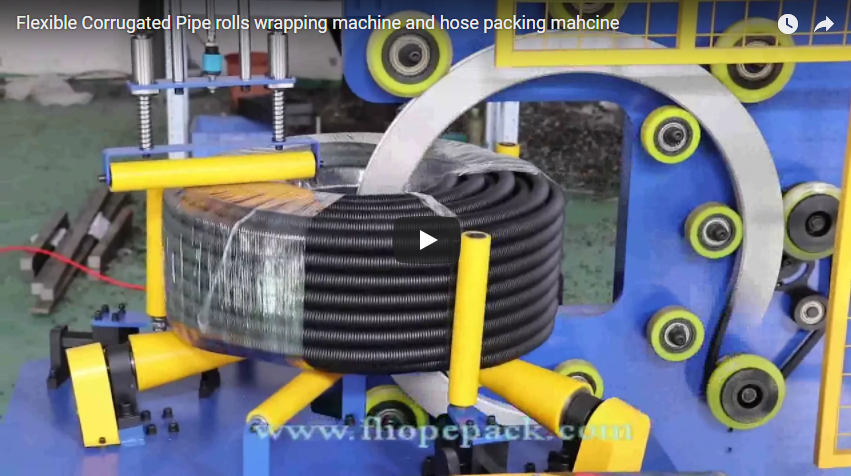
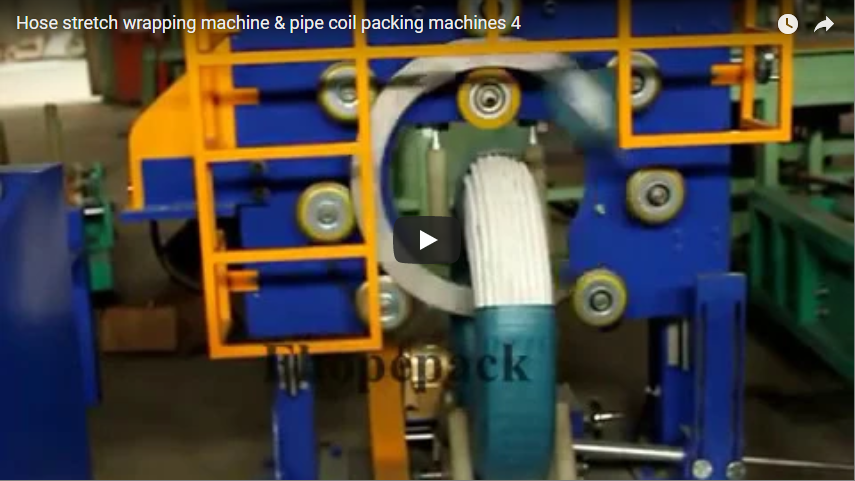
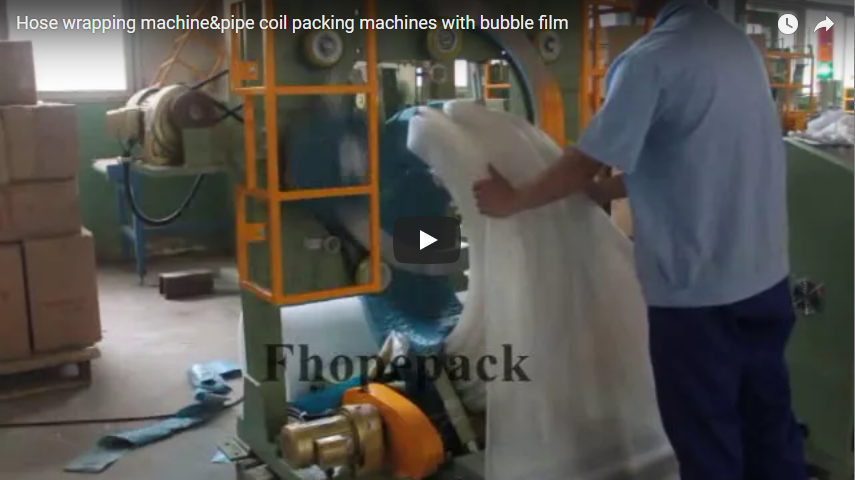
The demonstration coils and wraps blue corrugated hose, the sort used for drainage pipe, cable ducting and ventilation hose. Because loading is by hand, the machine fits plants packing corrugated hose in small to medium batches.
For larger output, coil sizing and line integration can be set to match the batch. The wrapped ring stacks evenly, so more coils fit in the warehouse. Batch size and coil format are confirmed per project.
What the footage shows
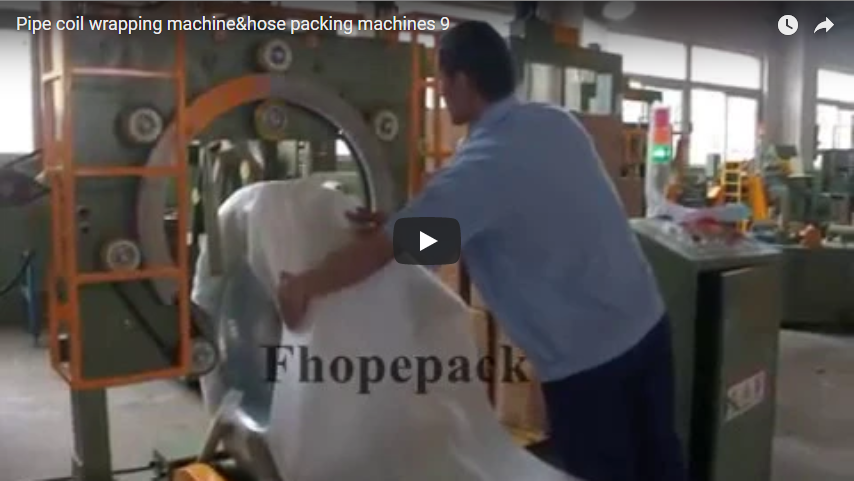
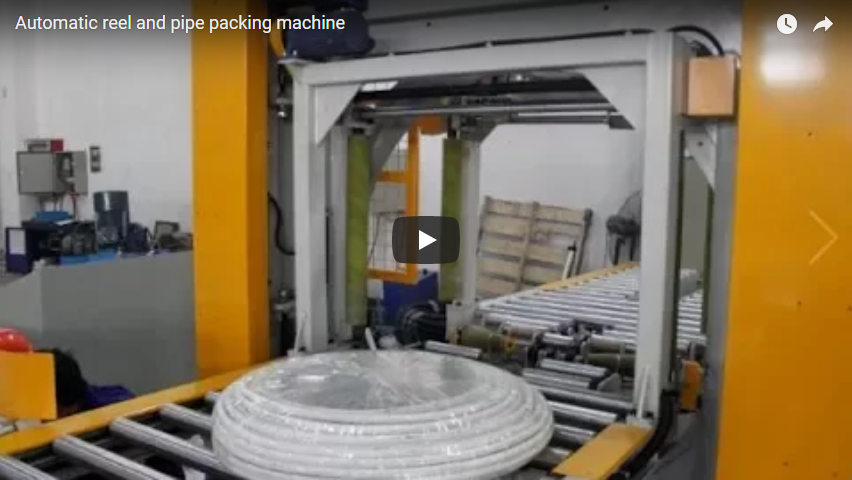
Our footage shows a vertical hose coil wrapping machine winding corrugated hose into a ring and wrapping it with film. It is a general demonstration, so your hose range and coil requirements are confirmed with us per project.
Typical configuration
Figures below list functional design boundaries rather than numeric values, and are confirmed per project.
| Parameter | Typical range, confirmed per project |
|---|---|
| Product | corrugated hose, flexible ducting |
| Coil | vertical ring |
| Wrap | film layer |
| Loading | manual |
| Control | PLC and HMI |
| Electrical supply | 380 V three phase 50 Hz, or 220 V single phase for light machines, selected per project |
Selection checklist
| Question | Confirm per project |
|---|---|
| Hose range | diameters, lengths |
| Coil | diameter, width |
| Wrap | film width, layers |
| Loading | manual or line feed |
| Control | PLC and HMI options |
| Electrical supply | voltage, phase and frequency on site |
Operation and safety
Guide the hose into the ring, then run the cycle from the panel and the machine coils and wraps it automatically. Keep clear of the ring track, drive components and film feed while the machine runs, with guarding and emergency stops at the operator position. The coil is formed inside the machine rather than by hand.
Routine checks cover the ring drive, guide rollers, film unit, sensors and control, per the machine manual. Confirm the coil settings against the hose before each run so coils form tight.
Engineering FAQ
Q: What does the machine do? A: It winds corrugated hose into a vertical ring and wraps the coil with film.
Q: Why coil on the machine? A: A machine-wound ring holds its shape and stacks evenly, unlike a loose hand coil.
Q: Is loading manual? A: The hose is guided in by hand; the winding and wrapping run on the machine.
Q: What hose suits it? A: Corrugated hose such as drainage pipe, cable ducting and ventilation hose.
Q: What does the footage prove? A: A full coil-and-wrap cycle on corrugated hose in one demonstration.
Next step
- Email us at info@fhopepack.com with your hose diameters and lengths.
- We send a coiling proposal and a layout drawing within 48 hours.
- We arrange a site survey to confirm hose range and coil requirements.
Related reading
- PU air pipe coiling machine with bobbin
- Automatic pipe coiler and hose coiling machine
- Hose and cable coil wrapping machine
- FHOPE packing machinery product lines
Sources and standards
- ISO 12100:2010 Safety of machinery, general principles for design and risk assessment
- EN 415-10:2014 Safety of packaging machines, general requirements
- EN ISO 13849-1:2023 Safety of machinery, safety-related parts of control systems
FHOPE vertical hose coil wrapping machine demonstration video. Reviewed as a general demonstration; hose range and coil confirmed per project.
Last reviewed: 2026-10-11