Executive summary Our flat rail transfer cart carries steel coils between bays on a steel track, and the same deck takes moulds and other heavy loads. The video is a load test: the cart stands on its track with a heavy test block strapped to the deck before it ships. A flat cart is the simplest way to move heavy loads without a crane. Where coils must also be lifted or turned, our coil transfer car adds those motions and is built for loads up to 20 t.
Table of Contents
- What the flat rail cart does
- Why we load-test before shipping
- Carrying coils on a flat deck
- Flat cart or coil transfer car
- Sizing wheels and rails
- Controls and safety
- Selection checklist
- Engineering FAQ
- Next step
- Related reading
- Sources
What the flat rail cart does
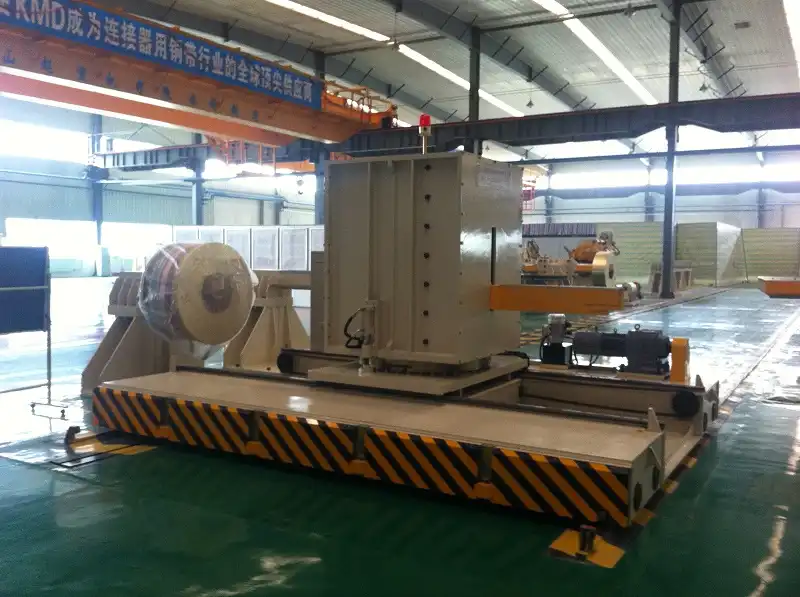
The cart is a heavy flat deck on a welded frame, riding on rail wheels with a motor drive. It runs on a steel track laid in the floor, so it follows the same path every time and needs no steering. A crane or forklift sets the load on at one end of the track, and the cart takes it to the next bay, the packing line or the loading area.
We build these carts to the plant. Track length, deck size and load are set for each project, and auxiliary machines like this one often do not appear on our product pages. We often integrate them into a complete handling line, so the whole route from the mill to the packing area works as one system.
Why we load-test before shipping
Every cart carries a heavy load in our workshop before it ships, and our video is that test. The test block is strapped and blocked to the deck exactly as a real load would be. The frame, the wheels and the drive have all worked under load before they reach your plant.
An empty test run proves the drive works. A load test also proves three things that only appear under weight:
| Check | What we look for |
|---|---|
| Frame deflection | The deck stays flat under the test load |
| Wheels and axles | No binding or uneven wear on the rail |
| Drive and brake | The cart starts, travels and stops smoothly with the load on |
Carrying coils on a flat deck
A steel coil is round, and a flat deck gives it nothing to rest against. Lying with its eye horizontal, the coil can roll when the cart starts or brakes. We fit the deck with a coil cradle or chocks, so the coil sits in a V and cannot move.
For an eye-vertical coil, the coil stands on its flat face and is stable, but it should sit in the centre of the deck so the load spreads evenly over the wheels. Moulds and other square loads go straight onto the deck with blocks and straps, like the test block in our video.
Flat cart or coil transfer car
| Item | Flat rail transfer cart | Coil transfer car |
|---|---|---|
| Motion | Travel on track | Travel on track, lift and rotate the coil |
| Loads | Steel coils, moulds, heavy loads | Steel coils |
| Maximum load | Built to the project | 20 t |
| Turning | None | 360° |
| Control | Control box on the cart | Manual control box or remote, speed-regulating inverter |
| Work mode | Built to the project | Semi-automatic |
The coil transfer car links into a slitting line coil car, a coil turnstile or a coil downender and replaces crane handling between them. If you only need to move loads from one bay to the next, the flat cart is the simpler and lower-maintenance choice.
Sizing wheels and rails
Wheel load decides the wheel diameter, the rail section and the floor under the rail. Add the cart’s own weight to the load and divide by the number of wheels, then allow for an off-centre load.
Illustrative example for a 20 t coil on a cart weighing 5 t, with four wheels:
| Item | Value |
|---|---|
| Load (example) | 20 t |
| Cart weight (example) | 5 t |
| Total | 25 t |
| Even share per wheel, 25 ÷ 4 | 6.25 t |
| With a 25% off-centre allowance | about 7.8 t |
We size the wheels and the rail for the higher figure. The floor under the track has to carry those point loads too, which is why we check the foundation at the site survey.
Controls and safety
The cart in our video carries its own control box with a red emergency stop and a red warning light, so the operator can stop it from the cart side. On our coil transfer car, the control is a manual box or a remote, with an inverter for speed control, and an emergency stop with a position lock holds the car where it stops. Automatic positioning stops it at the loading and unloading points.
The standards that apply depend on the destination market. For CE markets, ISO 12100 sets the risk-assessment method.
Selection checklist for a rail transfer cart
- Heaviest load, and its footprint on the deck.
- Load type: coil eye-horizontal, coil eye-vertical, mould or other.
- Track length and the stations along it.
- Is lifting or turning needed at the stations?
- How the load gets on and off: crane, forklift or line.
- Floor and foundation under the track.
- How the cart is powered along the track.
- Local power supply.
Engineering FAQ
Q: Flat deck or cradle for steel coils? A: An eye-horizontal coil needs a cradle or chocks so it sits in a V and cannot roll when the cart starts or brakes. If the same cart also moves moulds, removable chocks keep the deck flat for them.
Q: How heavy a load can a rail cart carry? A: We build the flat cart to your load. Our coil transfer car with lift and rotation carries up to 20 t.
Q: How do you stop a coil rolling on the deck? A: We fit a coil cradle or chocks so an eye-horizontal coil sits in a V. An eye-vertical coil stands on its face in the centre of the deck.
Q: Why use rails instead of a free-steering vehicle? A: The track fixes the path, so the cart arrives at the same point every time and needs no steering.
Q: Can it link to a coil downender or slitting line? A: Yes. Our coil transfer car connects to a slitting line coil car, a coil turnstile or a coil downender.
Next step
We plan your rail transfer cart in three steps:
- Submit your layout drawing with the track route, load weights and stations to info@fhopepack.com.
- Receive a proposal within 48 hours, with the cart design and wheel loads.
- Book a site survey to check the floor and the track route.
Related reading
- Coil transfer car
- Video: large and long coil upenders in real-world operation
- Video: coil packing machine, packing and handling
Sources
- Cart purpose (steel coils, moulds, heavy loads), load-test video, project-built auxiliary machines: FHOPE engineering team, 2026-10-04
- Coil transfer car data (20 t, 360°, semi-automatic, by orbit, inverter, position lock): coil transfer car page
- Machine in action: our rail transfer cart video on YouTube
- Wheel load example: our worked example, illustrative values
- Standards scope: ISO 12100:2010
Last reviewed: 2026-10-04