Executive summary
A motor sitting on a tray is heavy and awkwardly shaped, and getting a protective film layer onto it by hand is slow and uneven. This orbital horizontal stretch wrapper runs a horizontal film ring along a roller conveyor: the motor, on its paper tray, moves through the ring and the ring orbits the load, feeding stretch film from a supply that rides with the ring and wrapping the surface in a spiral. The film applies while the load stays level, then the wrapped load continues out and the machine cycles onto the next tray. Load size, tray dimensions and film setup are confirmed per project.
Table of Contents
- Why motors need wrapping
- What the machine does
- The film ring orbits the load
- In-line motor flow
- What the footage shows
- Typical configuration
- Selection checklist
- Operation and safety
- Engineering FAQ
- Next step
- Related reading
- Sources and standards
Why motors need wrapping
Motors are heavy, they have exposed surfaces, and they shift on a tray during transport. A protective film layer keeps dust and moisture off the motor and holds it in place for delivery.
Hand wrapping a motor on a tray is slow and applies film unevenly, so the result varies unit to unit. A machine that runs the load through a film ring gives every motor the same coverage. Load and film setup are confirmed per project.
What the machine does
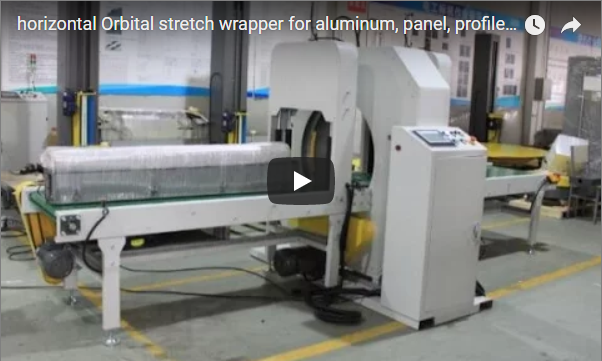
The machine is an orbital horizontal stretch wrapping line for motors on trays. A roller conveyor carries the motor into a large circular ring, and the ring rotates around the load. Stretch film is fed from a supply carried with the ring and laid around the motor in a spiral. The load stays level on its tray through the whole wrap.
The machine cycles continuously: trays enter in sequence, each motor is wrapped as it passes through the ring, and finished loads move out at the far end. Load size, tray dimensions and film width are confirmed per project.
The film ring orbits the load
In an orbital design the wrapping element travels around the workpiece instead of the workpiece spinning. The film ring surrounds the motor and rotates around it, feeding film from the ring supply and laying it over the surface in a spiral. At the end of the pass the ring tightens the film to close the wrap.
Because the load does not rotate, a motor stays balanced on its tray through the whole cycle. Ring movement and film overlap are confirmed per project.
In-line motor flow
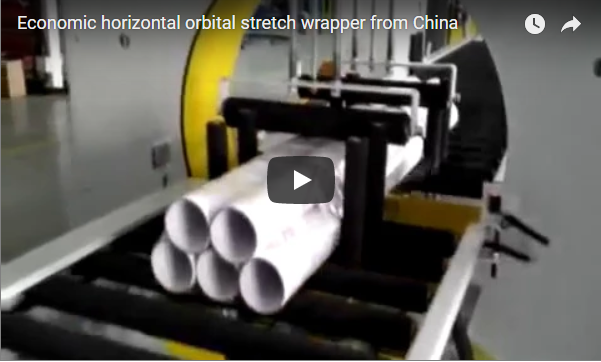
The footage shows motors moving through the machine as a continuous line. Each motor on its tray travels in on the conveyor, passes under and through the film ring, and continues out once wrapped. An operator appears at the machine during parts of the clip, standing clear while the line runs.
The straight-through layout suits production lines where motors arrive one after another. Conveyor length and line speed are confirmed per project.
What the footage shows
Our footage shows an orbital horizontal stretch wrapper wrapping black motors on paper trays with transparent stretch film as they move along a roller conveyor. It is a general demonstration, so your motor size, tray dimensions and film requirements are confirmed with us per project.
Typical configuration
Figures below list functional design boundaries rather than numeric values, and are confirmed per project.
| Parameter | Typical range, confirmed per project |
|---|---|
| Load | motor on a paper tray |
| Wrap | orbital horizontal film ring |
| Film | stretch film, mast fed |
| Conveyor | roller line, in and out |
| Flow | continuous, one tray at a time |
| Electrical supply | 380 V three phase 50 Hz, or 220 V single phase for light machines, selected per project |
Selection checklist
| Question | Confirm per project |
|---|---|
| Load range | motor size, weight |
| Tray | dimensions, load height |
| Film | width, tension, wrap cycles |
| Ring | orbit clearance for the load |
| Conveyor | line speed, infeed height |
| Electrical supply | voltage, phase and frequency on site |
Operation and safety
Start the line from the panel and motors travel through the ring under power. Keep clear of the conveyor, the rotating ring and the film path while the machine runs, with guarding and emergency stops at the operator position.
Routine checks cover the conveyor drives, the film ring, the film mast and the control panel, per the machine manual. Confirm the wrap settings against the motor before each run.
Engineering FAQ
Q: What does this machine do? A: It wraps a motor on a tray with stretch film as the load passes through a rotating ring.
Q: Why do the motors stay level? A: The ring orbits the load, so the workpiece does not spin or tilt during the wrap.
Q: Does it run as a line? A: Yes, motors feed in on a roller conveyor one after another and move out wrapped.
Q: What does it suit? A: Motors and other tray-mounted products with a stable, level base.
Q: What does the footage prove? A: A full feed, wrap and outfeed cycle on an orbital horizontal line in one continuous demonstration.
Next step
- Email us at info@fhopepack.com with your motor size and tray dimensions.
- We send an orbital wrapper proposal and a layout drawing within 48 hours.
- We arrange a site survey to confirm line layout and film requirements.
Related reading
- Horizontal stretch wrapping machine
- Orbital wrapping machines
- Stretch wrapping machines
- FHOPE packing machinery product lines
Sources and standards
- ISO 12100:2010 Safety of machinery, general principles for design and risk assessment
- EN 415-10:2014 Safety of packaging machines, general requirements
- EN ISO 13849-1:2023 Safety of machinery, safety-related parts of control systems
FHOPE orbital horizontal stretch wrapper demonstration video. Reviewed as a general demonstration; motor size, tray dimensions and film setup confirmed per project.
Last reviewed: 2026-10-11