Executive summary A steel pipe bundling line takes tubes from the mill run-out, counts and layers them, forms a bundle, straps it and stacks the finished bundles. Our clip, about 220 s long, shows a magnet gantry over the tube infeed, a truss gantry over the bundle former, a strapping head on a column and finished bundles in the yard. The line runs in three modes and stacks finished bundles five at a time on chains.
Table of Contents
- What the clip shows, in order
- Cycle time on the clip
- How the line counts, layers, bundles and stacks
- Steel pipe bundling line stages
- Takt check
- Selection checklist for a steel pipe bundling line
- Controls and safety
- Engineering FAQ
- Next step
- Related reading
- Sources
What the clip shows, in order
The 220 s clip shows the line installed on site, with blue steel frames, yellow guide posts and grey control consoles.
- About 10 s. A worker in a hard hat and high-visibility vest walks beside the tube infeed conveyor.
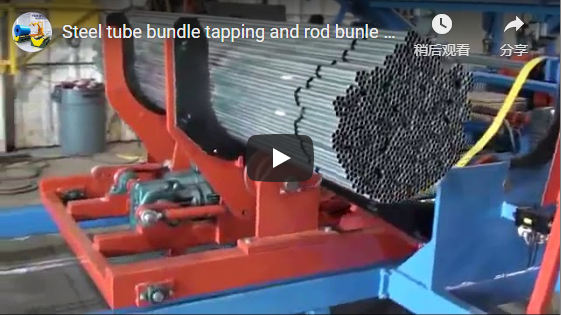
- About 40 s. A yellow magnet lifter on a gantry stands over galvanised round tubes lying on the infeed chains.
- About 70 s. A blue truss gantry spans the bundle former, where yellow posts line up along the bundling station.
- About 100 s. A formed bundle of round tubes lies in the station, with a strapping head on a vertical column and a grey control console in front.
- About 130 to 190 s. The view follows the bundle along the station and closes in on the strapping head.
- About 215 s. Outdoors, finished hexagonal bundles of round tubes lie on a rack of blue frames and rollers.
Cycle time on the clip
| Part of the clip | Time window | Duration |
|---|---|---|
| Infeed and magnet gantry | about 10 to 40 s | about 30 s |
| Bundle former | about 70 s | one view |
| Strapping station | about 100 to 190 s | about 90 s |
| Finished bundles | about 215 s | end of clip |
The clip moves between stations, so these windows are not cycle times. The times come from frames we took at about 30 s steps.
How the line counts, layers, bundles and stacks
Tubes leave the mill on the run-out roller conveyor. A kicker rejects bad tubes into a waste collection system, and the good ones are picked up piece by piece, with an air blower at the pick-up. A second air blower works on the bundle after strapping.
Each tube is pushed to storage against a striker plate, then kicked out one by one onto the layer forming chain. A photocell counts each kick, and the counter resets for the next layer. Rectangular tubes are detected and flipped 90 degrees.
An electromagnetic chuck lifts each finished row and stacks it in the bundle former. The forming device is adjustable to the bundle shape, and stoppers clamp the row tightly. The former contains the sides until strapping is complete.
| Stage | What it does |
|---|---|
| Run-out conveyor and kicker | Takes tubes in and rejects bad ones |
| Layer forming chain | Counts tubes into rows |
| Electromagnetic chuck | Lifts and stacks rows |
| Bundle former | Holds the bundle shape |
| Strapping | Straps the bundle |
| Out-loading conveyor | Sends bundles to chain stacking |
Steel pipe bundling line stages
| Steel pipe bundling line | Stage or feature |
|---|---|
| Infeed | Run-out roller conveyor, rejection kicker, waste collection |
| Counting | Photocell per kick, counter reset per layer |
| Rectangular tubes | Detected and flipped 90 degrees |
| Layering | Electromagnetic chuck row stacking |
| Bundling | Adjustable forming device, sides held until strapped |
| Strapping | Bundle strapping, then the bundling air blower |
| Stacking | Out-loading conveyor, 5 bundles chain stacking |
| Control | Touch screen station, PLC; automatic, semi-automatic and manual |
Takt check
For an illustrative tube mill that cuts one tube every 6 s, a bundle of 60 tubes builds in 360 s. Strapping, transfer and stacking of one bundle then have to fit inside 360 s.
Smaller bundles shorten that time, so the strapping station is the one to size first. The chain stacking of five bundles buffers the out-loading end.
Selection checklist for a steel pipe bundling line
- Tube shapes, round or rectangular, and lengths.
- Tubes per minute from the mill.
- Bundle shape and tube count.
- Strap count per bundle.
- Stacking and pickup at the out-loading end.
Controls and safety
On the clip, a worker walks beside the infeed conveyor while tubes lie on the line. Anyone beside the chains, under the magnet gantry or at the bundle former is the move to design out. We fence the line and set the consoles outside the moving area.
Stop, isolate and lock out the line before anyone frees a tube, clears the former or works at the strapping head. Lower any load on the magnet gantry to rest first, then isolate.
The standards that apply depend on the destination market. For CE markets, ISO 12100 sets the risk-assessment method, and EN 415-10 covers general requirements for packaging machines, which fixes guarding and the stop arrangement.
Engineering FAQ
Q: How does the line count the tubes? A: A photocell counts each tube kicked onto the layer forming chain, and the counter resets for each layer.
Q: Can it bundle rectangular tubes? A: Yes. Rectangular tubes are detected and flipped 90 degrees before layering.
Q: What control modes does it have? A: A PLC with a touch screen runs it in automatic, semi-automatic or manual mode.
Next step
We size a steel pipe bundling line in three steps:
- Submit your layout drawing with the tube sizes, mill speed and bundle plan, to info@fhopepack.com.
- Receive a proposal within 48 hours, with the station list, the bundle former and the cycle check.
- Book a site survey so we confirm the run-out, the strapping method and the stacking area.
Related reading
- Automatic steel pipe bundle packing line
- Steel pipe bundling line: layering, bundling and strapping
- Slit coil packing line: strapping, eye-through wrapping and stacking
Sources
- Line stages: steel pipe bundle packing line page
- Clip timing: frame timings taken from our clip, at about 30 s steps
- Machine in action: our video on YouTube
- Standards scope: ISO 12100:2010, EN 415-10:2014
Last reviewed: 2026-10-05