Executive summary A steel slit coil packing line takes narrow coils from the slitter, turns them, wraps them and moves them on toward stacking, with few manual lifts. Our clip, about 51 s long, follows slit coils through a tilting unit, a ring wrapping station and yellow roller conveyors. The line is rated for 25 to 40 coils per hour, 100 to 4,000 kg and 15 to 500 mm coil width.
Table of Contents
- What the clip shows, in order
- Stations of a slit coil packing line
- Line specifications
- Takt check
- Selection checklist for a slit coil packing line
- Controls and safety
- Engineering FAQ
- Next step
- Related reading
- Sources
What the clip shows, in order
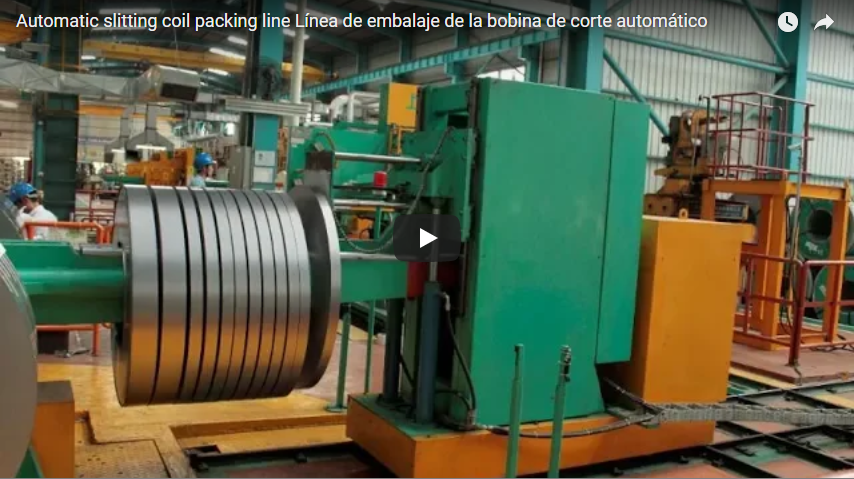
The line is built from blue steel frames with yellow roller conveyors, hydraulic cylinders and drag chains. Control cabinets with touch panels stand beside the stations, and a signal lamp sits on the overhead frame.
- 0 to about 3 s. A silver steel coil sits on a blue and yellow handling unit with rollers and hydraulic cylinders. A worker in green gloves stands near the machine.
- About 6 s. A tilting unit turns a coil between its two positions.
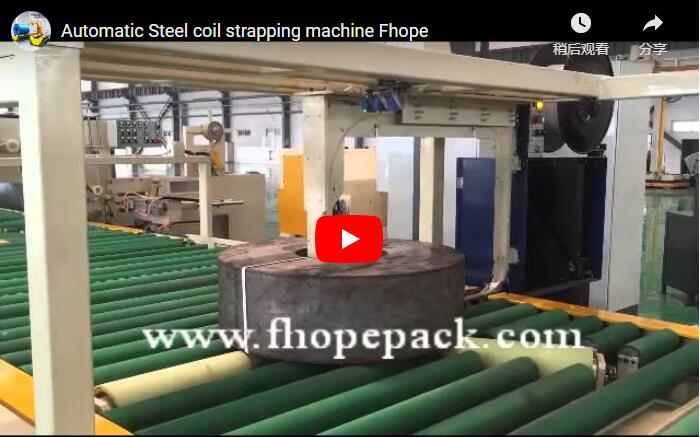
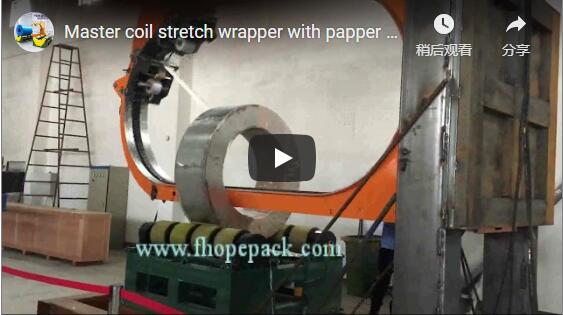
- About 9 to 15 s. At the ring wrapping station a coil on the yellow rollers is being wrapped in film from the head above it.
- About 18 to 21 s. A coil rests on the conveyor under an overhead frame with a green lamp lit.
- About 24 s. A coil sits on a rotating platform in the centre of the line. A worker in a white hard hat stands in the background.
- About 27 to 36 s. A white wrapped coil sits on the rollers under the wrapping head, with the film roll on the head. A worker watches from the side.
- About 39 to 42 s. A conveyor carries flat strip pieces, and wrapped coils stand in the storage racks behind it.
- About 45 to 51 s. The wrapping station runs again and wrapped coils move along the conveyor.
Stations of a slit coil packing line
A slit coil leaves the slitter with its eye horizontal. The line has to wrap it, strap it, and turn it eye-up for stacking on a pallet. The clip covers the turning, wrapping and conveying part of that path. Strapping and stacking are stations on the line but are not part of this footage.
| Station | What it does |
|---|---|
| Coil car or turnstile pick-up | Takes coils off the slitter exit |
| Tilting unit (down-ender) | Turns the coil between eye-horizontal and eye-up |
| Ring wrapping station | Wraps film through the eye, with overlap set per coil |
| Strapping station | PET or steel straps through the eye |
| Roller conveyors and rotating platform | Move and orient coils between stations |
| Stacking station | Stacks wrapped coils on a pallet |
We build the line in three levels. The economic line uses a coiler trolley, a 90° tilting down-ender and a manual jog crane. The standard line adds an exit turnstile pick-up, in-line weighing and automatic or semi-automatic bundling. The advanced line runs automatic strapping, eye-through orbital wrapping and automatic gantry stacking.
Line specifications
| Slitting coil packaging line | Specification |
|---|---|
| Packaging capacity | 25 to 40 coils per hour |
| Coil weight | 100 to 4,000 kg |
| Coil width | 15 to 500 mm |
| Coil outer diameter | 600 to 1,500 mm, up to 2,100 mm on request |
| Coil inner diameter | 508 or 610 mm |
| Strapping cycle | 15 to 35 s per strap |
| Strapping tension | 2,000 to 22,000 N |
| Wrapping overlap | 10% to 90%, orbital eye-through film |
| Stacking accuracy | ±2 mm |
| Utilities | 380 to 480 V, 50 or 60 Hz, 3 phase; air 5 to 8 bar |
| Lead time | 110 to 140 days for fabrication, assembly and FAT |
Takt check
At 40 coils per hour the takt is 3,600 ÷ 40 = 90 s per coil. At 25 coils per hour it is 3,600 ÷ 25 = 144 s.
Each station has to finish inside that window. With strapping at 15 to 35 s per strap, a coil with two straps uses 30 to 70 s of pure strapping time. That leaves 20 to 60 s for indexing and conveying within a 90 s takt. Wrapping time depends on the coil width and the overlap, so we check it per coil range in the proposal. Where one station runs close to the takt, we add a buffer conveyor ahead of it.
Selection checklist for a slit coil packing line
- Coil width, OD, ID and weight range from the slitter.
- Output per hour, matched to the slitter cycle.
- Wrapping material and overlap, and the strap type and count.
- Line level: economic, standard or advanced.
- Stacking pattern, pallet size and labelling.
- Floor space, crane access and the operator positions.
Controls and safety
On the clip workers stand beside the stations while the line runs. A person inside the reach of a tilting unit, a wrapping ring or a moving conveyor is the move to design out. Our lines carry complete perimeter fencing, light curtains and fail-safe interlocks, so the operator works from outside the fence.
Stop, isolate and lock out the station before anyone enters the fence to clear a film or strap break, change a roll or work on a tilter or ring. Restart only after the fence is closed and the interlock is reset.
The standards that apply depend on the destination market. For CE markets, ISO 12100 sets the risk-assessment method and EN 415-10 covers general requirements for packaging machines, which fixes guarding and the stop arrangement.
Engineering FAQ
Q: What output does a slit coil packing line reach? A: Our line is rated for 25 to 40 coils per hour, for coils of 100 to 4,000 kg and 15 to 500 mm width.
Q: Which coil sizes does the line take? A: Coils of 600 to 1,500 mm OD, up to 2,100 mm on request, with 508 or 610 mm ID.
Q: How long does a line take to build? A: Fabrication, assembly and FAT take 110 to 140 days for a standard line.
Next step
We size a slit coil packing line in three steps:
- Submit your layout drawing with the slitter exit, coil range, output target and stacking pattern, to info@fhopepack.com.
- Receive a proposal within 48 hours, with the station list, the line level and the takt check per station.
- Book a site survey so we confirm the floor space, the crane access and the fence layout.
Related reading
- Slitting coil packaging line
- Steel coil packing machine FPS-400
- Coil packing machines
- Steel strip coil packing machine
Sources
- Line specifications and configurations: slitting coil packaging line product page
- Clip timing: frame timings taken from our clip, 3 s between frames
- Line in action: our video on YouTube
- Standards scope: ISO 12100:2010, EN 415-10:2014
Last reviewed: 2026-10-05