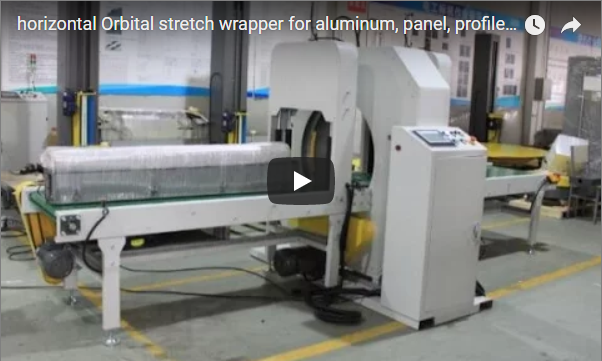
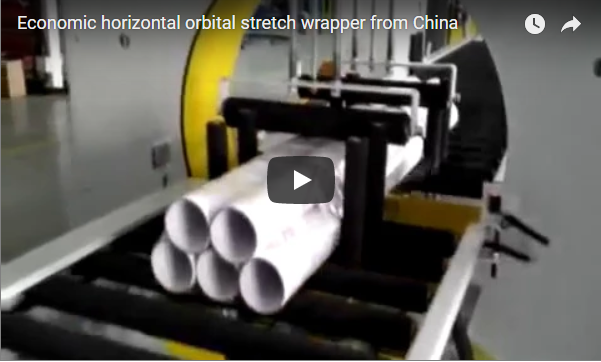
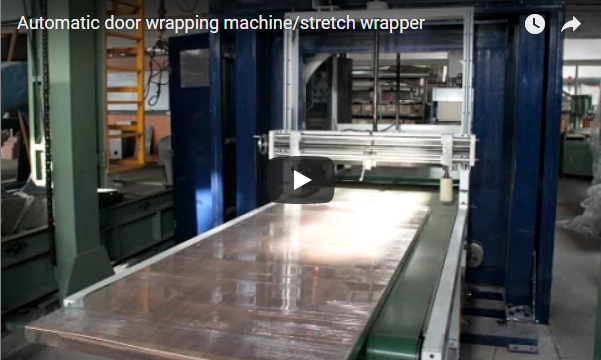
Executive summary Our horizontal orbital wrapper wraps a pallet load as it travels through a rotating ring, so the film passes around the whole cross-section. A chain conveyor moves the pallet, and a transfer conveyor bridges the ring. Our standard range takes loads 800–1,500 mm wide and high at a wrapping speed of 2–9 m/min.
Table of Contents
- How pallet orbital wrapping works
- Size window
- Time per pallet
- Conveyors and film
- Low-volume option
- Utilities and safety
- Selection checklist
- Engineering FAQ
- Next step
- Related reading
- Sources
How pallet orbital wrapping works
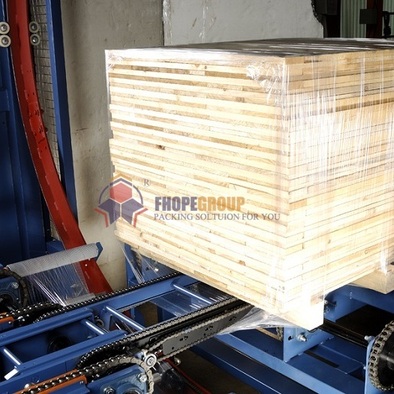
Most people think of a turntable wrapper for pallets, but our horizontal orbital wrapper also packs pallet loads. The pallet travels through the ring on a conveyor. As the ring turns, it lays film around the top, sides and bottom of the load, so the film runs under the pallet and binds load and pallet together.
The load travels straight through and is never spun, as it would be on a turntable.
Because the ring wraps around the travel direction, the front and rear faces of the load stay open; we confirm end-face protection in the proposal if you need it. In our video, a carton pallet passes through the guarded station and leaves wrapped in clear film. This line wraps with film only. If you need straps as well, we add a strapper in the proposal.
At the end of each cycle, the film is cut and sealed automatically. An inverter sets the speed.
Size window
| Parameter | Horizontal orbital stretch wrapper |
|---|---|
| Load width | 800–1,500 mm |
| Load height | 800–1,500 mm |
| Load length | 1,000–6,000 mm |
| Load weight | 100–2,000 kg |
| Ring speed | 30–60 r/min |
| Wrapping speed | 2–9 m/min |
| Overlap | 20–80% |
Most pallets are up to 2 m long, well inside the length window. The width and height of the load, including the pallet, set the ring. Illustrative example: a 1,200 × 1,000 mm pallet stacked to 1,400 mm high passes through the ring with its 1,000 mm side across, so the cross-section is 1,000 × 1,400 mm, inside the window.
Time per pallet
Travel time = load length ÷ wrapping speed. For the 1,200 mm pallet:
- At 9 m/min: 1.2 ÷ 9 = 0.13 min, or 8 s.
- At 2 m/min: 1.2 ÷ 2 = 0.6 min, or 36 s.
A higher overlap needs a slower wrapping speed at the same ring speed. Advance per ring turn = wrapping speed ÷ ring speed: at 9 m/min and 30 r/min it is 300 mm, and at 2 m/min and 60 r/min it is about 33 mm.
Overlap is the share of the film width that the next turn covers, so we set these speeds with the film width in your proposal. Infeed, transfer, film cut and outfeed add to every cycle, so we time the full cycle on your pallet before quoting pallets per hour.
Conveyors and film
| Item | Specification |
|---|---|
| Pallet conveyor | chains |
| Ring transfer | transfer conveyor between infeed and outfeed, needed in most layouts |
| Wrapping material | PE film, stretch film, knit belt or VCI paper |
| Film end | cut and sealed automatically |
Chains carry the pallet by its bottom boards. The transfer conveyor keeps the pallet supported while the ring passes underneath it.
Low-volume option: wrapping from the forklift
For lower volumes, our patented orbital wrapper works with the load still on the forklift. The operator places the pallet in the machine frame and stays on the truck, running the cycle by remote control. The ring orbits the load, and the wrapping unit moves back and forth to set the overlap.
Utilities and safety
| Utility | Requirement |
|---|---|
| Power | 6.5 kW |
| Power supply | AC 380 V, 50 Hz, or your requirement |
| Speed control | inverter |
In our video, the wrapping station sits inside a mesh guard. The standards that apply depend on the destination market. For CE markets, ISO 12100 sets the risk-assessment method and EN 415-10 sets general requirements for packaging machines.
Selection checklist for a pallet orbital wrapper
- Pallet size and load height.
- Heaviest load.
- Pallets per hour.
- Film only, or film plus straps.
- Inline with chain conveyors, or forklift loading.
- Wrapping material: stretch film, PE film or VCI paper.
Engineering FAQ
Q: Why use an orbital wrapper instead of a turntable for pallets? A: The orbital ring wraps under the pallet as well as around it, binding load and pallet together. The load also moves straight through without being spun.
Q: What load sizes fit? A: Loads 800–1,500 mm wide and high, 1,000–6,000 mm long, up to 2,000 kg.
Q: How long does one pallet take? A: For a 1,200 mm pallet, 8–36 s of travel at 2–9 m/min, before transfer and film cut.
Q: Why does the pallet conveyor use chains? A: Chains move the pallet on its bottom boards, and a transfer conveyor supports it across the ring.
Q: Do we need a conveyor line? A: Not for low volumes. Our forklift orbital wrapper wraps the load while it stays on the truck.
Next step
We size your pallet orbital wrapper in three steps:
- Submit your layout drawing with pallet sizes and pallets per hour to info@fhopepack.com.
- Receive a proposal within 48 hours, with the ring, conveyors and cycle time.
- Book a site survey to fit the wrapper to your line.
Related reading
- Horizontal orbital wrapper for pallets
- Forklift orbital pallet wrapper
- Horizontal orbital stretch wrapping machine
- Automatic pallet wrapping machines
- Video: fully automatic pallet wrapping machinery line
Sources
- Pallet orbital wrapping, chain and transfer conveyors, auto cut and seal: horizontal orbital wrapper for pallet page
- Size window, speeds, power: horizontal orbital stretch wrapping machine page
- Forklift option: forklift orbital pallet wrapper page
- Machine in action: our pallet orbital wrapper video on YouTube
- Standards scope: ISO 12100:2010, EN 415-10:2014
Last reviewed: 2026-10-04