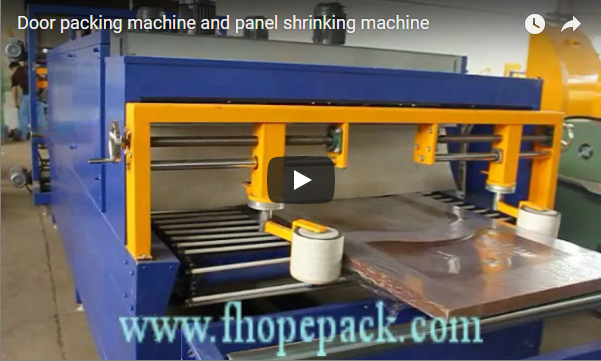
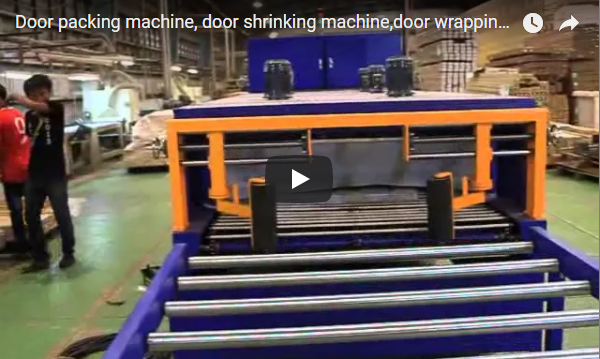
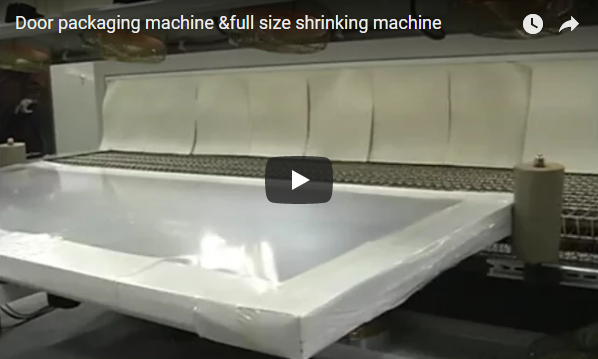
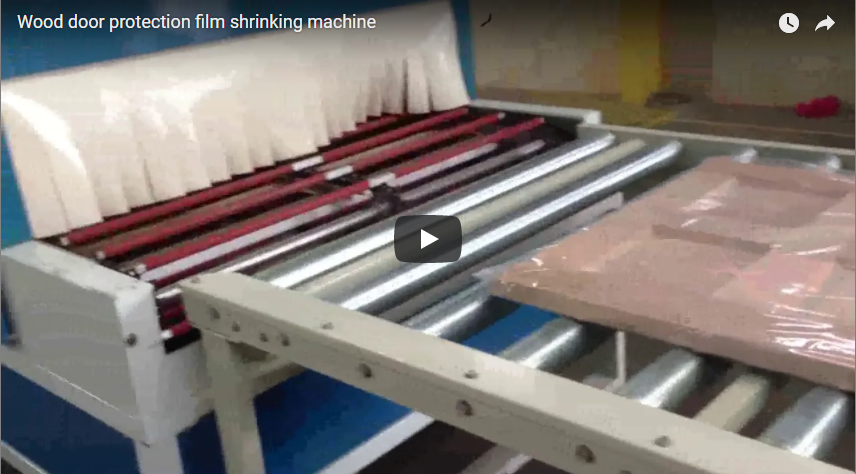
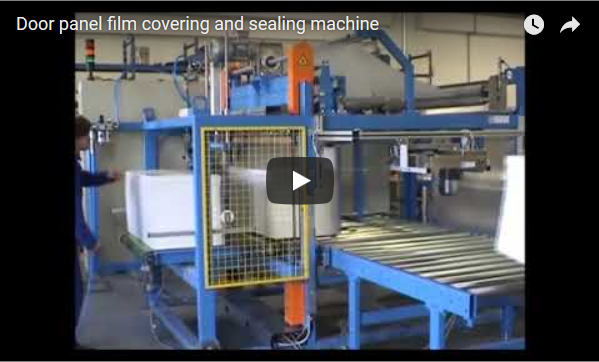
Executive summary This clip shows one of our door and panel packing lines in a customer’s hall. Operators lay panels on a green belt infeed, a sealer wraps each panel in film and seals it, and a shrink tunnel pulls the film tight before the panel runs out on rollers. Our door shrink machine adds two upright press rolls after the tunnel to square the edges. Below we cover the steps, why the film is sealed before shrinking and a worked example for film size.
Table of Contents
- What the clip shows
- Why seal first, then shrink
- Door shrink machine features
- Film size per door
- Selection checklist
- Safety
- Engineering FAQ
- Next step
- Related reading
- Sources
What the clip shows
| Step | What you see |
|---|---|
| Loading | Two operators lay yellow panels on a long green belt infeed |
| Sealing | The panels run into a sealing machine with a touch screen, where film is wrapped round and sealed |
| Shrinking | A shrink tunnel with blue covers and a red curtain heats the film tight |
| Outfeed | The packed panels run out on a roller table |
| Result | The last frame shows packed panels stacked on pallets in the hall |
Sealed and shrunk film keeps dust, scratches and moisture off the door faces in storage and transport.
Why seal first, then shrink
- Closed package. The sealer closes the film round the panel, so the tunnel has a sealed bag to shrink.
- Tight fit. Heat pulls the film tight to the panel faces and edges.
- Square edges. Press rolls after the tunnel push the film flat on the two long sides.
- One pass. Loading, sealing, shrinking and outfeed run in one line, so each panel is handled once.
Door shrink machine features
Our door shrink wrap machine has these published features:
| Feature | Published detail |
|---|---|
| Edge finish | Two vertical press rolls flatten the film on both sides right after shrinking |
| Sealer | Single sealing station before the tunnel |
| Controls | HMI for settings and alarm display |
| Tunnel conveyor | Solid steel poles with silicone rubber tube, chain-driven |
| Cooling | Cooling fan after the tunnel |
| Products | Wooden doors, plastic panels and boards |
Each line is customized, so conveyor lengths and sealing size are matched to your door sizes.
Film size per door
Worked example (illustrative).
| Item | Value |
|---|---|
| Door size (illustrative) | 2,100 × 900 × 45 mm |
| Girth round the door, 2 × (900 + 45) | 1,890 mm |
| Film length per door, 2,100 + 2 × 100 mm end allowance | 2,300 mm |
| Film area per door, 1.89 × 2.30 | about 4.3 m² |
We set film width and seal size from your door sizes during the proposal.
Selection checklist
- Door or panel length, width and thickness.
- Door weight.
- Doors per hour.
- Film type and thickness.
- Manual loading or a conveyor from the finishing line.
- Stacking or palletizing after the outfeed.
Safety
- Keep hands clear of the sealing frame and knife.
- The tunnel and curtain are hot; let panels cool on the outfeed.
- Stop the line before clearing a film jam.
- For CE markets, the line is designed to ISO 12100 and EN 415-10.
Engineering FAQ
Q: What sets the film width? A: The door girth: a 900 × 45 mm section has a girth of 1,890 mm in the worked example, plus seal allowance.
Q: Why press the edges after shrinking? A: Two upright press rolls push the warm film flat on both long sides, so the edges stay tidy.
Q: How do panels pass through the tunnel? A: On chain-driven steel poles covered with silicone rubber tube, so the film does not stick.
Q: Which products can it pack? A: Wooden doors, plastic panels and boards.
Q: How much film does one door use? A: About 4.3 m² for a 2,100 × 900 × 45 mm door in the worked example.
Q: How is the line set up? A: Settings and alarms are on the HMI.
Q: Which standards apply? A: For CE markets, ISO 12100 and EN 415-10.
Next step
We size a door packing line in three steps:
- Submit your layout drawing with door sizes, weights and doors per hour, to info@fhopepack.com.
- Receive a proposal within 48 hours with the machine data and layout.
- Book a site survey so we confirm the infeed and outfeed.
Related reading
- Door and Panel Shrink Packaging Machine
- Automatic Panel Sealing and Shrinking Machine
- Panel Bubble Film Sealing and Cutting Machine
- Door shrink wrap machine
Sources
- Clip: the video on YouTube
- Press rolls, sealer, HMI, tunnel conveyor, cooling and products: door shrink wrap machine
- Film size: our worked example, illustrative values
- Standards scope: ISO 12100:2010; EN 415-10:2014
- Proposal timing: approved house CTA (proposal within 48 hours)
Last reviewed: 2026-10-10