> **Executive summary**
> Cable sold by the coil has to arrive with an exact length, tied turns and a clean cover, so cable plants coil, strap and shrink-wrap in one line.
> Our line does all three: a coiler with red feed rollers winds green cable on a mandrel, a yellow strapping head ties the coil, and a shrink tunnel heats the film tight around it.
> Turns and film size follow from the **cable length** and the **coil size**. All are set per project.
Table of Contents
- What the video shows
- How the coiling, strapping and shrink line works
- Turns per coil
- Shrink film size
- Controls and safety
- Selection checklist for a cable coiling and packing line
- Engineering FAQ
- Next step
- Related reading
- Sources
What the video shows
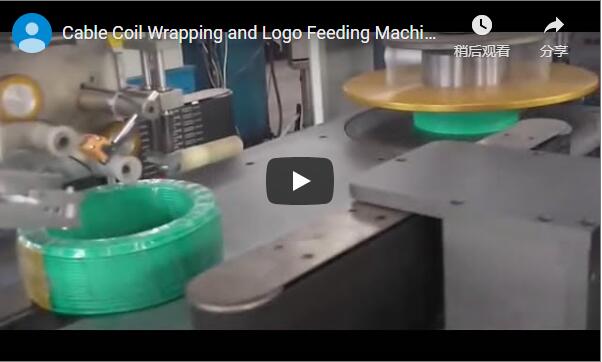
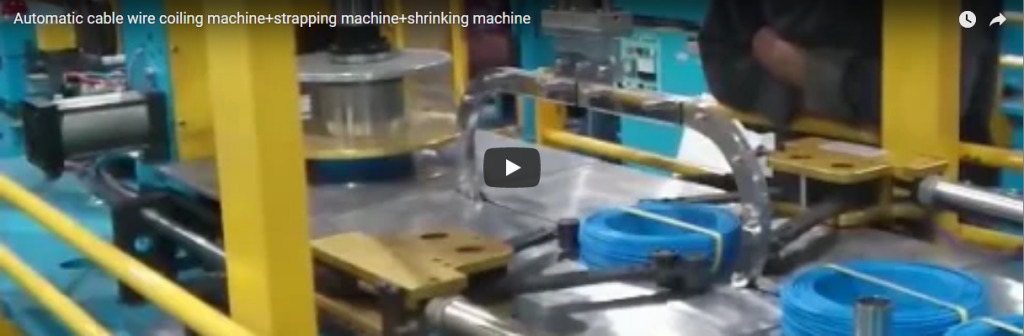
Green cable runs from a spool through red feed rollers into the coiler, beside a blue cabinet and silver control panel. The cable winds onto a turning mandrel as the coiling head moves across to lay tight turns.
The finished coil moves to the yellow strapping station, where a strap goes round it. It then runs on a conveyor into a long shrink tunnel, where the clear film on the coil is heated tight, and the packed coil leaves on the conveyor. Yellow fencing encloses the line.
How the coiling, strapping and shrink line works
| Station | What it does |
|---|---|
| Coiler | Feeds cable through the rollers and winds it on the mandrel |
| Transfer | Moves the coil off the mandrel |
| Strapping | Ties the coil so the turns hold |
| Shrink tunnel | Heats film tight around the coil |
| Outfeed | Carries the packed coil out |
Strapping before shrinking holds the turns, so the film shrinks onto a coil that keeps its shape. For coils covered with stretch film instead, see our [economic cable coil packing machine](https://www.fhopepack.com/videos/economic-cable-coil-packing-machine-wire-wrapping-machine/).
Turns per coil
Turns follow from the cable length and the mean coil diameter. Illustrative example for a 100 m coil:
| Item | Value |
|---|---|
| Coil ID (illustrative) | 180 mm |
| Coil OD (illustrative) | 260 mm |
| Mean diameter, (180 + 260) ÷ 2 | 220 mm |
| Length per turn, π × 0.22 m | about 0.69 m |
| Turns, 100 ÷ 0.69 | about 145 |
The coiler counts length, not turns, so the coil length stays exact even if the diameter varies a little.
Shrink film size
The film has to cover the coil face to face with enough to close. Illustrative example for the same 260 mm OD coil, 100 mm high:
| Item | Value |
|---|---|
| Coil OD | 260 mm |
| Coil height (illustrative) | 100 mm |
| Closing allowance each side (illustrative) | 30 mm |
| Film width, 260 + 100 + 2 × 30 | 420 mm |
Taller coils need wider film. We set the film size from your largest coil.
Controls and safety
The mandrel, strapping head and shrink tunnel run inside the yellow fence, and the tunnel is hot. Keep people outside the fence while the line runs, and clear jams only with the station stopped.
The standards that apply depend on the destination market. For CE markets, ISO 12100 sets the risk-assessment method and EN 415-10 sets general requirements for packaging machines.
Selection checklist for a cable coiling and packing line
- [ ] Cable diameter and type.
- [ ] Coil length, ID, OD and height.
- [ ] Coils per hour.
- [ ] Straps per coil.
- [ ] Shrink film type and thickness.
- [ ] Floor space and power supply.
Engineering FAQ
Q: Why strap before shrink-wrapping?
A: So the turns hold and the film shrinks onto a coil that keeps its shape.
Q: How does coil size affect the number of turns?
A: Turns = length ÷ (π × mean diameter). A 100 m coil at a 220 mm mean diameter has about 145 in our example.
Q: How wide should the shrink film be?
A: Coil OD plus height plus closing allowance. Our 260 mm OD, 100 mm high coil needs about 420 mm.
Q: Does the coiler count turns or length?
A: Length, so the coil length stays exact.
Q: Is the line guarded?
A: Yes. Yellow fencing encloses the line.
Next step
We plan your cable coiling and packing line in three steps:
1. **Submit your layout drawing** with cable sizes, coil lengths and output to **info@fhopepack.com**.
2. **Receive a proposal within 48 hours**, with the coil, strap and film plan.
3. **Book a site survey** to check the line layout and floor space.
Related reading
- [Automatic coil packing line](https://www.fhopepack.com/Automatic-Coil-Packing-Line/)
- [Video: automatic steel wire coiler for wire winding and strapping](https://www.fhopepack.com/videos/automatic-steel-wire-coiler-for-wire-winding-and-strapping/)
- [Video: double wall corrugated hose coiling and strapping machine](https://www.fhopepack.com/videos/double-wall-corrugated-hose-coiling-and-strapping-machine/)
- [Video: cable coil packing machine for small-ID wire coils](https://www.fhopepack.com/videos/cable-coil-packing-machine-and-wire-packing-machine/)
Sources
- Machine content: FHOPE engineering team, 2026-10-04
- Turns and film examples: our worked examples, illustrative values
- Machine in action: [our video on YouTube](https://www.youtube.com/watch?v=3RD6ifUnGKs)
- Standards scope: [ISO 12100:2010](https://www.iso.org/standard/51528.html), [EN 415-10:2014](https://www.nen.nl/en/nen-en-415-10-2014-en-191845)
Last reviewed: 2026-10-04