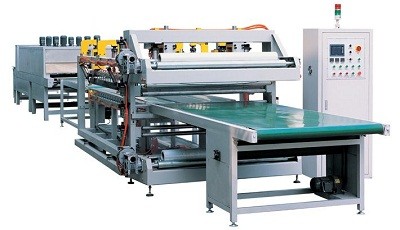
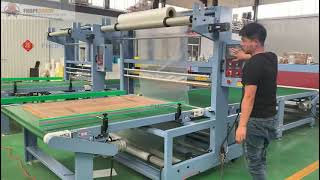
Executive summary This clip from our workshop shows our bubble film sealing and cutting machine for panels. A panel runs on a belt conveyor between a lower and an upper bubble film web, and a heated bar seals and cuts the film round it. Our sealing station takes panels 900–2,400 mm long and 20–100 kg at about 4–9 m/min. Below we cover the steps, how the station seals, the data and a worked example for panels per hour.
Table of Contents
- What the clip shows
- How the sealing station wraps a panel
- Sealing station data
- Panels per hour
- Selection checklist
- Safety
- Engineering FAQ
- Next step
- Related reading
- Sources
What the clip shows
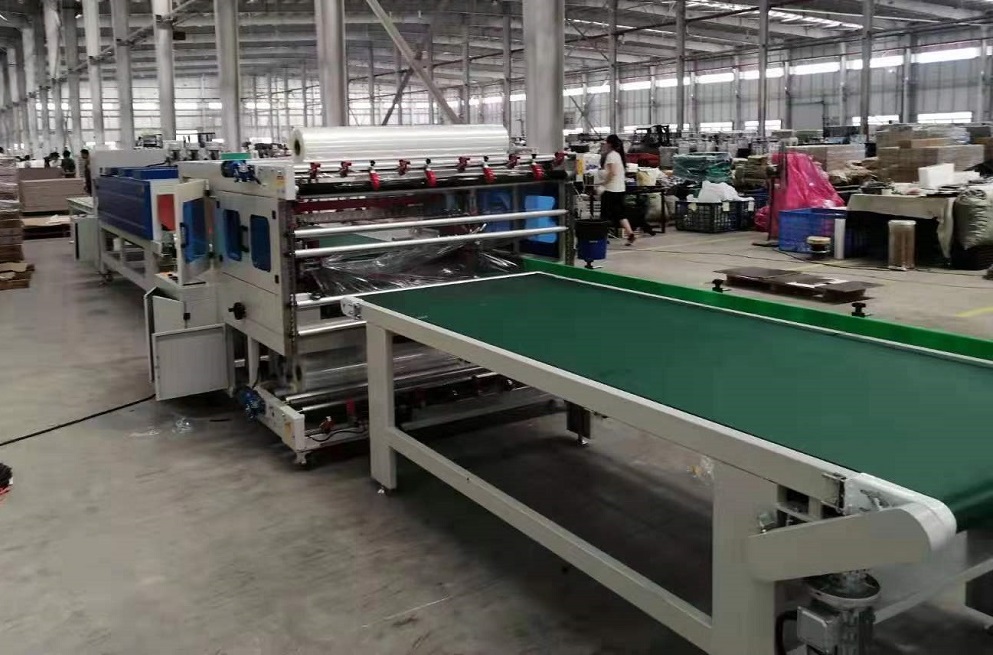
The clip is filmed in our workshop on a bubble film sealing and cutting machine for panels.
| Step | What you see |
|---|---|
| Film rack | A bubble film roll sits on a low floor-level rack at the infeed, with a second roll above the conveyor |
| Infeed | A panel runs on a green belt conveyor between the lower and upper bubble film webs |
| Sealing | A sealing frame with a heated bar seals the film round the panel and cuts it off |
| Controls | A touch screen, a temperature display, a start button and an emergency stop sit on the machine |
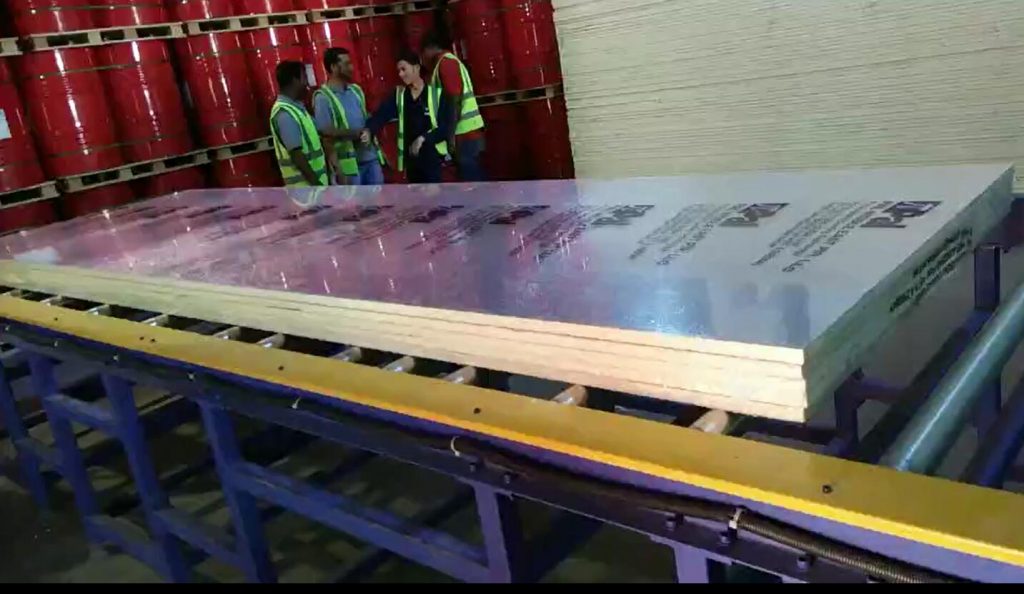
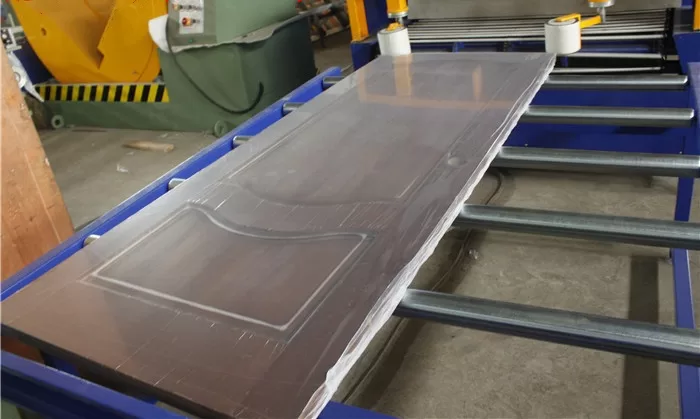
| Result | Close-ups show clear, straight seams along the bubble film envelope |
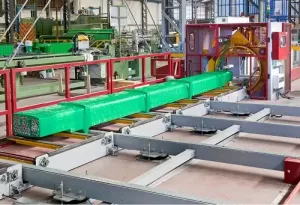
The low film rack lets one person change a heavy bubble film roll without lifting it overhead. The YouTube title notes that the machine connects with a shrink wrapper; the clip itself shows the sealing and cutting station.
How the sealing station wraps a panel
- Two webs. Bubble film runs from a roll below and a roll above, so the panel enters between two layers.
- Position. A photo-eye detects the panel and sets its position before sealing.
- Three sides. The two webs are already joined ahead of the panel by the previous cross seal, so the machine seals the other three sides automatically and the panel ends up in a closed envelope.
- Constant heat. The seal bar stays heated, and the PLC controls and checks its temperature.
- Height. The sealing height is adjusted to the panel thickness.
Sealing station data
Our published data for the sealing part of our bubble film wrapping line:
| Item | Published value |
|---|---|
| Panel length | 900–2,400 mm |
| Panel width | 200–1,200 mm |
| Panel height | 100–800 mm |
| Panel weight | 20–100 kg |
| Working table height | About 800 mm |
| Conveyor speed | About 4–9 m/min |
| Sealing power | About 6.5 kW |
| Power supply | 230 V, 3-phase, 50 Hz |
| Air supply | 6–8 kgf/cm² |
| Control | PLC |
The machine can be designed for other package sizes.
Panels per hour
Worked example (illustrative). A 2,000 mm panel with a 500 mm gap to the next one needs 2.5 m of conveyor per panel. At 6 m/min that is 6 ÷ 2.5 = 2.4 panels per minute, or about 144 panels per hour, if sealing keeps up with the conveyor. Seal and cut time per panel lowers this, so it is checked on a trial run.
Selection checklist
- Panel length, width and thickness.
- Panel weight.
- Bubble film width and roll size.
- Panels per hour.
- Stand-alone, or linked to stretch wrapping or shrinking as in our bubble film end sealing and orbital wrapping line.
Safety
- Keep hands away from the seal bar; it stays hot between cycles.
- Use the emergency stop before clearing film.
- Change film rolls with the conveyor stopped.
- For CE markets, the machine is designed to ISO 12100 and EN 415-10.
Engineering FAQ
Q: What does this machine do? A: It encloses a panel in bubble film from a lower and an upper roll and seals and cuts the film round it.
Q: How many sides does it seal? A: It seals the other three sides automatically, so the panel is closed in a bubble film envelope.
Q: What panel sizes fit? A: Length 900–2,400 mm, width 200–1,200 mm and height 100–800 mm on our published data.
Q: How heavy can the panel be? A: 20–100 kg.
Q: How fast is the conveyor? A: About 4–9 m/min.
Q: How many panels per hour? A: About 144 per hour is the conveyor-limited figure at 6 m/min in the worked example; real output is lower by the seal and cut time per panel.
Q: Why is the film rack low? A: So one person can load a heavy bubble film roll without lifting it overhead.
Q: Which standards apply? A: For CE markets, ISO 12100 and EN 415-10.
Next step
We size a bubble film sealing machine for your panels in three steps:
- Submit your layout drawing with panel sizes and weight, film width and panels per hour, to info@fhopepack.com.
- Receive a proposal within 48 hours with the machine data and layout.
- Book a site survey so we confirm the line layout and any link to wrapping or shrinking.
Related reading
- 6-Side Sealed Furniture Packaging: Bubble Film End Sealing and Orbital Wrapping
- Automatic Profile and Panel Bagging and Shrinking Line
- Sandwich Panel Wrapping Machine: Orbital Stretch Wrap Inline
- Bubble film wrapping line data
Sources
- Clip (our footage): the video on YouTube
- Panel range, conveyor speed, film, power, air and control: bubble film wrapping line data
- Panels per hour: our worked arithmetic
- Standards scope: ISO 12100:2010; EN 415-10:2014
- Proposal timing: approved house CTA (proposal within 48 hours)
Last reviewed: 2026-10-10