Executive summary Our horizontal orbital ring wrapper wraps wide, flat bundles of sheet metal and building panels as they pass through a rotating ring. Two models cover most bundles: E1400 for widths up to 1,400 mm and E1800 for widths up to 1,800 mm. Check three things: bundle width and height, the bundle diagonal against the ring, and film use per metre of bundle.
Table of Contents
- How the wrapper handles flat bundles
- Choosing E1400 or E1800
- Ring clearance
- Film use per metre
- Protecting the sheet surface
- Utilities and safety
- Selection checklist
- Engineering FAQ
- Next step
- Related reading
- Sources
How the wrapper handles flat bundles
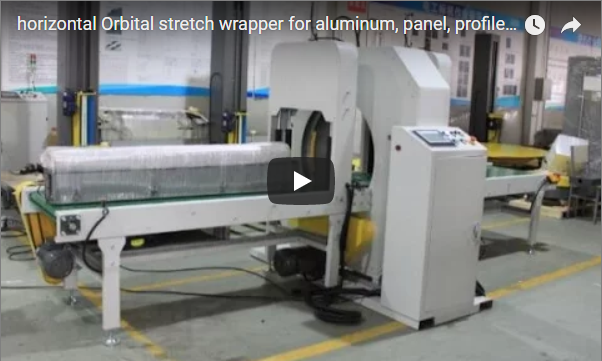
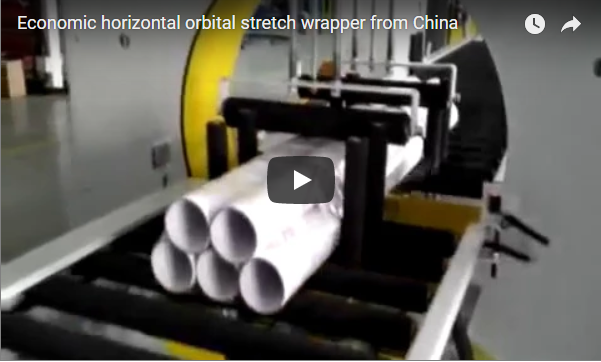
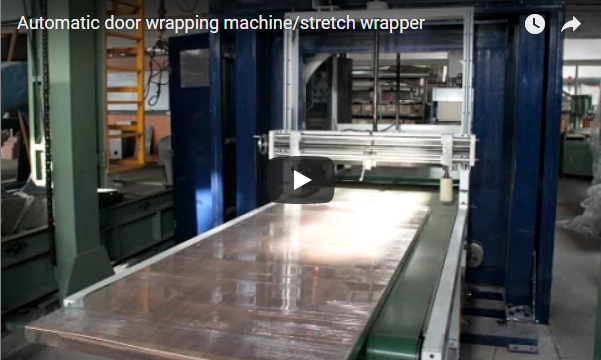
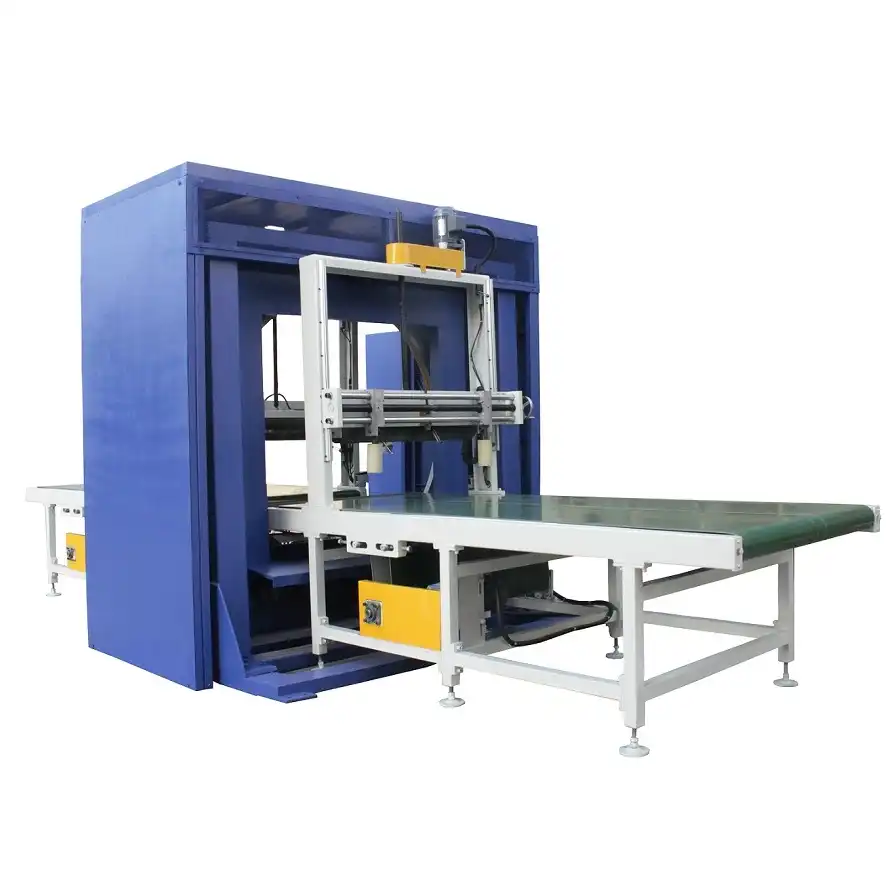
In this installation, our ring wrapper packs stacked sheet bundles for the building materials industry. The infeed conveyor carries each bundle into the ring. The ring turns around it while the conveyor moves it forward, so the film is laid as a spiral, and the outfeed conveyor takes the wrapped bundle away.
The wrapper works online with a production line or offline as a standalone station. A sensor detects the bundle and starts each action. The film seals the bundle against dust and moisture and keeps the sheets together.
Choosing E1400 or E1800
| Parameter | E1400 | E1800 |
|---|---|---|
| Bundle width | 300–1,400 mm | 400–1,800 mm |
| Bundle height | 50–1,000 mm | 50–1,500 mm |
| Bundle length | 1,000–3,000 mm | over 1,200 mm |
| Max. bundle OD (ring pass-through) | confirmed in proposal | under 1,800 mm |
| Conveyor speed | 4–15 m/min | 4–15 m/min |
| Ring speed | 10–60 r/min | 10–60 r/min |
| Film width | 300 or 500 mm | 250, 300 or 500 mm |
| Power | about 4.5 kW | about 4.5 kW |
The width and height limits are not meant to be used at their maximum together: a 1,400 × 1,000 mm bundle has a diagonal of about 1,720 mm, so the ring clearance below decides. For example, an illustrative bundle of 1,250 mm wide sheets stacked 300 mm high fits the E1400. A bundle 1,500 mm wide needs the E1800.
Ring clearance
A flat bundle passes the ring corner first, so its diagonal matters as well as its width. Diagonal = √(width² + height²):
- 1,250 × 300 mm: diagonal about 1,285 mm.
- 1,500 × 400 mm: diagonal about 1,552 mm, inside the E1800 limit of under 1,800 mm OD.
We check the diagonal of your largest bundle, including any edge protectors, against the ring before we fix the model.
Film use per metre
Each ring turn lays film around the bundle perimeter. A quick estimate for a 1,250 × 300 mm bundle:
- Perimeter. 2 × (1,250 + 300) = 3,100 mm, so each turn uses about 3.1 m of film on the bundle.
- Turns per metre. With 500 mm film at 50% overlap, the bundle advances 250 mm per turn, so 4 turns per metre.
- Film per metre. 4 × 3.1 m = about 12.4 m of film laid on each metre of bundle. This is the film as applied. Because stretch film elongates under tension, less length comes off the roll, and we measure the real roll use on a trial bundle.
Overlap is adjustable from 10% to 90%. A higher overlap adds protection and film. We confirm the setting on a trial bundle.
Protecting the sheet surface
Sheet metal and coated panels scratch easily, so the wrapper protects the surface while it wraps:
- Soft rollers contact the product surface.
- Press-down devices are built in different versions to suit the load shape.
- Automatic protective devices keep the bundle from shaking during wrapping.
- Conveyors are PVC belt, roller or chain, chosen for the load.
Film tension is adjustable. The double ring runs on friction drive wheels, and the friction between the wheels and the ring is adjustable for steady turning.
Utilities and safety
| Utility | Requirement |
|---|---|
| Power | about 4.5 kW, AC 380 V, 60 Hz, 3 phase |
| Film roll | E1800: OD 100–220 mm, ID 50 or 76 mm |
| Conveyors | 2,000 mm infeed and outfeed |
| Compressed air | confirmed in your proposal |
All moving parts are in a closed structure, with guardrails and soft start. The standards that apply depend on the destination market. For CE markets, ISO 12100 sets the risk-assessment method and EN 415-10 sets general requirements for packaging machines.
Selection checklist for a sheet bundle wrapper
- Bundle width, height and length, smallest and largest.
- Bundle diagonal, with edge protectors.
- Sheet surface: bare, coated or film-laminated.
- Bundles per hour and target overlap.
- Conveyor type: PVC belt, roller or chain.
- Online with the line, or offline.
Engineering FAQ
Q: Which model fits a 1,250 mm wide sheet bundle? A: The E1400, which takes bundles 300–1,400 mm wide and 50–1,000 mm high. At 300 mm high, the diagonal is about 1,285 mm, and we confirm the ring clearance in the proposal.
Q: Why check the bundle diagonal? A: The bundle passes the ring corner first. A 1,500 × 400 mm bundle has a diagonal of about 1,552 mm, inside the E1800’s under 1,800 mm limit.
Q: How much film does one metre of bundle use? A: About 12.4 m for a 1,250 × 300 mm bundle with 500 mm film at 50% overlap.
Q: How do you avoid scratching coated sheets? A: Soft rollers contact the surface, and press-down and protective devices keep the bundle from shaking.
Q: Can the wrapper run without a production line? A: Yes. It works online with a line or offline as a standalone station.
Next step
We size your sheet bundle wrapper in three steps:
- Submit your layout drawing with bundle sizes and bundles per hour to info@fhopepack.com.
- Receive a proposal within 48 hours, with the model, conveyors and film setting.
- Book a site survey to fit the wrapper to your line.
Related reading
- Horizontal stretch wrapper E1400
- Horizontal stretch wrapper E1800
- Customize orbital wrapper
- Video: horizontal orbital stretch wrapper and horizontal wrapping machine
- Video: automatic horizontal wrapping machine and orbital wrapper
Sources
- E1400 window, wrapping station, protective devices: E1400 horizontal stretch wrapper page
- E1800 window and film: E1800 horizontal stretch wrapper page
- Machine in action: our horizontal orbital ring stretch wrapper for sheet metal video on YouTube
- Standards scope: ISO 12100:2010, EN 415-10:2014
Last reviewed: 2026-10-04