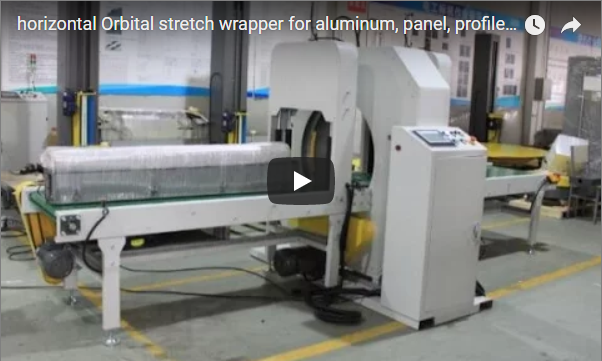
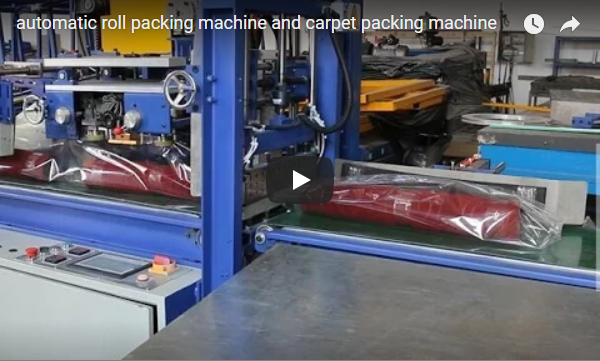
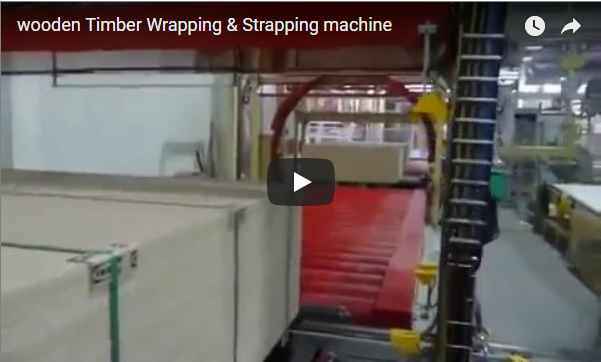
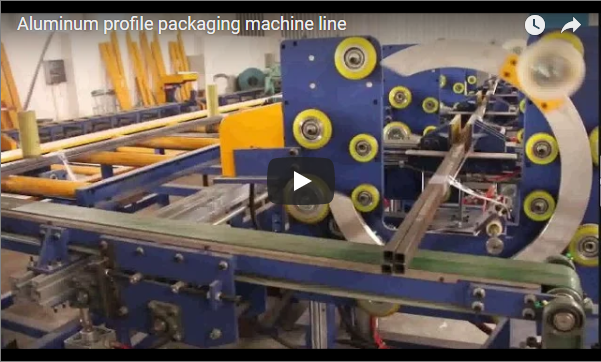
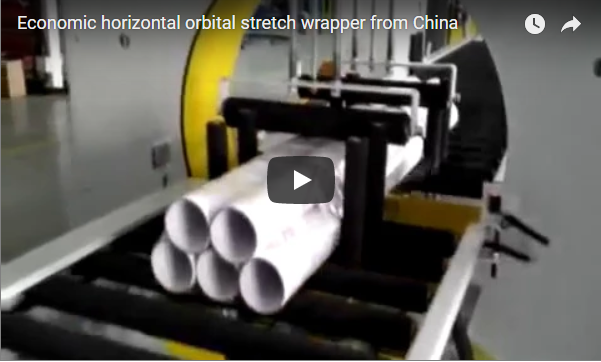
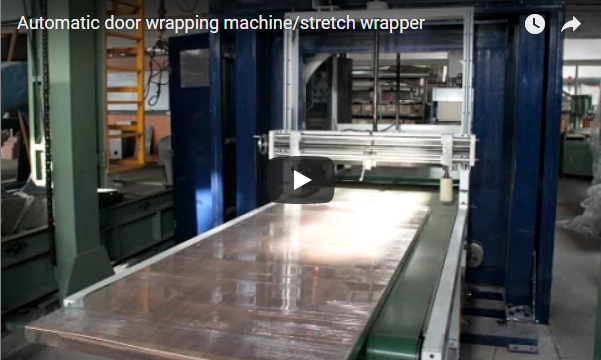
Executive summary This clip shows our orbital stretch wrapper set up straight after a baler. Each compressed bale rides on roller tables through a vertical ring, white film builds up round its four long sides, and the wrapped bales collect on the outfeed table. Our horizontal orbital wrapper for bales takes loads 800–1,500 mm across and 1,000–6,000 mm long, with a six-side option that also closes the bale ends. Below we cover the cycle, the data and a worked example for wrap time.
Table of Contents
- What the clip shows
- Why wrap bales after baling
- Four sides or six sides
- Machine data
- Wrap time per bale
- Selection checklist
- Safety
- Engineering FAQ
- Next step
- Related reading
- Sources
What the clip shows
The clip is filmed from the side of the line in a wide workshop.
| Area | What you see |
|---|---|
| Upstream | A large blue baler stands behind the line and feeds compressed bales onto the conveyor |
| Wrapping | A bale travels through a vertical orbital ring, and white film builds up round it as the ring turns |
| Conveyor | Conveyor tables carry the bale into and out of the ring |
| Outfeed | Wrapped bales wait on a long roller table, fully covered in white film |
| Operator | One operator watches the line from the floor while the cycle runs |
The bale travels through the ring rather than turning on a table, so the film runs round the long axis of the bale.
Why wrap bales after baling
- Shape. A compressed bale wants to spring back. Film round the bale helps keep it in shape and keeps loose material in between the baler and storage.
- Moisture and dust. Film keeps rain and dust off the material in yard storage and transport.
- Clean handling. A wrapped bale can be stacked and lifted without loose material.
- Inline. With the wrapper straight after the baler, bales are covered as they are made, with no manual step.
Four sides or six sides
The ring wraps the four long sides of the bale as it travels. On our six-side version, the machine then turns the load 360° on a turntable so the film also covers the head and tail ends. Choose six-side wrapping when the bale ends must be closed for storage, and four-side wrapping when the ends can stay open.
Machine data
Our published data for the horizontal orbital stretch wrapper used for bales, wood and panels:
| Item | Published value |
|---|---|
| Load width | 800–1,500 mm |
| Load height | 800–1,500 mm |
| Load length | 1,000–6,000 mm |
| Load weight | 100–2,000 kg |
| Ring speed | 30–60 r/min |
| Wrapping speed | 2–9 m/min |
| Overlap | 20–80% |
| Wrap material | PE stretch film, knit belt, VCI paper |
| Power | 6.5 kW, AC 380 V 50 Hz or to order |
| Conveyor | PVC belt conveyor for bales, chain conveyor for pallets |
Settings are entered on the touch screen, and the line is built to order round your baler.
Wrap time per bale
Worked example (illustrative). A bale 1,200 mm long wrapped at 3 m/min passes the ring in 1.2 ÷ 3 = 0.4 minute, about 24 s. At the 9 m/min top of the range the same bale passes in about 8 s. Your baler cycle sets how slow the wrapper can run and still keep up.
Selection checklist
- Bale width, height, length and weight.
- Bales per hour from your baler.
- Four-side or six-side wrapping.
- Film layers needed for outdoor storage.
- Conveyor type and outfeed buffer length.
- Link to stacking or storage after wrapping.
Safety
The turning ring and the conveyor are the main hazards. We guard the ring zone to the risk assessment and interlock it with the baler line, so nobody enters the ring while bales are moving. For CE markets we apply ISO 12100:2010 for the risk assessment and EN 415-10:2014 for general packaging-machine requirements.
Engineering FAQ
Q: What bale sizes can the orbital wrapper take? A: Loads 800–1,500 mm wide and high, 1,000–6,000 mm long and 100–2,000 kg on our published range.
Q: How fast does the bale pass through the ring? A: Wrapping speed is 2–9 m/min; a 1,200 mm bale at 3 m/min takes about 24 s.
Q: Can it close the bale ends? A: Yes. The six-side version turns the load 360° on a turntable to wrap the head and tail.
Q: Which conveyor is used for bales? A: A PVC belt conveyor; chain conveyors are used for pallets.
Q: Can I change the overlap? A: Yes, overlap is set from 20% to 80%.
Q: What power does it need? A: 6.5 kW at AC 380 V 50 Hz, or to your supply.
Q: What wrap materials can it use? A: PE stretch film, knit belt or VCI paper.
Q: Which standards apply? A: For CE markets, ISO 12100 and EN 415-10.
Next step
We size an orbital stretch wrapper for bales in three steps:
- Submit your layout drawing with bale sizes and weight, bales per hour, four- or six-side wrapping and your baler layout, to info@fhopepack.com.
- Receive a proposal within 48 hours with the machine data and layout.
- Book a site survey so we confirm the floor space and the link to your baler.
Related reading
- Horizontal Ring Orbital Stretch Wrapping Machine
- Pallet Orbital Wrapping Machine with Forklift Loading
- Giant Horizontal Orbital Stretch Wrapping Machine with Film Covering Unit
- Horizontal orbital stretch wrapper data
Sources
- Clip (our footage): the video on YouTube
- Load range, speeds, overlap, materials, power, conveyor and six-side data: Horizontal orbital stretch wrapper data
- Wrap time: our worked arithmetic
- Standards scope: ISO 12100:2010; EN 415-10:2014
- Proposal timing: approved house CTA (proposal within 48 hours)
Last reviewed: 2026-10-10