> **Executive summary**
>
> Hose and flexible pipe leave the extruder as coils, and a hose packing machine wraps each coil eye-through so it ships clean, tight and labelled. Our upright FPH wrappers stand the coil on support rollers and run a film ring through the eye. The FPH-200 takes coils of 5–50 kg at 15–35 s per coil, and the FPH-300N takes 10–100 kg at 23–35 s.
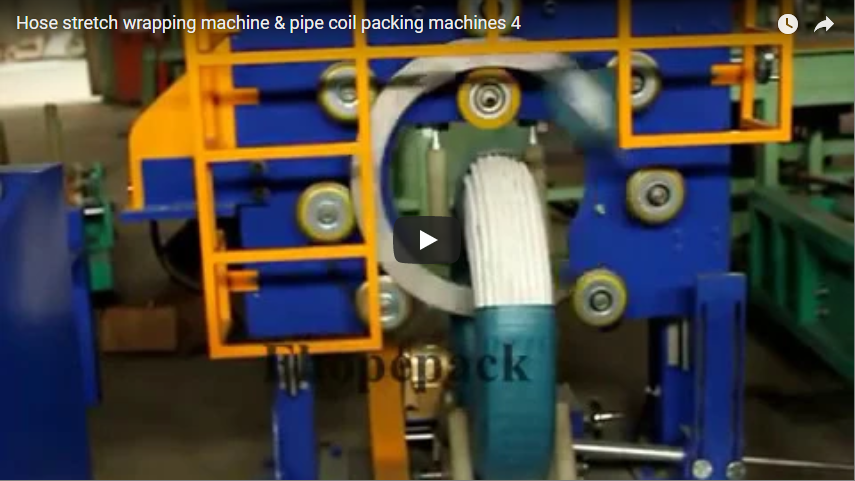
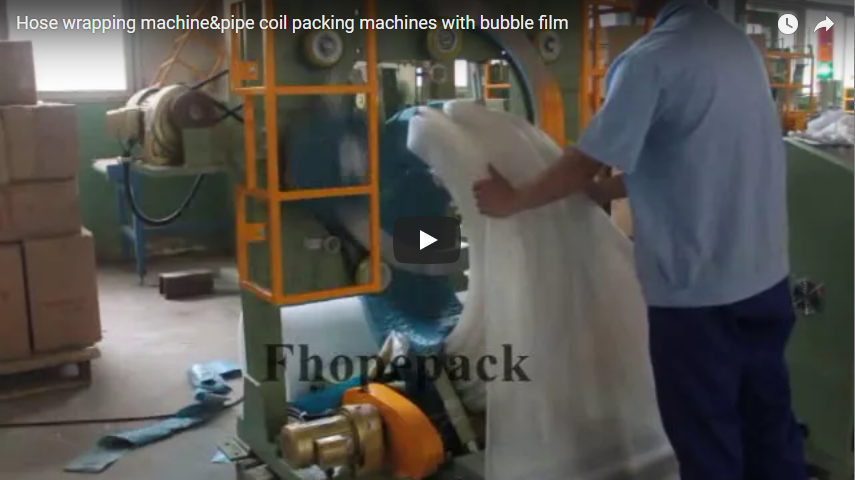
On this machine a yellow corrugated pipe coil stands upright in the ring, held by side guide rollers, and is wrapped in film and blue PE tape. A yellow guard frame covers the upper ring, and the control cabinet with a signal tower stands beside it.
Table of Contents
- Hose and pipe packing solutions by product
- How an upright eye-through hose packing machine works
- FPH-200 and FPH-300N data
- Worked example: a 50 m garden hose coil
- Film, PE tape or paper
- Selection checklist
- Safety: EN 415-10 and ISO 12100
- Engineering FAQ
- Next step
- Related reading
- Sources
Hose and pipe packing solutions by product
The right machine depends on what leaves the extruder: a coil or a straight length.
| Product | Form | Our solution |
| :--- | :--- | :--- |
| Garden hose, PVC hose, small corrugated pipe | Light coil, 5–50 kg | FPH-200 upright coil wrapper |
| Larger corrugated pipe, PE pipe coils | Coil, 10–100 kg | FPH-300N upright coil wrapper |
| Coils still to be wound | Loose from extruder | Coiling and strapping machine ahead of the wrapper |
| Straight pipe or tube lengths | Straight lengths (S200 takes pieces over 300 mm) | Horizontal orbital wrapper |
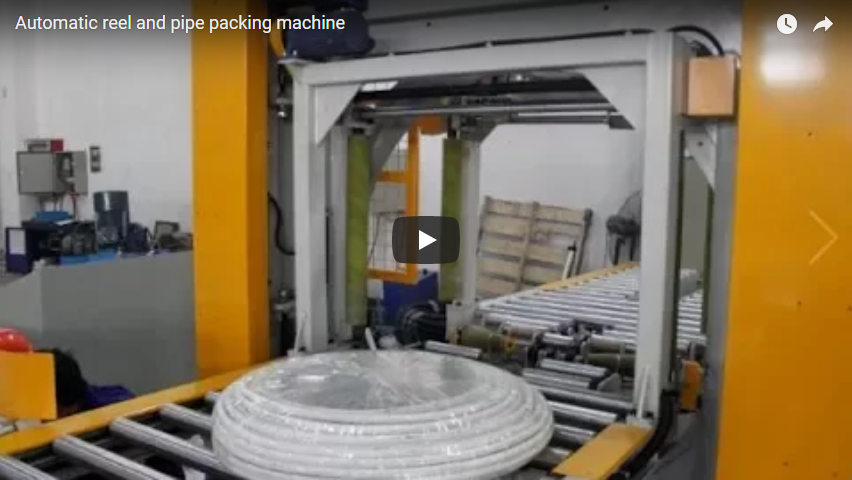
Most plants combine two steps: a coiler winds and straps the coil, then the wrapper seals it. Running both in sequence takes the hand work out of the end of the extrusion line.
How an upright eye-through hose packing machine works
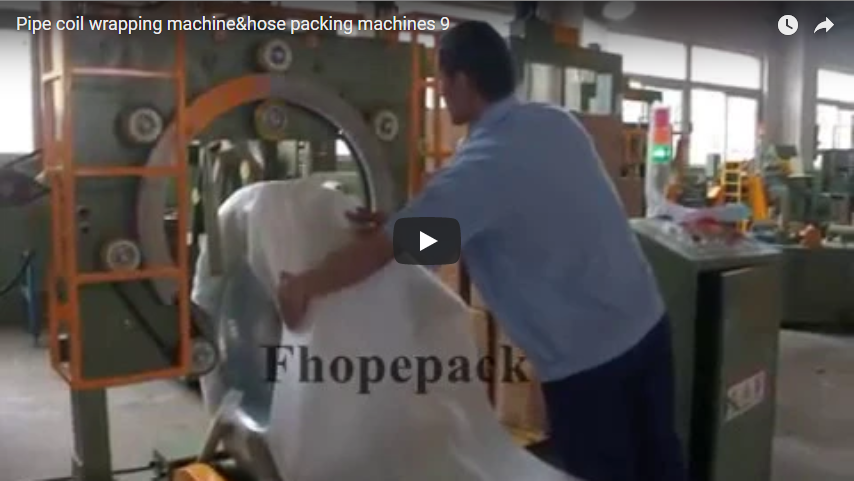
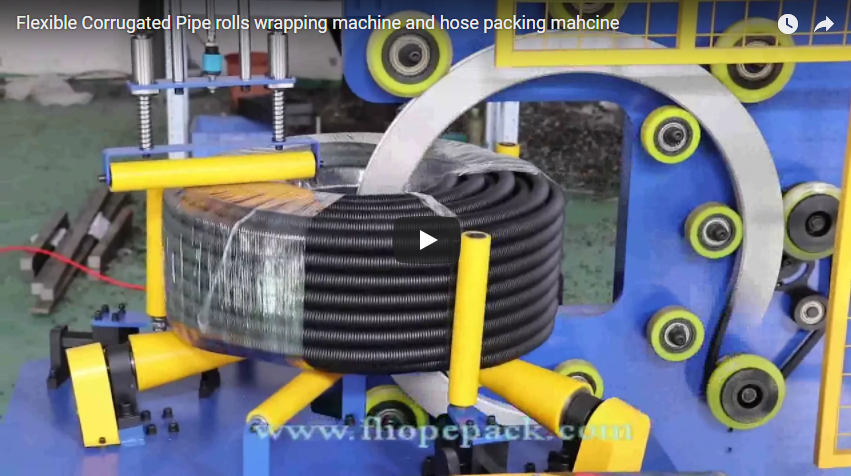
The coil stands on powered rollers with its eye around the ring. Supportive guide rollers on each side keep a light coil from tipping. The ring turns and lays film around the coil section while the rollers turn the coil, so each ring turn covers the next band. Ring and roller speed are set by inverter, which sets the overlap.
Hose coils are light and springy. The guide rollers and a low start speed matter more here than on steel coils, because a light coil can sway when the ring starts.
FPH-200 and FPH-300N data
| Item | FPH-200 | FPH-300N |
| :--- | :--- | :--- |
| Coil ID | 300–600 mm | 300–700 mm |
| Coil OD | 400–900 mm | 500–1,000 mm |
| Coil width | 50–200 mm | 100–300 mm |
| Coil weight | 5–50 kg | 10–100 kg |
| Cycle | 15–35 s per coil | 23–35 s per coil |
| Ring speed | 20–90 r/min | up to 120 r/min |
| Overlap | 20–90% | adjustable |
| Power | 1.5 kW, AC 380 V 50 Hz or to requirement | 1.9 kW, 380 V 60 Hz 3 ph; other supplies confirmed at quote |
| Material | LLDPE, PE, stretch film, PVC | film roll OD 100–180 mm, ID 50 mm, width 90–100 mm; paper or HDPE optional |
Worked example: a 50 m garden hose coil
Take a 25 mm OD hose, 50 m long, wound on a 350 mm ID with a 200 mm coil width. Each layer holds 200 ÷ 25 = 8 turns.
| Layer | Mean turn diameter | Length in layer | Running total |
| :--- | :--- | :--- | :--- |
| 1 | 350 + 25 = 375 mm | 8 × π × 0.375 = 9.4 m | 9.4 m |
| 2 | 425 mm | 8 × π × 0.425 = 10.7 m | 20.1 m |
| 3 | 475 mm | 8 × π × 0.475 = 11.9 m | 32.0 m |
| 4 | 525 mm | 8 × π × 0.525 = 13.2 m | 45.2 m |
| 5 (part) | 575 mm | remaining 4.8 m | 50.0 m |
Coil OD = 350 + 2 × 5 × 25 = 600 mm. That fits the FPH-200 range (ID 300–600, OD 400–900, width 50–200 mm).
Wrap it with 100 mm film at 50% overlap. Size the ring turns on the outer circumference, because that is where the bands spread furthest apart: π × 600 ≈ 1,885 mm. Each ring turn advances 50 mm there, so the coil needs about 38 ring turns, and the inner face gets more than 50% overlap.
At 60 r/min that is about 38 s, just over the FPH-200 cycle of 15–35 s; at 80 r/min it is about 28 s, inside it. Film tail cut and clamp, plus soft start and stop, add to the wrap time and are confirmed at quote. Weigh the coil to confirm it is within 5–50 kg.
Film, PE tape or paper
Stretch film seals the coil against dust and moisture and shows the product. Coloured PE tape over the film gives a brand or product colour and an extra layer over the film. Paper or HDPE is an option on the FPH-300N where a breathable or printable wrap is wanted.
Selection checklist
1. Hose or pipe OD and length per coil.
2. Coil ID, OD, width and weight.
3. Coils per hour from the extruder.
4. Wrap material and colour.
5. Coiling and strapping needed before wrapping.
6. Labelling and line connections.
Safety: EN 415-10 and ISO 12100
The wrapper is built to EN 415-10, the general safety requirements for packaging machines, with the risk assessment done to ISO 12100. A guard frame covers the ring. Manual intervention or hand-steadying of the coil while the ring rotates is prohibited; the coil is positioned before the cycle starts.
Engineering FAQ
Q: Can the same machine wrap hose and corrugated pipe?
A: Yes, as long as the coil sizes and weight fall inside the model range.
Q: What is the wrapping cycle time of the FPH-200 hose packing machine?
A: 15–35 s per coil, depending on coil size and overlap.
Q: Can the wrapper connect to a coiler?
A: Yes. A coiling and strapping machine winds the coil and the wrapper seals it in sequence.
Q: What overlap range does the FPH-200 cover?
A: 20–90%, set by ring and roller speed.
Next step
1. **Send your hose OD, length and coil size** to info@fhopepack.com.
2. **We match** the coiler and FPH wrapper to your line speed.
3. **We reply within 24 hours** with a proposal and quotation.
Related reading
- [Hose coil wrapper FPH-200 (product)](https://www.fhopepack.com/Pipe-packing-machine/Hose-Coil-wrapper-FPH-200.html)
- [Hose wrapping machine FPH-300 (product)](https://www.fhopepack.com/Hose-packaging-machine/Hose-wrapping-machine-FPH-300.html)
- [Vertical hose coil wrapping machine](https://www.fhopepack.com/videos/vertical-hose-coil-wrapping-machine/)
- [Hose coil wrapping machine by film](https://www.fhopepack.com/videos/hose-coil-wrapping-machine-by-film/)
Sources
- FHOPE product pages: hose coil wrapper FPH-200; hose wrapping machine FPH-300N
- EN 415-10; ISO 12100:2010
- Our hose and pipe coil wrapper shown above
Last reviewed: 2026-10-19