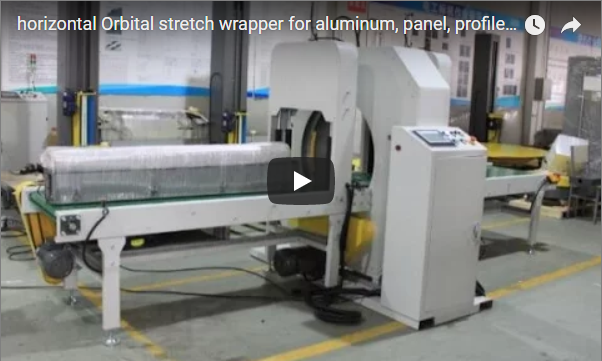
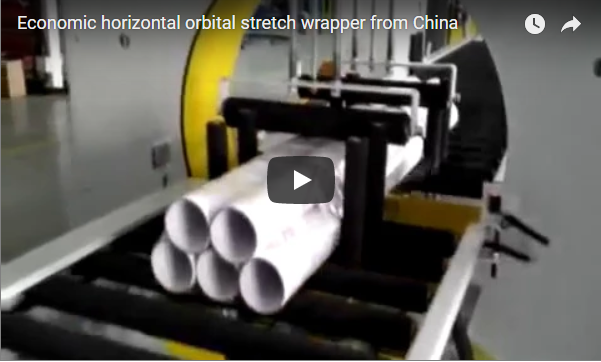
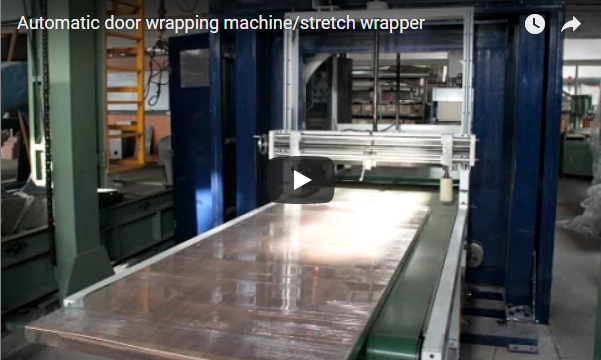
Executive summary A horizontal wrapping machine spiral-wraps long products such as battens and profiles as they pass through a turning ring. The clip, about 96 s long, shows a long silver batten running on orange rollers through a white ring wrapper. Our equivalent E200 wrapper takes packages of 50 to 200 mm across, at a conveyor speed of 6 to 12 m/min.
Table of Contents
- What the clip shows, in order
- Cycle time on the clip
- How a horizontal ring wrapper works
- E200 horizontal stretch wrapper specifications
- Takt check
- Selection checklist for a batten wrapper
- Controls and safety
- Engineering FAQ
- Next step
- Related reading
- Sources
What the clip shows, in order
The wrapper in the clip has a white C-shaped ring housing with a film carriage inside. Orange rollers carry the product on white conveyor frames in front of and behind the ring. A grey control cabinet stands at the side, with buttons, a small screen and blue geared motors below.
- 0 s. A worker stands at the control panel. A long silver batten lies on the orange infeed rollers, lined up with the ring.
- About 4 to 16 s. The worker steps away. The batten runs into the ring, the film carriage turns and the film starts to lay onto the batten.
- About 20 to 24 s. Part of the batten is wrapped, and the conveyor carries the wrapped length out of the ring.
- About 28 to 32 s. The ring runs with no new product. The camera turns to the control cabinet, whose door stands open.
- About 36 to 56 s. A new batten enters, the film carriage turns again and the wrapped batten leaves the ring. The ring then stops in its start position.
- About 60 to 96 s. Close views and a wider view of the whole wrapper at rest, then the control panel and the open cabinet.
Cycle time on the clip
| Step on the clip | Time window | Duration |
|---|---|---|
| First batten into the ring | about 4 to 16 s | about 12 s |
| Wrapped length carried out | about 20 to 24 s | about 4 s |
| Ring running empty | about 28 to 32 s | about 4 s |
| Second batten wrapped and out | about 36 to 56 s | about 20 s |
The times come from frames 4 s apart. A wrap takes as long as the batten needs to pass through the ring at the conveyor speed.
How a horizontal ring wrapper works
The infeed conveyor carries the batten into the ring. A photocell sets the start of the wrap. As the batten moves forward, the ring turns around it and the film carriage lays a spiral of stretch film along its length.
The overlap of each turn depends on the ratio of conveyor speed to ring speed. Both speeds are set by inverters, and the overlap is adjustable from 10% to 90%. At the end of the batten, the cutter cuts the film and the outfeed conveyor carries the wrapped batten away.
| Part | What it does |
|---|---|
| Infeed conveyor, 2,000 mm | Carries the batten into the ring |
| Turning ring and film carriage | Lay the spiral of film |
| Tension control | Keeps the film tight on small and large sections |
| Automatic cutter | Cuts the film at the end of the wrap |
| Outfeed conveyor, 2,000 mm | Carries the wrapped batten away |
| Separate control panel with PLC | Sets the wrap and shows alarms |
E200 horizontal stretch wrapper specifications
| E200 horizontal stretch wrapper | Specification |
|---|---|
| Package outer size (OD) | 50 to 200 mm |
| Package length | over 1,000 mm |
| Package weight | 8 to 100 kg |
| Infeed and outfeed conveyors | 2,000 mm each, motor driven |
| Conveyor speed | 6 to 12 m/min |
| Overlap | adjustable, 10% to 90% |
| Power | about 2.5 kW |
| Supply | 380 V, 3 phase, 60 Hz |
| Film roll | 100 to 200 mm wide, 50 mm core |
Takt check
For an illustrative 4 m batten at a conveyor speed of 6 m/min, the wrap takes 4 ÷ 6 × 60 = 40 s. At 12 m/min, the same batten takes 20 s.
Add a few seconds to load and unload, and the slow setting gives about 80 battens per hour. A wider overlap needs a slower conveyor, so we set the speed to the protection the product needs.
Selection checklist for a batten wrapper
- Batten section, against 50 to 200 mm across.
- Batten length, over 1,000 mm, and the conveyor length.
- Weight per piece, against 8 to 100 kg.
- Single pieces or bundles, and the overlap needed.
- Battens per hour, against 6 to 12 m/min.
Controls and safety
On the clip, a worker stands at the control panel right next to the ring and the infeed rollers, and the cabinet door stands open while the ring runs. A hand near the turning ring or the roller nip is the move to design out. We fit mesh guards around the moving parts, and an interlock is available.
Stop, isolate and lock out the wrapper before anyone changes the film roll, clears a jam inside the ring or opens the control cabinet. Keep the cabinet door closed and locked while the machine runs.
The standards that apply depend on the destination market. For CE markets, ISO 12100 sets the risk-assessment method, and EN 415-10 covers general requirements for packaging machines, which fixes guarding and the stop arrangement.
Engineering FAQ
Q: What size of batten fits through the E200 ring? A: Packages from 50 to 200 mm across, over 1,000 mm long and from 8 to 100 kg.
Q: How is the film overlap set? A: By the ratio of conveyor speed to ring speed, both set by inverters, from 10% to 90%.
Q: Does the wrapper cut the film itself? A: Yes. An automatic cutter cuts the film at the end of each wrap.
Next step
We size a horizontal wrapping machine for battens in three steps:
- Submit your layout drawing with the batten sections, lengths, weights and output, to info@fhopepack.com.
- Receive a proposal within 48 hours, with the ring size, the conveyor lengths and the speed check.
- Book a site survey so we confirm the floor space, the infeed and outfeed and the guarding.
Related reading
Sources
- Machine specifications: E200 horizontal stretch wrapper product page
- Clip timing: frame timings taken from the clip, 4 s between frames
- Machine in action: the video on YouTube
- Standards scope: ISO 12100:2010, EN 415-10:2014
Last reviewed: 2026-10-05