> **Executive summary**
>
> A door or panel that arrives scratched or damp has to be reworked or replaced, so the package matters as much as the finish. Our door and panel sealing and shrinking machine seals PE film around the product with a permanently heated seal bar, then shrinks it tight in a hot-air tunnel at 100–220 °C. It takes products 900–1,200 mm wide and 20–100 mm thick. This page covers what makes the package high quality, the quotation data, tunnel dwell maths and buyer checks.
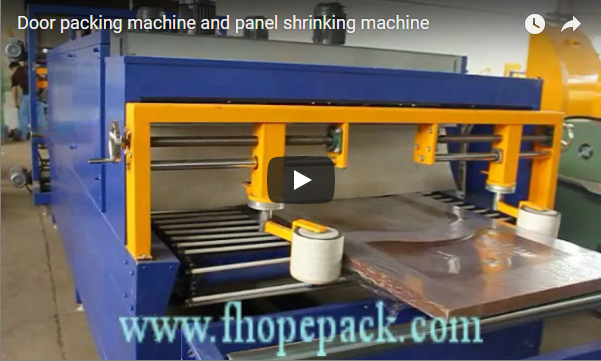
This machine has a light grey frame with film rolls and guide rails above the sealing area, and a control unit with touch screen and E-stop on the right. A light-coloured flat panel runs on a green belt, is covered in clear film, passes through the heated tunnel and leaves on red rollers with the film tight and glossy.
Table of Contents
- What makes a high quality shrink package
- How the machine works
- Quotation data
- Tunnel dwell maths
- Selection checklist
- Safety
- Engineering FAQ
- Next step
- Related reading
- Sources
What makes a high quality shrink package
Three things decide it. The seal must be clean and continuous, with no burnt film or open spots; a permanently heated bar with PLC temperature control gives that. The shrink must be even, so the film lies flat without bubbles or ears; that needs the right tunnel temperature and dwell. And the panel must not be marked, so the conveyors and rollers must be smooth and the panel must cool before stacking.
How the machine works
1. **Infeed:** the door or panel runs in on a 2,500 mm infeed belt.
2. **Cover:** PE film from the top and bottom rolls covers the product.
3. **Seal:** the heated seal bar seals and cuts the film around the product; the blade is easy to exchange.
4. **Shrink:** the product passes through the tunnel at 100–220 °C, and the film shrinks tight.
5. **Cool and out:** the package cools on the 2,500 mm outfeed conveyor.
Quotation data
From our 2023 automatic door and panel sealing and shrinking machine quotation:
| Item | Sealing part | Shrink tunnel |
| :--- | :--- | :--- |
| Product width | 900–1,200 mm | — |
| Product length | over 1,500 mm | — |
| Product thickness | 20–100 mm | — |
| Product weight | 10–50 kg | — |
| Working table height | about 800 mm | — |
| Conveyor speed | about 0–12 m/min | about 0–8 m/min |
| Power | about 5.5 kW | about 38 kW |
| Tunnel size | — | L 3,000 × W 1,400 × H 200 mm |
| Temperature | — | 100–220 °C |
| Film | PE, 40–100 µm (30–150 µm available) | |
| Supply | 380 V, 50/60 Hz, 3 phase ±6% | |
The tunnel opening (1,400 × 200 mm) clears the largest product (1,200 × 100 mm). The sealer stops each product briefly to seal, then releases it. The faster sealing conveyor (up to 12 m/min) keeps a gap to the next product. The tunnel speed (up to 8 m/min) sets the line output.
**Panels per minute ≈ tunnel speed (m/min) ÷ (panel length + gap) (m).** Example only: 2.1 m doors with a 0.4 m gap at 8 m/min give 8 ÷ 2.5 ≈ 3.2 panels per minute.
Tunnel dwell maths
**Dwell time (s) = tunnel length (m) ÷ conveyor speed (m/min) × 60.**
**Energy per panel (kWh) ≈ tunnel power (kW) × dwell (s) ÷ 3,600.**
Example only: at 6 m/min through the 3 m tunnel, dwell is 3 ÷ 6 × 60 = 30 s. At full 38 kW this is about 38 × 30 ÷ 3,600 ≈ 0.32 kWh per panel if one panel is in the tunnel at a time; with panels end to end it is lower per panel. Thicker film needs a longer dwell or higher temperature, set in trials.
Selection checklist
1. Door or panel width, length and thickness?
2. Weight per piece?
3. Film thickness?
4. Pieces per hour?
5. Corner protectors or labels under the film?
6. Power available for the tunnel?
Safety
We design shrink packers to EN ISO 12100:2010 for risk assessment, EN 415-10 for packaging machine safety and EN 60204-1 for electrical equipment. The seal bar is guarded, the tunnel is insulated, and an E-stop is on the control unit.
Engineering FAQ
Q: Does the seal bar smell?
A: No. The permanently heated bar seals without odour at the set temperature.
Q: Can it pack panels thinner than 20 mm?
A: Thin panels can be stacked to reach the range, confirmed at quote.
Q: How long is the line?
A: Infeed and outfeed are 2,500 mm each, plus the sealer and the 3,000 mm tunnel.
Q: Can it run at 60 Hz?
A: Yes, the supply is 380 V, 50/60 Hz.
Next step
1. **Send your door or panel sizes and output** to info@fhopepack.com.
2. **We confirm** the sealer and tunnel.
3. **We reply within 24 hours** with a proposal and quotation.
Related reading
- [Door shrinking machine with motion sealer (product)](https://www.fhopepack.com/door-packing-machine/Door-Shrinking-Machine-with-Motion-Sealer.html)
- [Economic type door shrink packing machine (product)](https://www.fhopepack.com/door-packing-machine/Economic-Type-Door-Shrink-Packing-Machine.html)
- [Door panel sealing and shrinking machine (video)](https://www.fhopepack.com/videos/door-panel-sealing-and-shrinking-machine-2/)
- [Door and panel shrink packaging machine (video)](https://www.fhopepack.com/videos/door-and-panel-shrink-packaging-machine/)
- [Automatic panel sealing and shrinking machine (video)](https://www.fhopepack.com/videos/automatic-panel-sealing-and-shrinking-machine/)
Sources
- FHOPE automatic door and panel sealing and shrinking machine quotation (2023)
- FHOPE product page: door shrinking machine with motion sealer
- EN ISO 12100:2010; EN 415-10; EN 60204-1
- The door and panel sealing and shrinking machine shown above
Last reviewed: 2026-10-20