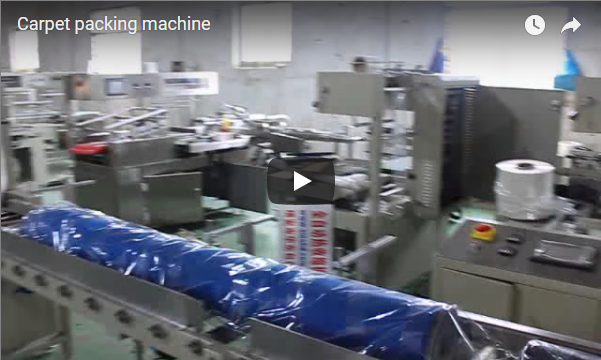
Executive summary This clip shows a packing line for long, narrow cartons. An operator lays each carton on the infeed, two arch strapping machines band it, a side sealer wraps it in film and a heat tunnel shrinks the film tight. The sealing section matches our MO-350, which takes products up to 400 mm in width plus height with no length limit. Below we cover the steps, why straps go on first, the data and a worked example for film use.
Table of Contents
- What the clip shows
- Why strap first, then shrink
- Side sealer and tunnel data
- Film per carton
- Selection checklist
- Safety
- Engineering FAQ
- Next step
- Related reading
- Sources
What the clip shows
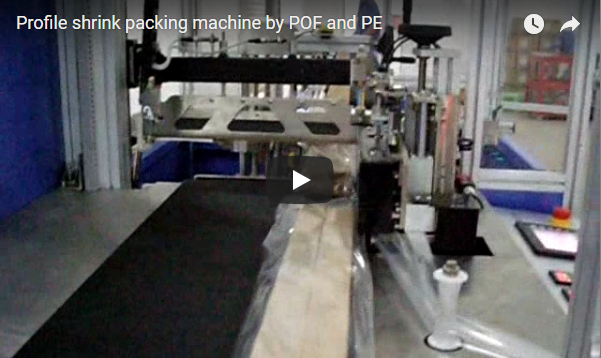
The clip is a short vertical video of a packing line for long, narrow cartons.
| Step | What you see |
|---|---|
| Loading | An operator places a long carton on the infeed conveyor |
| Strapping | The carton passes through two arch strapping machines in a row, which band it |
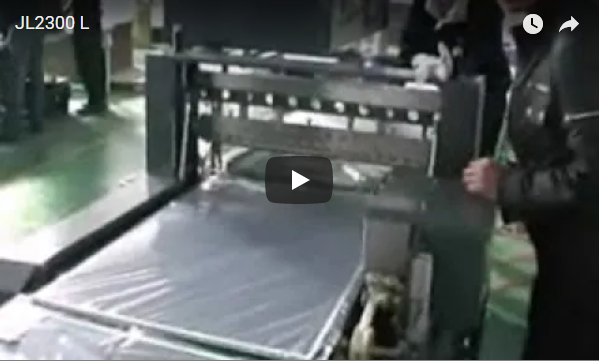
| Film and sealing | A sealer with a raised black cover wraps the carton in film and seals it |
| Shrinking | The carton runs through a heat shrink tunnel with a red curtain |
| Result | The last frames show strapped cartons with tight, clear film on the floor |
Strapping first holds the carton closed, and the shrink film then keeps dust and moisture off the board.
Why strap first, then shrink
- Closed carton. The straps hold the flaps and the contents before the film goes on.
- Long products. A side sealer seals along the length, so the carton length is not limited by the seal bar.
- Tight film. The shrink tunnel pulls the film tight around the carton and straps.
- One line. Strapping, film, sealing and shrinking run in one pass, so the carton is handled once.
Side sealer and tunnel data
The film and sealing section matches our side sealer shrinking machine MO-350. Our published data:
| Item | Published value |
|---|---|
| Sealing height | Up to 200 mm |
| Sealing width | Up to 350 mm |
| Product size | Width + height up to 400 mm |
| Product length | Not limited |
| Film | Centre-folded POF or PE film |
| Max film roll | 580 mm wide, 280 mm OD |
| Power | 10.5 kW, 380 V 50–60 Hz 3-phase |
| Working height | 780–820 mm |
| Air pressure | Up to 0.5 MPa |
| Tunnel conveyor | Chains with rotating silicone-coated rods |
| Control | PLC with touch screen |
Packing capacity depends on product length, and the strapping section is matched to the carton size of each project.
Film per carton
Worked example (illustrative). A carton 150 mm wide and 100 mm high has a girth of 2 × (150 + 100) = 500 mm. Centre-folded film opened to about 600 mm covers that with room for the side seal. For a 1,200 mm carton plus about 100 mm of film at each end, one carton uses about 1.4 m of film.
Selection checklist
- Carton length, width and height.
- Carton weight.
- Number of straps and their positions.
- POF or PE film.
- Cartons per minute.
- Manual loading or an infeed conveyor from the packing table.
Safety
- Keep hands clear of the strapping arches and the sealing knife.
- The tunnel and its curtain are hot; let cartons cool on the outfeed.
- Stop the line before clearing a jam.
- For CE markets, the line is designed to ISO 12100 and EN 415-10.
Engineering FAQ
Q: What does this line do? A: It straps long cartons, wraps them in film, seals the film and shrinks it in a heat tunnel in one pass.
Q: Why strap before shrinking? A: The straps hold the carton closed, and the shrink film then covers the carton and the straps.
Q: How long can the carton be? A: Product length is not limited on our MO-350 side sealer, because it seals along the length.
Q: What carton sizes fit the sealer? A: Width plus height up to 400 mm, sealing height up to 200 mm, on our MO-350 data.
Q: How do cartons travel through the shrink tunnel? A: On a chain conveyor with rotating silicone-coated rods, on our MO-350 data.
Q: What power does the sealing and shrink section need? A: 10.5 kW on a 380 V, 50–60 Hz 3-phase supply, on our MO-350 data.
Q: Which films can it use? A: Centre-folded POF or PE film, rolls up to 580 mm wide.
Q: How much film does one carton use? A: About 1.4 m for a 1,200 mm carton in the worked example.
Q: How many cartons per minute? A: It depends on carton length; we confirm it from your carton sizes.
Q: Which standards apply? A: For CE markets, ISO 12100 and EN 415-10.
Next step
We size a carton strapping and shrink line in three steps:
- Submit your layout drawing with carton sizes and weight, strap pattern and cartons per minute, to info@fhopepack.com.
- Receive a proposal within 48 hours with the machine data and layout.
- Book a site survey so we confirm the line layout and infeed.
Related reading
- Automatic Profile and Panel Bagging and Shrinking Line
- Hose Coil Wrapping, Cartoning and Carton Sealing Line
- Automatic Pipe Bagging and Shrinking Machine
- Door and Panel Shrink Packaging Machine
- MO-350 side sealer data
Sources
- Clip: the video on YouTube
- Sealing size, film, power, air, tunnel conveyor and control: MO-350 side sealer data
- Film per carton: our worked arithmetic
- Standards scope: ISO 12100:2010; EN 415-10:2014
- Proposal timing: approved house CTA (proposal within 48 hours)
Last reviewed: 2026-10-10