Overview
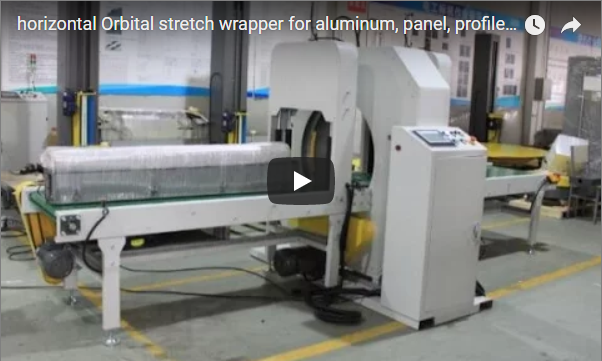
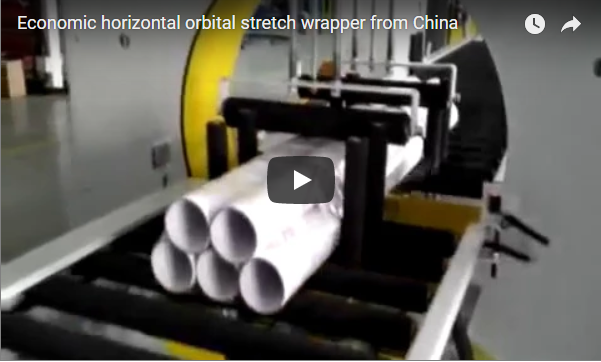
An orbital wrapping machine wraps a long or bulky load with a continuous film spiral while the load stays on a fixed line: the film carriage orbits around the product, so a six-metre bundle, a palletized stack or an open-top carton is covered in one pass without turntable rotation. This machine is built for efficient packaging in the power, tooling and logistics trades. The guide below covers what the orbital wrapper does, how it compares with a turntable wrapper, what to specify, and what to check at acceptance. It is written for plant engineers and packaging line owners.
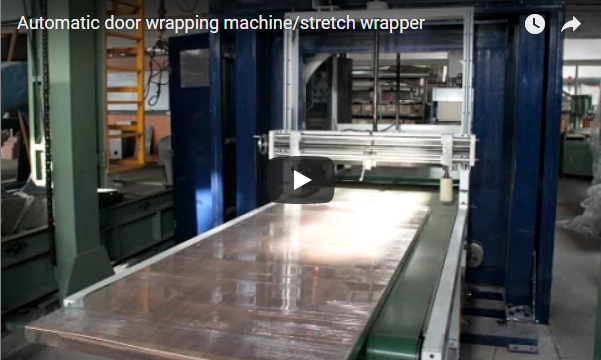
The video below shows the orbital wrapper in operation on a palletized load:
Orbital vs Turntable: Which Motion Fits the Load
Both machines apply stretch film; they differ in which part moves:
| Aspect | Orbital (ring) wrapper | Turntable wrapper |
|---|---|---|
| Moving part | Film carriage orbits the stationary load | Load rotates on a turntable under a fixed carriage |
| Load length | Unlimited in-line (load passes through the ring) | Limited by table diameter and tower |
| Foothold | Ring over conveyor or pit | Turntable on the floor |
| Stability | Load is never spun; heavy/tall loads stay put | Spinning can shift offset loads |
| Best fit | Long loads, in-line flow, heavy/top-heavy units | Mixed pallets on a single station |
For a palletized carton stack or a long bundle, the orbital pass wraps the sides in one continuous spiral, then film can be added or a top sheet fitted depending on the requirement.
How the Machine Wraps
The sequence on a typical orbital cycle:
| Step | What happens |
|---|---|
| Load entry | The product moves onto the infeed line, centered for the ring. |
| Film threading | The operator or an automatic threader feeds the film through the carriage. |
| Orbital pass | The carriage rotates around the load while it advances, laying a spiral of pre-stretch film. |
| Edge/end coverage | Programmed passes build layers at each end where containment matters most. |
| Film clamp and cut | At the end of the cycle the film is clamped, cut and sealed against the load. |
| Outfeed | The wrapped load leaves the ring for storage or palletizing. |
The result is a fixed, repeatable wrap; changing film pitch and layer counts is a parameter change, not a machine conversion.
What to Specify
Provide the manufacturer with:
| Input | Why it matters |
|---|---|
| Load size (length, width, height) and weight | Sets the ring diameter and feed rail rating. |
| Infeed/outfeed height and conveyor type | Sets the line integration and ring position. |
| Film type and gauge | Sets the prestretch unit and clamp/seal design. |
| Layers and film pitch per wrap | Sets the program and cycle time. |
| Cycle throughput | Sets carriage speed and automation level. |
| Power, air and control interface | Sets electrical integration and PLC hand-off. |
| Safety perimeter | Light curtains or interlocked guarding around the ring. |
All parameters are confirmed per project before the machine is built.
Factory Testing and Acceptance
- Full-cycle evidence. Ask for a test log of complete wrapping cycles (film feed, rotate, clamp, cut, seal) at the required layers.
- Extended run. The vendor’s stated practice on this machine family includes near-continuous testing before delivery (up to about 24 hours where stated).
- Control and safety. Confirm the control system was checked for smooth, responsive operation and the emergency stop verified.
- Line handover. Proof that infeed, wrap and outfeed pass without jams at the required pace.
- Commissioning. Written definition of installation, commissioning and on-site service.
- Fast Orbital Wrapping Machine: Technology and Best Practices – Orbital wrapper mechanics for long loads in the same family.
- Coil Packaging: Operation and Applications – The coil packing sequence in the same product family.
- Coil Upender & Industrial Turnover Solutions – Coil and pallet handlers used with wrapping lines.
On arrival repeat: empty pass, loaded pass, emergency stop.
FAQ
Q: Can an orbital wrapper handle a pallet?
A: Yes. The palletized load is conveyed through the ring and the sides are wrapped in a spiral; a top sheet can be fitted where dust or weather protection is needed.
Q: How do you change the wrap pattern?
A: Layer counts, film pitch and end-programming are stored per product on the PLC; operators recall the recipe instead of re-rigging the machine.
Q: What film can I use?
A: Standard stretch film with or without pre-stretch. Film type and gauge are confirmed per project because they drive the prestretch and seal settings.
Q: What safety standards apply?
A: The machine family is designed with EN 415-10 as the packaging-machinery safety reference and an ISO 12100 risk assessment for the rotating carriage.
Next Step
Send load size and weight, infeed/outfeed heights, film type, required layers and throughput, power and air supply, and safety/perimeter requirements so the wrapper is sized on the approval drawing.