Executive summary A steel or aluminum coil only rolls when you do not want it to. A coil tilter and upender rotates coils through 90 degrees in either direction on a powered cradle, turning stored eye-to-sky coils horizontal for the payoff reel and back again for storage. Coil weight, cradle type and table options are configured per project.
Table of Contents
- Two names, one job
- Orientation scenarios
- How the unit rotates the coil
- Cradle and table options
- Drive options
- Above and below the turn
- Typical configuration
- What the video shows
- Selection checklist
- Controls and safety
- Engineering FAQ
- Next step
- Related reading
- Sources and standards
Two names, one job
Coil tilter, coil upender, coil inverter, coil tipper: the names describe the same family of equipment, a machine that rotates a heavy coil through 90 degrees on a powered platform. Whether you call it a tilter or an upender usually just tells you which direction your line uses it most.
Orientation scenarios
| Change | Where it happens |
|---|---|
| Vertical to horizontal | stored eye-to-sky coils turned eye-to-wall for the payoff reel on slitting or stamping lines |
| Horizontal to vertical | processed coils upended for storage, banding or crane attachment |
A unit that turns both ways handles coils arriving either orientation and leaving the other.
How the unit rotates the coil
The coil sits in a cradle or on a table connected to a rotating structure. A drive turns the structure through the set angle while the coil stays supported, so the load never swings at the end of a sling. Movement is driven from the control panel and holds at the end of travel until the next station is ready.
Cradle and table options
| Option | Use |
|---|---|
| V saddle | holds the round coil centered and stable through the turn |
| Flat deck | for coils that sit on a flat base or pallet |
| Sliding table | moves the coil in and out for fork or reel alignment |
| Conveyor table | feeds coils on a line without extra handling |
We select the carrying surface from the coil shape and how the coil arrives and leaves. The frame and drive are then matched to your coil weight, outside diameter and width; capacity classes follow those dimensions per project.
Drive options
Electro-mechanical drive runs clean and positions accurately, with no fluid system to maintain. Hydraulic drive delivers higher force for the heaviest coils. The choice follows the coil weight and how often it turns per shift.
Above and below the turn
The work at each end of the turn decides the options as much as the turn itself. On the infeed side, a sliding table or conveyor lines the coil up with the unit. On the discharge side, the same table hands the coil to a pay-off reel, a strap station or a crane hook. We lay the in-and-out path for your line at the survey.
Typical configuration
Figures below are common starting envelopes for this machine class and are confirmed per project.
| Parameter | Typical range, confirmed per project |
|---|---|
| Load capacity | sized to the heaviest steel or aluminum coil |
| Turn angle | 90 degrees standard, in either direction |
| Carrying surface | V saddle or flat deck, combined with sliding or conveyor feed per line layout |
| Drive | electro-mechanical or hydraulic |
| Electrical supply | 380 V or 415 V three phase, selected per project to the plant supply |
What the video shows
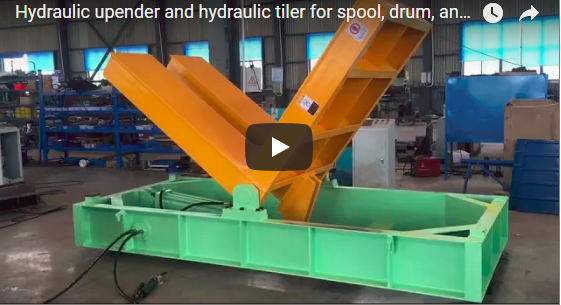
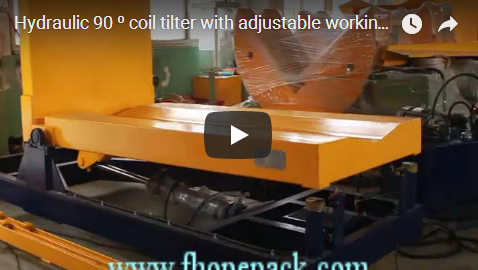
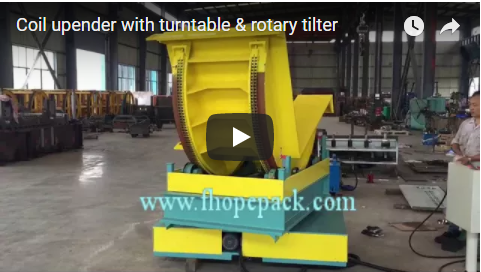
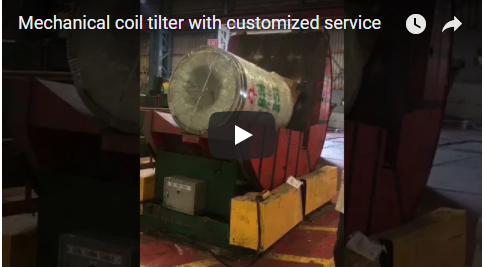
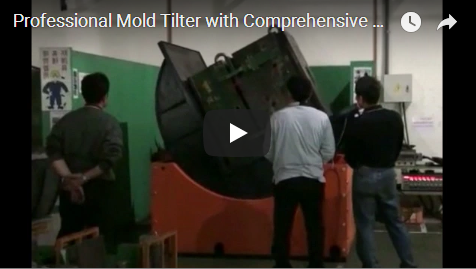
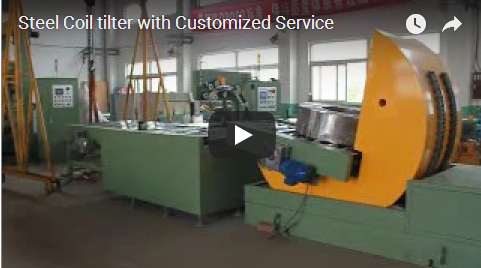
Our footage shows a coil unit rotating a strapped coil in a mill setting. It is a general demonstration, so capacity, cradle and table options for your coils are confirmed with us per project.
Selection checklist
| Question | Confirm per project |
|---|---|
| Heaviest coil | rated capacity |
| Coil diameter and width | cradle and table size |
| Both directions needed | upend and tilt on one unit |
| Arrival and discharge | sliding table, conveyor or crane access |
| Drive choice | electro-mechanical or hydraulic |
| Electrical supply | voltage, phase and frequency on site |
Controls and safety
The panel drives the turn with start, stop, forward and reverse, plus an emergency stop. Keep the area clear while the unit moves, keep the coil centered in the cradle, and stay within the rated capacity. Routine checks cover the cradle, drive and safety devices, per the machine manual.
Engineering FAQ
Q: Tilter or upender, which do I need? A: Both describe a 90-degree coil turn; which you call it depends on your dominant direction. One unit handles both directions.
Q: V saddle or flat deck? A: A V saddle centers a round coil; a flat deck suits a flat or palletized base. We select from the coil shape per project.
Q: What is the sliding table for? A: It moves the coil in and out of the unit, lining it up for a fork, a pay-off reel or a strap station, per line layout.
Q: Does it handle aluminum coils too? A: Yes. The unit is sized by weight and dimensions, so steel and aluminum are covered within the rated capacity.
Q: What capacity range is available? A: Sized to your heaviest coil; the upper range is confirmed per project with the cradle and drive.
Next step
- Email us at info@fhopepack.com with your coil weights, diameters and both directions of travel.
- We send cradle options, table layouts and a layout drawing within 48 hours.
- We arrange a site survey to confirm the unit fits your line.
Related reading
- Steel coil tilter with customized service
- Automatic & multipurpose tilter for box
- Professional mold tilter with comprehensive technical support
- FHOPE packing machinery product lines
Sources and standards
- ISO 12100:2010 — Safety of machinery. General principles for design, risk assessment and risk reduction
- EN 415-10:2014 — Safety of packaging machines. General requirements
- EN ISO 13849-1:2023 — Safety of machinery. Safety-related parts of control systems
- FHOPE coil tilter and upender demonstration video. Reviewed as a general demonstration; capacity, cradle and table confirmed per project.
Last reviewed: 2026-10-10