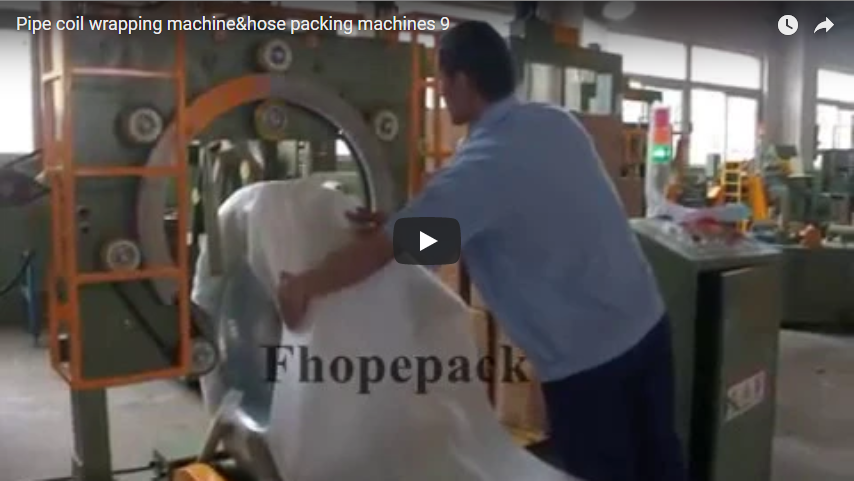
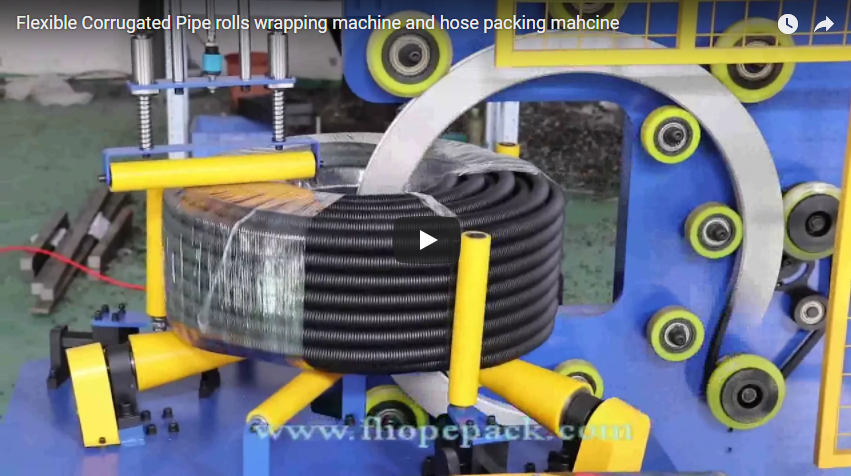
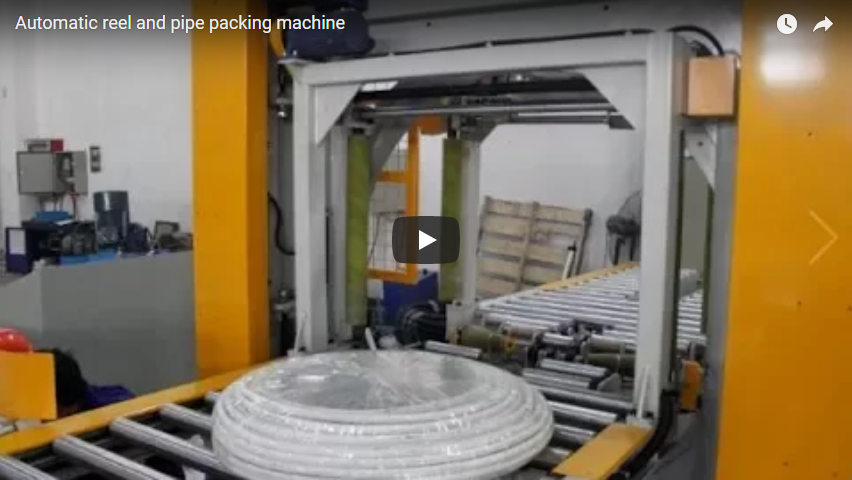
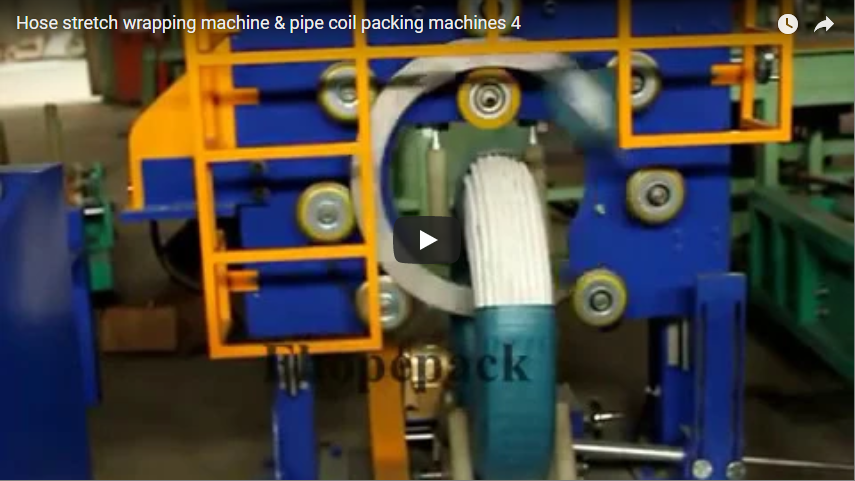
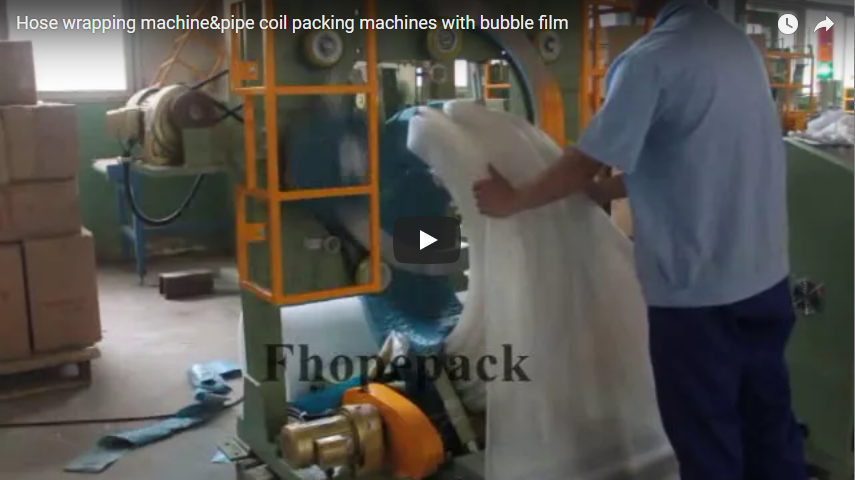
Abstract: Vertical hose coil wrapping machine designed for oversized diameter coils up to 3000mm OD, 2000kg weight. Features eye-through shuttle wrapping technology with 55-65 second cycle time. Supports dual-material composite packaging (LLDPE stretch film + HDPE knit belt). CE certified per Machinery Directive 2006/42/EC. Suitable for industrial hoses, cables, wire ropes, and large-diameter coiled products.
Why Do Large-Diameter Hose Coils Require Vertical Wrapping Machines Instead of Horizontal?
Vertical hose coil wrapping machines are engineered for coils exceeding 1500mm outer diameter, solving center-of-gravity instability and loading difficulties that horizontal machines cannot handle.
When hose coil OD exceeds 1200mm, horizontal wrapper shaft support produces 3-5mm deflection, causing uneven wrapping tension. Vertical design places the coil on support rollers in vertical orientation, distributing gravity evenly across the circumference and eliminating eccentric loads. For 3000mm OD, 2000kg hose coils, vertical support points are adjustable to 1800-2200mm spacing, ensuring no axial displacement during high-speed rotation (typical 8-12 RPM).
Loading method difference: Vertical wrappers use overhead crane loading, with coils lowered vertically onto support rollers in 30-45 seconds. Horizontal machines require forklifts or flipping mechanisms to push coils horizontally into chucks. For 3000mm OD coils, forklift arm reach needs 3.5-4m, with coil rolling risk. In facilities processing 400-600 coils monthly, vertical design reduces loading time by 18-25 minutes per shift.
What Are the Core Technical Specifications of Vertical Hose Coil Wrapping Machines?
| Parameter | Specification | Unit | Notes |
|---|---|---|---|
| ———– | ————— | —— | ——- |
| Max Coil OD | 3000 | mm | Customizable to 3500mm |
| Max Coil Weight | 2000 | kg | Support roller load capacity |
| Coil Width Range | 200-800 | mm | Customizable to 1000mm |
| Wrapping Ring ID | 1200-2500 | mm | Customized per coil ID |
| Ring Shuttle Speed | 0.8-2.5 | m/s | VFD controlled |
| Support Roller Speed | 8-12 | RPM | Variable frequency |
| Cycle Time per Coil | 55-65 | seconds | Including 30-40s loading |
| Film Pre-Stretch Ratio | 200-280 | % | Mechanical pre-stretch |
| HDPE Belt Tension | 80-150 | N | Pneumatic tension control |
| Control System | Siemens S7-1200 | PLC | Optional Mitsubishi FX5U |
| HMI | 7″ Touch Screen | — | 800×480 resolution |
| Power Supply | 380V/50Hz/3-phase | — | Optional 220V/60Hz |
| Air Supply | 0.5-0.7 | MPa | For tension brake and clamping |
| Equipment Power | 3.5-5.5 | kW | All motors included |
| Safety Standard | ISO 12100:2010 | — | CE certified |
Material Specifications:
- Stretch Film: LLDPE, 15-23 micron thickness, 500mm width, 2.8-3.2 m²/kg coverage after pre-stretch
- HDPE Knit Belt: 40-60mm width, 0.3-0.5mm thickness, ≥350N break strength, UV resistance level 7
Deliverable Documents:
- CE Declaration of Conformity (Machinery Directive 2006/42/EC)
- ISO 12100:2010 Risk Assessment Report
- Electrical Schematics (PDF + DWG)
- FAT Record (including 3-coil full-load test video)
- 3D STEP File (for production line integration)
How Does the Eye-Through Wrapping System Work?
Eye-through wrapping is the core process of vertical hose coil wrappers. The wrapping ring carries material through the coil’s center hole (“eye”) while the coil rotates on support rollers, achieving 360° full coverage.
Kinematic Principle: The wrapping ring moves along the circular ring at 0.8-2.5 m/s linear speed, passing through the coil’s inner diameter. Simultaneously, support rollers rotate the coil at 8-12 RPM. The compound motion ensures material covers the coil’s outer circumference in a spiral trajectory. For 3000mm OD coils with 800mm ID, the ring travel is approximately 3.8m per revolution, with single-revolution time of 1.5-2.0 seconds.
Material Composite Sequence: Typical process applies 2-3 layers of LLDPE stretch film first (providing dust/moisture protection and initial containment), then 1-2 layers of HDPE knit belt (providing tensile strength and puncture resistance). Stretch film pre-stretch ratio is set to 250%, HDPE belt tension to 100-120N. For export sea shipments, add an outer layer of 0.15mm VCI anti-corrosion film.
Field Failure Mode: After wrapping ring rail wear produces 0.5-1.0mm radial runout, material tension fluctuates ±20%. This creates visible “waves” on the wrapped coil surface, increasing loosening rate by 15-25% during transport. Preventive maintenance: Check rail straightness every 2000 operating hours (using laser alignment tool, tolerance ≤0.3mm/2m), replace guide wheels every 6000 hours (polyurethane material, Shore A 85-90 hardness).
Why Is Dual-Material (Stretch Film + HDPE Belt) Composite Packaging Necessary?
Limitations of Stretch Film Alone: LLDPE stretch film provides excellent dust/moisture protection and initial containment force, but has low puncture resistance (typical 4.5-5.5 N/25mm). For industrial hoses with metal fittings or sharp edges, vibration during transport causes fittings to puncture the film, losing protection.
HDPE Knit Belt Function: HDPE knit belt has ≥350N break strength, 60-70 times that of stretch film. It forms an external skeleton, bearing stacking loads (typical 2-3 layer stacking, bottom layer bears 4000-6000N static load) and transport vibration. The belt’s grid structure allows moisture to escape, preventing condensation buildup that causes hose corrosion.
Cost Comparison: For 3000mm OD coils:
- Stretch film only: 4.5-5.5kg film/coil, cost $12.6-15.4/coil ($2.80/kg), protection grade B (suitable for short-distance land transport)
- Composite: 2.5-3.0kg film + 1.2-1.5kg HDPE belt/coil, cost $9.5-11.0/coil, protection grade A (suitable for sea freight + long-term storage)
Composite reduces cost by 20-25% while improving protection by two grades. Reason: stretch film usage decreases (pre-stretch ratio increases from 200% to 280%), and HDPE belt unit price ($3.5-4.0/kg) is lower than stretch film.
Counter-Intuitive Finding: Many factories believe “thicker film is better,” but the key for sea freight packaging is “stiffness” not “thickness.” A 23-micron stretch film + 0.4mm HDPE belt composite structure has 3.2 times the anti-stacking-deformation capacity of 35-micron single-layer film (test standard: ASTM D642 compression strength). The HDPE knit belt forms a truss structure, distributing point loads across the entire circumference.
How Are Loading and Positioning Systems Designed?
Crane Loading Process: Operator uses nylon slings (100-120mm width, 3000kg rated load) through the coil’s inner diameter. The crane slowly lowers the coil to 200-300mm above the wrapper’s support rollers. The coil drops vertically onto the rollers, with positioning pins (20-25mm diameter, 80-100mm height) inserting into the coil ID to prevent axial displacement. Single loading time: 30-45 seconds.
Support Roller Design: Roller surface is polyurethane-coated (Shore A 70-75 hardness), providing 0.4-0.6 friction coefficient—preventing coil slippage without damaging hose surface. Roller diameter is 200-250mm, using SKF self-aligning roller bearings (model 22208 EK) with 58kN dynamic load rating. For 2000kg coils, safety factor is 2.9-3.2.
Positioning Accuracy Requirement: Coaxiality error between coil center and wrapping ring center must be ≤3mm. Exceeding this causes interference when the ring passes through the coil ID—minor cases scratch the hose surface, severe cases stall the ring motor (current peak reaches 3-4 times rated value). Positioning aid: laser alignment tool (projects crosshair, ±0.5mm accuracy), operator adjust coil position based on laser lines in 10-15 seconds.
Safety Interlocks: Photoelectric sensors under support rollers (detection range 0-3m, response time ≤10ms). When operator limbs enter the danger zone, rollers stop immediately (braking time ≤150ms), and the wrapping ring executes emergency retraction (retraction time ≤2s). Safety level: SIL2 (IEC 61508), Performance Level PLd (ISO 13849-1).
How Is Packaging Quality Quantified and Tested?
Containment Force Test: Measure radial containment force on the wrapped coil surface using a tension meter. For 3000mm OD hose coils, containment force should reach 800-1200N/m (per meter width along circumference). Below 600N/m causes loosening during transport; above 1500N/m crushes the hose outer layer.
Film Layer Thickness Measurement: Use eddy current thickness gauge (0.1 micron resolution) to measure stretch film thickness at 5 random points. For 23-micron setting, measured values should be within 20-26 microns. Thickness deviation exceeding ±30% indicates pre-stretch roller wear or tension control failure.
HDPE Belt Lap Width: Use vernier caliper to measure lap width between adjacent HDPE belts. Standard setting is 30-40% of belt width (40mm belt corresponds to 12-16mm lap). Insufficient lap creates local weak points; excessive lap wastes material and increases cost.
Drop Test: Per ISTA 2A standard, drop wrapped coils from 1.2m height onto concrete surface (3 different orientations, 1 drop each). Pass criteria: no HDPE belt breakage, no penetrative stretch film damage, coil OD deformation ≤2% (3000mm OD corresponds to ≤60mm).
Sea Freight Simulation Test: Place wrapped coils on vibration table, perform random vibration test per ASTM D999 (frequency 3-100Hz, acceleration 0.5Grms, duration 60 minutes). Pass criteria: no packaging loosening, containment force drop ≤15%, no HDPE belt displacement.
How to Choose Between Vertical and Horizontal Hose Coil Wrapping Machines?
| Selection Criteria | Vertical Wrapper | Horizontal Wrapper | Decision Recommendation |
|---|---|---|---|
| ——————– | —————— | ——————- | ———————— |
| Applicable Coil OD | 1500-3500 mm | 600-1800 mm | OD>1800mm: mandatory vertical |
| Applicable Coil Weight | 800-3000 kg | 200-1500 kg | Weight>1500kg: prefer vertical |
| Loading Method | Crane | Forklift/Flipper | Has crane: choose vertical |
| Floor Space | 2.5×2.5 m | 3.5×4.0 m | Space constrained: vertical |
| Cycle Time | 55-75 seconds | 45-60 seconds | Speed priority: horizontal (small coils) |
| Equipment Cost | $45,000-65,000 | $35,000-50,000 | Budget limited: horizontal |
| Maintenance Complexity | Medium (ring rail needs periodic alignment) | Low (simple structure) | No professional maintenance team: horizontal |
| Safety Level | SIL2/PLd | SIL1/PLc | High safety requirement: vertical |
Decision Tree:
- Coil OD > 1800mm? → Yes → Choose vertical
- Coil weight > 1500kg? → Yes → Choose vertical
- Factory has overhead crane? → Yes → Choose vertical
- Monthly production > 800 coils? → Yes → Choose vertical (better long-term ROI)
- All above No → Choose horizontal
Frequently Asked Questions
Can Vertical Wrapping Machines Handle Coils with Inner Diameter Less Than 500mm?
Yes, but requires custom small-ID wrapping ring. Standard ring ID is 1200mm, minimum customizable to 400mm. When ID < 500mm, ring shuttle speed must reduce to 0.5-0.8 m/s to prevent centrifugal force from causing tension control issues. Cycle time increases by 15-20 seconds per coil.
Can HDPE Knit Belt Completely Replace Stretch Film?
Not recommended. HDPE belt provides tensile strength but no sealing—cannot protect against dust or moisture. For hoses requiring long-term storage (>6 months) or sea freight export, must use “stretch film (inner) + HDPE belt (outer)” composite structure. Only consider HDPE belt alone when hoses already have anti-corrosion coating and are for short-distance land transport only.
Wrapped Coils Still Loosen During Transport—What Causes This?
Possible causes: (1) Stretch film pre-stretch ratio too low (<200%), causing insufficient containment force; (2) HDPE belt tension set too low (<80N), unable to constrain film rebound; (3) Insufficient wrap lap width (<30%), creating local weak points; (4) Coil itself is loosely wound with internal gaps. Solution: Set pre-stretch ratio to 250-280%, HDPE belt tension to 100-120N, lap width to 35-40%, and check coil tightness before wrapping.
What Is the Service Life of Vertical Wrapper Ring Rails?
Standard rails (carbon steel with surface hardening, HRC 52-56 hardness) last 18-24 months under 2-shift operation (3200 hours/year). Wear manifests as 0.3-0.5mm deep grooves on rail surface, guide wheel radial runout >0.5mm. Life extension methods: Clean rail surface every 500 hours (remove dust and oil), apply molybdenum disulfide grease every 1000 hours, check straightness with laser alignment tool every 2000 hours.
Can One Machine Handle Multiple Coil Sizes?
Yes, but requires adjustable support rollers and quick-change wrapping rings. Support roller spacing should be electrically adjustable within 800-2200mm range (adjustment time ≤3 minutes). Wrapping rings use quick-change flange connections, replacement time ≤10 minutes. For facilities processing 10-15 different coil sizes monthly, recommend configuring 2-3 spare wrapping rings (IDs: 800mm, 1200mm, 1800mm).
Request Technical Documentation
For complete specification sheets, CAD/STEP files, or FAT test reports, contact our engineering team.
We provide:
- Detailed specification sheet (PDF, all optional configurations included)
- 3D STEP file (for production line layout integration)
- Electrical schematics (DWG format)
- FAT factory acceptance test records (including video)
- CE Declaration of Conformity and ISO 12100 risk assessment report
- Spare parts list with recommended inventory (including lead times)