Executive summary A pallet of plastic bottles is tall, lightweight, and stacked in multiple tiers, requiring rigid vertical stabilization without inducing compressive crushing on lower layers. Our automated gantry strapping machine directs two vertical straps over the palletized load, applies calibrated tension, and executes heat-sealing and precision cutting with zero manual intervention at the palletizing station. The engineering setup reliably secures layered pallet loads up to approximately eight layers high within a single automatic operating cycle. Strap quantity, vertical gantry clearance, and tension thresholds are configured per project to match specific bottle profiles and pallet footprints.
Table of Contents
- What the machine does
- Why strap a bottle pallet
- Setting strap tension on plastic bottles
- Planning straps per hour
- Controls and safety
- Selection checklist for a pallet strapping machine
- Engineering FAQ
- Next step
- Related reading
- Sources
What the machine does
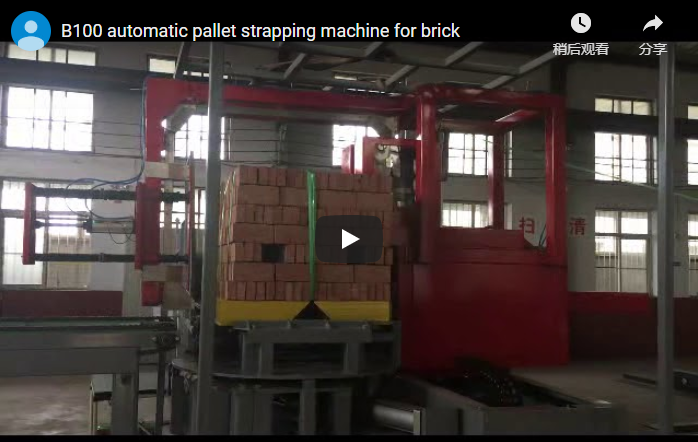
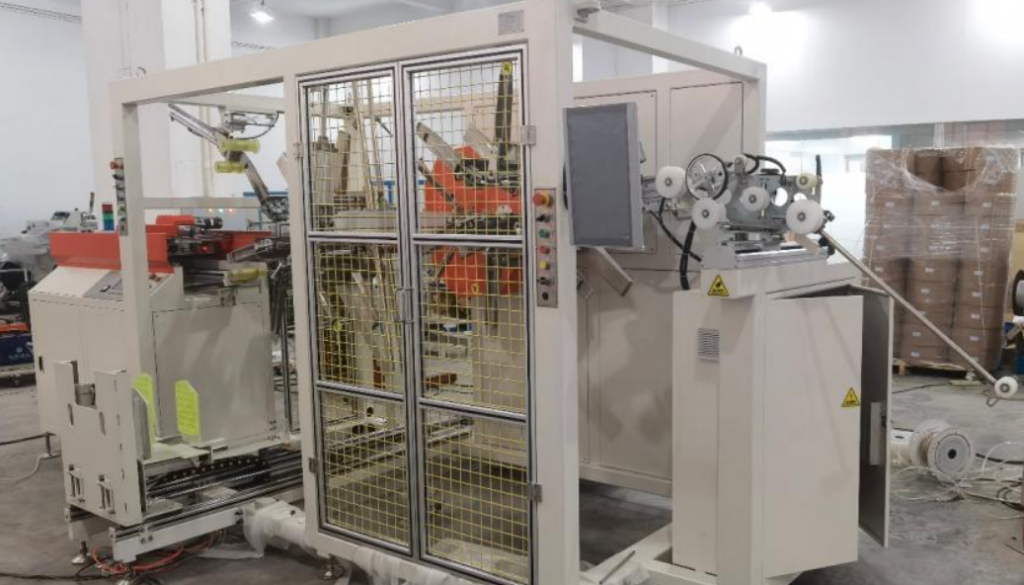
The gantry strapping system stabilizes tall, multi-tier pallet loads by integrating automated strap feeding, dynamic tensioning, and heat-seal joining within a rigid structural arch.
When an inbound conveyor delivers a layered bottle pallet into the strapping station, centering guides and optical sensors verify load alignment. The overhead gantry beam, carrying the heavy-duty strapping head, descends along vertical linear guideways toward the upper boundary of the stack. Strap chutes direct the strapping material vertically through the pallet fork voids or under the deckboards, forming a complete perimeter loop around the load.
Once the loop is closed, the machine retracts excess strap, applies preset tension to draw the bottles and layer sheets tight against the pallet base, and joins the strap ends by heat sealing before cutting the band clean. The beam then ascends clear of the load, and the secured pallet discharges downline. Throughout the cycle the bottles stay vertical and in their layers, bound as one block with no operator touching the load.
Why strap a bottle pallet
Plastic bottles are predominantly transported in tiered layers separated by corrugated tier sheets or slip sheets. Because empty containers have low individual mass, the friction between smooth bottle bottoms and slip sheets is easily overcome during warehouse moves, sharp forklift braking or transit vibration. Without vertical containment, upper tiers dislodge and the stack can collapse.
Vertical strapping exerts continuous downward compressive force from the top of the stack straight through to the pallet runner structure. This vertical clamping force transforms independent, floating tiers into a cohesive, interlocked vertical column. Within the FHOPE pallet packaging machinery program, the PET Strapping Machine architecture includes dedicated Vertical Pallet Strapping systems designed specifically for this load-containment profile [manufacturer rating].
| Load issue | What the straps do |
|---|---|
| Layers sliding | Press the layers onto each other |
| Top layer lifting | Hold a top sheet or frame down |
| Pallet separating from load | Tie the load to the pallet |
| Film-free loads | Let the pallet ship without stretch wrap |
By anchoring the entire stack directly to the pallet base, vertical straps prevent load separation during handling. For facilities seeking to reduce secondary packaging plastics, this structural strapping allows secure shipment without requiring complete stretch film wrapping.
Setting strap tension on plastic bottles
Calibrating strap tension for hollow plastic containers means balancing load retention against plastic deformation. Thin-walled bottles are vulnerable to localized stress concentration. If tension is set too high, the narrow strap band concentrates force onto the shoulders of the perimeter bottles in the top tier, causing wall buckling or shoulder crushing that renders containers unusable. If tension is too low, the clamping force is insufficient to stop tier sheets shifting during vehicle acceleration.
To eliminate localized crushing, industrial lines place a rigid top frame or distribution board across the top layer. This spreads the strap pull evenly across the top tier, so the head can pull enough tension to lock the lower tiers without exceeding the yield strength of the bottle shoulders.
Always validate tension on a production-representative pallet of your own containers before commissioning. Set it per bottle type in the PLC, because a thin-walled bottle needs less tension than a heavy-wall industrial container.
Planning straps per hour
Line throughput is set by the total cycle time per pallet, covering conveyor transfer, positioning, strapping and sealing. The following illustrative cycle outlines a two-strap vertical configuration:
| Step | Time (illustrative) |
|---|---|
| Pallet in and positioned | 20 s |
| Two straps, 12 s each | 24 s |
| Pallet out | 20 s |
| Total cycle | 64 s |
| Pallets per hour | about 56 |
A four-strap pattern (two parallel straps per axis or a 2×2 grid) requires indexing the pallet forward between parallel strap passes, or turning it for cross straps. Both indexing operations add handling and strapping time, which we calculate per line specification. Optimizing conveyor feed and positioning stops typically delivers more capacity than accelerating the strapping head beyond its reliable operating limits.
Controls and safety
The gantry frame straddles the conveyor line, with the beam moving up and down above the load. Keep people clear of the frame while it runs, and add guarding, interlocks and light curtains to suit your line layout.
The standards that apply depend on the destination market. For European installations, the machine follows ISO 12100 for risk assessment and EN 415-10 for packaging machine safety requirements.
Selection checklist for a pallet strapping machine
Specifying a vertical pallet strapping machine requires defining these parameters during preliminary engineering:
- Pallet length, width and full height.
- Load type: bottles, cans or cartons.
- Number of vertical straps per pallet.
- Pallet base, so the strap can pass under or through it.
- Strap material: PP or PET.
- Pallets per hour.
- Conveyor feed or forklift loading.
Engineering FAQ
Q: How many straps does a bottle pallet need? A: Two vertical straps cover a typical layered load. Larger or less stable loads use four, with the pallet indexed or turned between straps.
Q: Will the straps crush plastic bottles? A: They can if the tension is too high. Use a top frame or board and set the tension per bottle type.
Q: How long does one pallet take? A: In our two-strap example the cycle is 64 s, or about 56 pallets per hour.
Q: Does the operator need to touch the pallet? A: No. The gantry places, tightens, seals and cuts the straps automatically.
Q: Can the pallet ship without stretch film? A: Strapped layered bottles can, if your transport allows it. Film can be added for dust protection.
Next step
FHOPE tailors each gantry pallet strapping installation to your exact plant kinematics in three structured steps:
- Submit your layout drawing with pallet sizes, load heights and output to info@fhopepack.com.
- Receive a proposal within 48 hours, with the frame size and strap pattern.
- Book a site survey to check the conveyor line and floor space.
Related reading
- Automatic strapping machines
- Video: dual-clamp 180° pallet changer for glass bottle loads
- Video: V-shape pallet changer
Sources
- Machine content: FHOPE engineering team, 2026-10-04
- Cycle examples: our worked examples, illustrative values
- Machine in action: our video on YouTube
- Standards scope: ISO 12100:2010, EN 415-10:2014
- Equipment line reference: FHOPE Automatic Strapping Machine Solutions
Last reviewed: 2026-10-29